
 How-to
10 Steps to See Hair Loss Prevention Results
Last Updated: November 13, 2026
Quick Summary
Hair loss prevention typically takes several months before clear results appear, and the timeline depends on the treatment, the cause of your hair loss and how consistently you follow your plan. Most people need patience, because hair grows slowly and changes often appear in stages.
- With minoxidil, a short rise in shedding often appears in weeks 2 to 6 and is usually temporary.
- Reduced shedding is often the earliest reliable sign, typically noticed within months 1 to 3.
- Measurable improvement for minoxidil is typically most obvious between months 6 and 12.
- Take monthly photos in the same lighting and track shedding trends to judge progress.
- Contact your clinician promptly for sudden, patchy hair loss, scalp pain or scaling.
Table of Contents
- How Long Hair Loss Prevention Takes to Show Results
- Step 1: Understand the Hair Growth Cycle
- Step 2: Know the Timeline for Men
- Step 3: Know the Timeline for Women
- Step 4: Set Realistic Expectations for Minoxidil
- Step 5: Learn How to Stop Hair Fall Early
- Step 6: Track Your Progress and Know When to Reassess
- Booking Your Free Consultation to Start Your Plan
- Frequently Asked Questions
How Long Hair Loss Prevention Takes to Show Results
Hair loss prevention typically takes several months before clear results appear, and the timeline depends on the treatment, the cause of your hair loss and how consistently you follow your plan. The honest answer is that most people need patience, because hair grows slowly and changes often appear in stages.
Hair loss prevention is different from hair regrowth. Prevention aims to slow down or stop further loss, while regrowth aims to bring back hair that has already thinned. Many people notice that the first goal comes before the second, so it helps to know which one you are working toward.
Most people find that results build over time rather than appearing all at once. Treatment changes are often easier to see in the photos you take than in the mirror, so keep track of your progress as you go.
Step 1: Understand the Hair Growth Cycle
Hair grows in cycles. Each strand moves through a growth phase, a short transition phase and a resting phase before it sheds and a new strand begins to form in the same follicle. Because of this cycle, a treatment can take months to affect the hair you can see.
When hair loss is caused by factors that push many follicles into the resting phase at once, you may see extra shedding in the first weeks of treatment. This can feel discouraging, but it does not always mean the treatment is failing. Your clinician can help you tell the difference between expected shedding and a sign that something needs to change.
Knowing where you are in the cycle helps you judge your progress. Early changes usually show up as less shedding, stronger-looking hair and fuller-looking areas, not as sudden new growth.
Learn more about spotting early signs in How to Identify Early Signs of Hair Loss.
Step 2: Know the Timeline for Men
Men with pattern hair loss often ask how long treatment takes to work. Many men notice that shedding slows first, then hair looks thicker over the following months. Visible regrowth generally takes longer than prevention, and results vary from person to person.
Treatment timelines depend on the medication or procedure, how long the hair loss has been happening and how well the treatment is followed. Men who start early often have an easier time preventing further thinning than men who wait until the loss is advanced.
A realistic expectation is that men usually need several months of consistent treatment before judging whether a plan is working. Your clinician can set a review schedule based on your situation.
Step 3: Know the Timeline for Women
Women with female pattern hair loss often see a slower, more gradual change than men. Many women notice that shedding decreases first, while hair density and thickness improve over a longer period.
Hormonal changes, health conditions and medications can all affect the timeline, so the cause of hair loss matters. A healthcare professional can help identify the likely cause before recommending a plan. Keep in mind that the right timeline for one woman may be different from another. Because supplements may be part of a prevention plan, the hair supplements timeline is another factor to discuss when setting realistic expectations.
Consistency matters here too. Stopping and restarting treatment can reset progress, so work with your clinician on a plan you can keep up with.
Step 4: Set Realistic Expectations for Minoxidil
Minoxidil is a commonly used topical treatment for pattern hair loss. Its effects generally appear in phases rather than all at once, and understanding those phases helps set realistic expectations.
How minoxidil works, briefly. Minoxidil is believed to lengthen the growth (anagen) phase of the hair cycle and to widen the follicle slightly, which lets a thicker strand form.
Stage-by-stage timeline for topical minoxidil (5% solution or foam, applied twice daily for men or once daily for women per labeling):
- Weeks 2-6: temporary shedding. A common pattern is a short increase in shedding a few weeks after starting. This happens because resting hairs are pushed out to make room for new growth. It is usually temporary and is not a sign the treatment is failing.
- Months 1-3: reduced shedding. Many users notice that fewer hairs come out in the shower or on the pillow before they notice any new growth. This is the earliest reliable signal.
- Months 3-6: early visible change. Fine, lighter hairs may appear at the hairline or part, and existing hair may look slightly thicker. Photos taken in consistent lighting usually show this before the mirror does.
- Months 6-12: measurable improvement. This is the window most clinicians use to judge whether minoxidil is working for a given person. Density and caliber changes are typically most obvious here.
- Beyond 12 months: maintenance. Continued use is what holds the result. Stopping typically leads to loss of the gained hair over the following months, returning you toward your pre-treatment baseline.
What minoxidil does not do. It is better at slowing loss and thickening existing hair than at regrowing hair in areas that are already completely smooth. Results in long-empty areas are limited, which is why starting earlier generally produces better outcomes than starting later.
Formulation matters. Minoxidil comes in different strengths and forms, and the right choice depends on your case. Ask your clinician which form fits you.
Adherence is the whole game. Minoxidil only works while it is used. Missed days add up, and stopping and restarting resets the clock.
If you develop scalp irritation, itching, or a rash, contact your clinician rather than continuing without advice.
For a broader view of early intervention, see Reduce Hair Fall From Stress: A Step-by-Step Recovery Plan.
The table below summarises the typical minoxidil timeline described in this section.
| Stage | Timing | What you may notice |
|---|---|---|
| Temporary shedding | Weeks 2-6 | Short rise in shedding, usually temporary |
| Reduced shedding | Months 1-3 | Fewer hairs lost before new growth shows |
| Early visible change | Months 3-6 | Fine hairs at hairline or part; slight thickening |
| Measurable improvement | Months 6-12 | Most obvious density and caliber change |
| Maintenance | Beyond 12 months | Continued use holds the result |
Step 5: Learn How to Stop Hair Fall Early
Stopping hair fall early gives you the best chance of keeping the hair you have. Start by noting how much hair you lose each day and when you lose it, such as after washing or brushing. These notes can help your clinician see patterns.
Here are some simple steps many people take:
- Write down daily shedding and any changes in your scalp
- Take photos in the same lighting once a month
- Follow your treatment plan every day as directed
- Tell your clinician about new symptoms, such as sudden or patchy loss
- Ask about medical tests if hair loss is rapid or unusual
Early action makes it easier to slow loss before it becomes advanced. If you notice sudden or patchy hair loss, speak with a healthcare professional promptly.
Step 6: Track Your Progress and Know When to Reassess
Most timelines you read online assume you can tell whether a treatment is working. In practice, that is the hardest part, hair changes slowly, lighting lies, and normal shedding varies week to week.
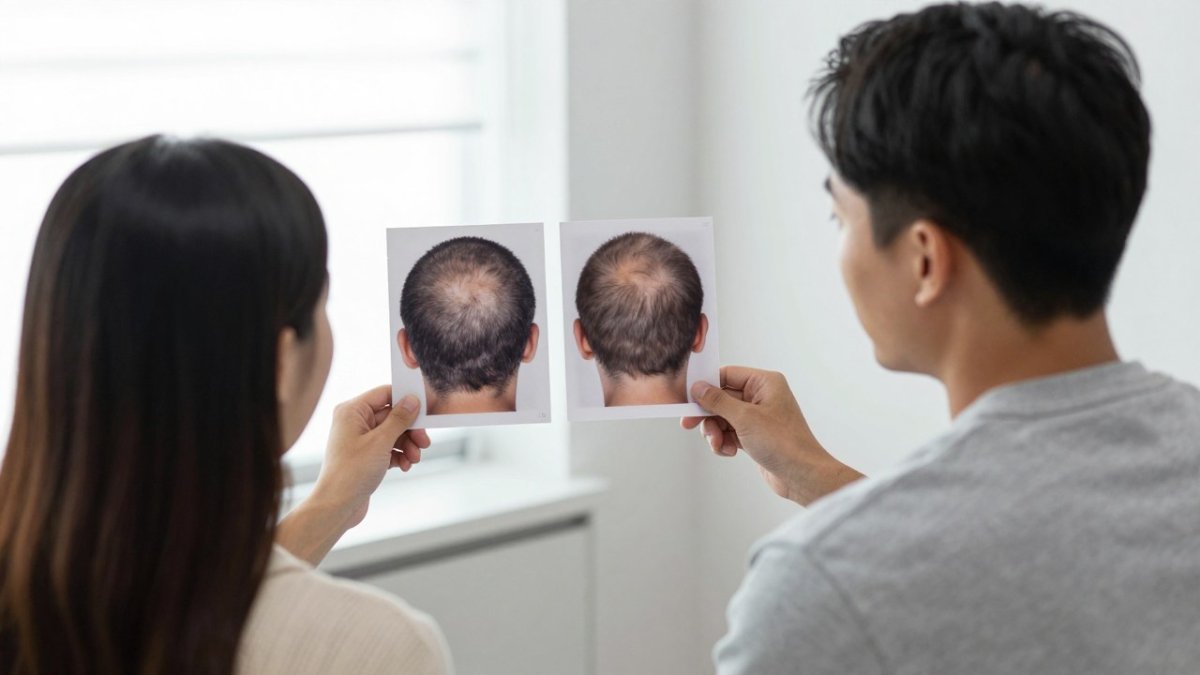
Set up a photo schedule you will actually keep.
- Baseline (day 0): Take photos before you start any treatment. Without a baseline, you have nothing to compare against.
- Monthly: Same day each month, same time of day, same room, same lighting, same camera distance.
- Standardize the shots: Front hairline, mid-scalp part, crown, and both temples. Use a tripod or have someone else hold the phone so the angle does not drift.
- Mark your spots: A small piece of tape on the mirror, or a consistent chair position, keeps framing identical month to month.
Track shedding, not just density. Density is hard to judge by eye, but shedding is countable.
Understand normal variation. Shedding fluctuates with season, stress, illness, diet, and hormonal changes. A single bad week is not a trend. Judge progress over three- to six-month blocks, not individual days.
Use a simple progress log. A notebook or phone note with four columns, date, shedding trend (up/down/flat), photo comparison (better/same/worse), and any side effects, gives your clinician a clear picture in under a minute.
Reassessment checkpoints. Rather than waiting indefinitely, set review points with your clinician:
- 3 months: Confirm you are tolerating the treatment and that shedding has not worsened unexpectedly.
- 6 months: First real judgment point for most treatments. If there is no change in shedding, density, or photo comparison, it is reasonable to discuss adjusting the plan.
- 12 months: For treatments that work slowly, this is the point at which most clinicians decide whether to continue, switch, or combine approaches.
When to reassess sooner. Contact your clinician before your scheduled checkpoint if you notice sudden or patchy loss, scalp pain, scaling, or a rapid change in shedding that does not settle within a few weeks.
Combination therapy changes the math. Many clinicians combine treatments, for example, a topical and an oral option, or a medication plus a procedure such as FUE hair transplant or Alma TED hair restoration, because the timelines stack rather than replace each other. You can also read what recovery and results look like after a procedure to compare timelines.
Watch out: do not judge a treatment by comparing photos taken in different lighting or at different hair lengths, a haircut alone can make density look dramatically different, and that false signal can lead you to abandon a plan that was working.
For a procedure-specific view of what recovery and results look like, see FUE Hair Transplant Recovery Timeline: Week by Week.
Booking Your Free Consultation to Start Your Plan
The timeline for hair loss prevention depends on your cause, your treatment and your habits, and a clinician is the best person to set expectations for you. Hair Restoration Clinic of Granite Bay offers a free consultation to review your hair loss and discuss treatment options. Schedule a Free Consultation to start a plan that fits your situation.
You can also read how to plan your visit in Book Your Hair Restoration Consultation: A Guide.
Frequently Asked Questions
Does hair loss prevention actually work?
Hair loss prevention treatments can slow further shedding for many people with pattern hair loss, but they work best when started early and used consistently. Results depend on the underlying cause, how far the thinning has progressed, and how closely the treatment is followed. Prevention is usually measured as stopping or slowing loss rather than restoring hair that is already gone. A physician can help confirm the cause and set expectations for your specific situation before you begin.
How long does minoxidil take to work?
Minoxidil is typically used for several months before people judge whether it is working. Early changes such as reduced shedding may appear within a few months, while visible thickening generally takes longer. Consistent daily use matters, because stopping the treatment usually leads to a return of hair loss. Track your progress with dated photos and discuss any lack of improvement with a healthcare professional.
How can I tell whether a hair loss treatment is working?
Look for less shedding in the shower and on your brush, and compare dated photos of the same areas taken in the same lighting. Measuring hair density or thickness at consistent points on the scalp can also help. Keep in mind that temporary shedding can happen when a new treatment starts. If you see no change after several months of consistent use, schedule a reassessment with a dermatologist or qualified hair restoration physician.
When should I talk to a doctor about ongoing hair loss?
Speak with a physician if hair loss is sudden, patchy, painful, or accompanied by scalp changes, or if you have not seen any improvement after several months of treatment. A doctor can look for underlying causes and recommend appropriate options. Early evaluation gives prevention treatments the best chance to help, so waiting longer than necessary can make the outlook less favorable.