 how-to
How Does an Eyebrow Transplant Work? Step-by-Step Guide
Table of Contents
- How Does an Eyebrow Transplant Work? The Step-by-Step Process
- Preparing for Eyebrow Transplant Surgery
- Eyebrow Transplant Recovery Timeline: What to Expect
- Eyebrow Transplant vs Microblading: Which Is Right for You?
- Eyebrow Transplant Risks and Long-Term Results
- The Psychological Impact of Fuller Brows
- Schedule Your Eyebrow Transplant Consultation
- Frequently Asked Questions
Last Updated: September 8, 2026
How Does an Eyebrow Transplant Work? The Step-by-Step Process
An eyebrow transplant is a permanent hair restoration procedure that relocates living hair follicles from a donor site, typically the back of the scalp, to sparse or absent eyebrows. It relies exclusively on follicular unit extraction (FUE), which leaves no linear scar, so the donor area heals as scattered, nearly invisible dots. At Hair Restoration Clinic of Granite Bay, this procedure is performed under local anesthesia in a single session.
The entire process follows a deliberate sequence designed to protect graft survival and match your natural brow shape. Below, we break down each stage so you know exactly what happens before, during, and after your procedure.
Step 1: Consultation and Eyebrow Design
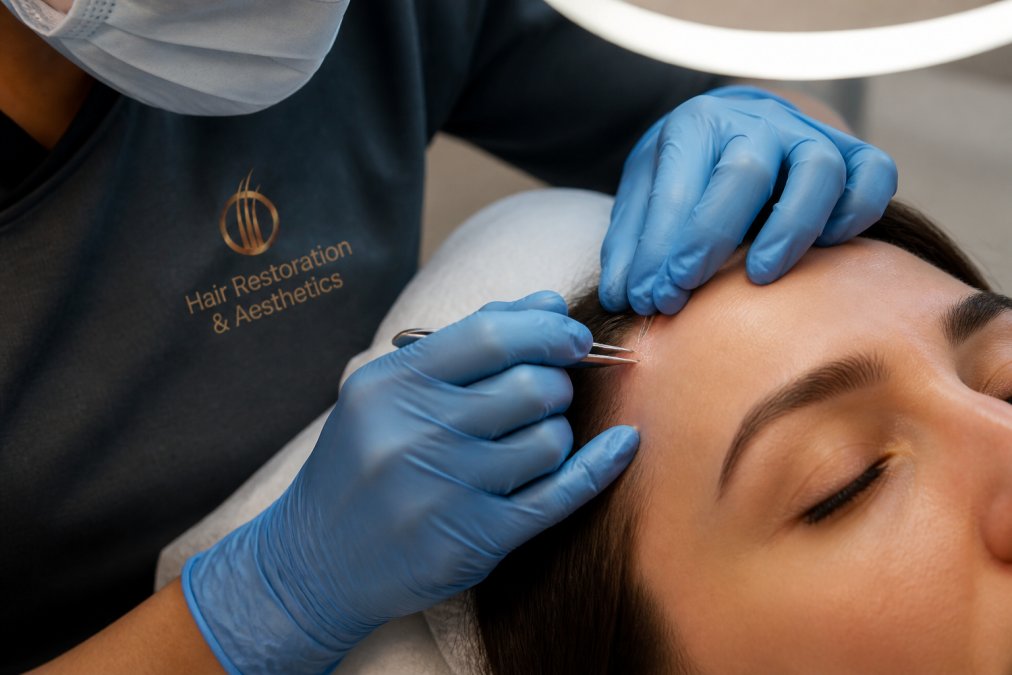
Your procedure begins with a consultation where the physician assesses your facial structure, existing brow hair, and aesthetic goals. The brow shape is mapped out with careful attention to natural brow direction, arch placement, and density targets. This design phase determines how many follicular units are needed and where each graft will sit. A common mistake is skipping this step or rushing it; the design dictates everything that follows.
The physician also evaluates donor hair quality, since not all scalp hair suits brow transplantation. Ideal follicles are fine-caliber, non-curly hairs from the lower occipital scalp; coarse or tightly curled donor hair can look like a unibrow. The physician also assesses your existing brow hair's growth direction, which angles upward and outward from the center of the face.
Step 2: Harvesting Follicular Units
Under local anesthesia, the donor area is prepared, and individual follicular units are extracted using the FUE technique. The physician uses a micro-punch tool to score a circular incision around each follicular unit, then extracts it with fine forceps. Each unit contains one to three hair follicles, and the extraction site heals as tiny, scattered dots rather than a linear scar. The number of grafts harvested depends on your desired brow density and the quality of your donor hair.
The surgeon does not simply grab any follicle; the physician selects follicles matching the texture and caliber of natural brow hair. Nape hair is finer than crown hair, making it the preferred donor zone. Extracted grafts are kept in a chilled preservation solution, and most surgeons aim to complete placement within two to four hours of extraction to maximize survival.
Step 3: Creating Micro-Incisions
The physician then creates micro-incisions in the recipient area. These tiny openings determine the angle, direction, and depth of each graft. Surgical precision at this stage is critical: brows grow at specific angles that differ from scalp hair, and recreating that geometry is what separates a natural result from an obvious transplant. The incisions are made to follow your existing hair growth pattern and the natural brow direction.
Incision angle matters physiologically: scalp hair grows at roughly 45 degrees, while brow hair grows at a much shallower 10 to 20 degrees. Too steep an angle makes hairs stand upright and look unnatural. Depth also matters, too shallow and the graft may not seat; too deep and the follicle may be damaged. Incisions are typically created to a specific depth.
Step 4: Graft Placement and Directional Mapping
Each harvested follicular unit is placed into its designated micro-incision using fine forceps. Directional mapping means the physician angles every graft to mimic how your natural brows grow, including the way hairs turn toward the center and taper at the tail. This meticulous step is time-intensive, but it directly determines how natural the final brow shape appears.
Placement follows a deliberate three-zone pattern: hairs at the inner head point upward and slightly inward, mid-body hairs angle upward and outward, and tail hairs angle sharply outward and downward. The number of grafts required varies per patient, as each graft contains one to three hairs.
Graft survival is a critical technical metric. Factors that can influence survival include handling, time outside the body, bleeding, and post-operative trauma. The physician's technique during placement directly influences the final density.
Preparing for Eyebrow Transplant Surgery
Preparation is straightforward: avoid blood-thinning medications and supplements, limit alcohol, and refrain from smoking in the weeks before, as these affect graft survival and healing. Your physician will review your medical history to confirm you are a suitable candidate.
Plan for a ride home, since your brow area will be tender. You do not need to shave your head, as FUE allows donor hair to be trimmed rather than fully removed. Wear loose clothing that does not need to be pulled over your head; your clinic will provide a detailed instruction sheet tailored to your case.
Eyebrow Transplant Recovery Timeline: What to Expect
Recovery follows a predictable timeline. In the first three days, expect mild swelling and redness. Small crusts form around each graft site and fall off within seven to ten days; resist picking at them to avoid dislodging grafts.
By the second week, transplanted hairs shed, a normal part of the growth cycle that often alarms patients but simply means follicles are entering a resting stage. New growth appears between three and four months, with meaningful density by six months and full results over twelve to eighteen months.
Post-operative care focuses on keeping the area clean and avoiding friction. Light exercise can typically resume after about a week. Avoid direct sun exposure and heavy sweating for the first two weeks.
Eyebrow Transplant vs Microblading: Which Is Right for You?
An eyebrow transplant is a permanent solution that uses your own living hair follicles to create natural, growing brows. Microblading, by contrast, is a cosmetic tattooing technique that deposits pigment into the skin to create hair-like strokes. The right choice depends on whether you want a permanent, surgical result or a semi-permanent cosmetic enhancement.
| Consideration | Eyebrow Transplant | Microblading |
|---|---|---|
| Longevity | Permanent | 1-3 years, then touch-ups |
| Appearance | Real, growing hair | Pigmented strokes |
| Maintenance | Normal brow grooming | Periodic reapplication |
| Downtime | 2-3 days | Minimal to none |
| Best for | Thinning, over-plucked, or absent brows | Adding fullness to existing brows |
Microblading works well for adding density to brows that already have hair, but it cannot replace the texture or movement of real hair, and pigment can fade unevenly. For sparse eyebrows from over-plucking, aging, or alopecia, an eyebrow transplant offers a permanent fix that feels and behaves like natural brow hair, though it requires surgery and a healing period.
Eyebrow Transplant Risks and Long-Term Results
An eyebrow transplant is generally safe when performed by a qualified physician, but every surgical procedure carries some risk. Common side effects include temporary swelling, redness, and crusting. More significant complications, such as infection or poor graft survival, are uncommon but possible, which is why choosing an experienced provider matters.
The Maintenance Reality Nobody Warns You About
The transplanted hair is permanent because scalp follicles are genetically resistant to the hormones that cause pattern baldness (the NIH). But that permanence comes with a trade-off: scalp hair never stops growing, and it grows on a scalp cycle, not a brow cycle.
Natural brow hair has a short anagen phase of roughly 30 to 45 days, which is why brow hairs stay short (PubMed). Scalp hair has an anagen phase of two to seven years, and transplanted follicles carry that program with them (peer-reviewed research). The result is hair that grows continuously, requiring regular trimming every one to three weeks.
Patients who expect to treat their new brows like natural brow hair are often surprised to find them growing past the brow line within two weeks. The practical maintenance routine involves:
- Trimming every 1 to 3 weeks with small, curved scissors to keep hairs within the brow silhouette
- Brushing or combing the transplanted hairs daily to train them in the desired direction
- Avoiding waxing or tweezing the transplanted hairs, since plucking can damage the follicle and cause permanent loss, the same way repeated plucking of natural brow hair can
- Scheduling periodic touch-ups if you want to adjust shape or density as you age
Most patients find the maintenance manageable, about two minutes every week or two, but it is a permanent commitment. If you are not prepared to trim regularly, a transplant may not be the right choice.
The Texture Mismatch: What Informed Consent Really Means
The second issue that separates a satisfied patient from a disappointed one is texture. Scalp hair is typically coarser, straighter, and has a different growth pattern. Even when the surgeon selects the finest available donor follicles, transplanted hairs will often feel slightly different from natural brow hairs.
What does that difference look like in practice?
- Caliber: Scalp hairs are usually thicker in diameter than brow hairs. A skilled surgeon selects the thinnest available follicles, but the difference is often still perceptible on close inspection.
- Growth angle: Scalp hair grows straighter and more vertically than brow hair. The surgeon compensates by creating shallow incisions at the correct angle, but the hair's natural tendency to grow upward can cause some hairs to stick out slightly until trained by brushing.
- Color: Donor scalp hair may not exactly match your brow color. Most patients require a shade match that is close but not perfect; the difference is usually only noticeable in bright light.
- Curvature: Some scalp hair has a slight wave or curl that natural brow hair lacks. This can actually be an advantage, a subtle wave adds volume, but it can also make the brow look less sleek.
A reputable surgeon will show you donor hair under magnification during the consultation so you can see the texture difference before you commit; if a clinic does not offer this, consider it a warning sign. The goal is not to eliminate the difference, that is biologically impossible, but to minimize it through careful donor selection and placement.
Long-Term Results: What You Can Realistically Expect
Results vary based on graft survival rate, donor hair quality, and the physician's skill. In most cases, you can expect:
- Permanent hair growth that does not thin or fall out with age, since the follicles are genetically resistant to pattern baldness
- A visible result at 6 months and a mature result at 12 to 18 months
- A natural appearance when viewed at arm's length, though close inspection may reveal slightly coarser hair texture
- A brow that requires regular trimming for the rest of your life
Patient satisfaction with eyebrow transplants is generally high, particularly among those who have struggled with over-plucked brows or medical hair loss. The permanence of the result removes the need for daily drawing or repeated cosmetic treatments. That said, it is essential to have realistic expectations. A transplant can create fuller, natural-looking brows, but it will not replicate the exact characteristics of your original brow hair, and the result requires ongoing maintenance.
The Psychological Impact of Fuller Brows
The psychological benefits of eyebrow restoration are often as significant as the physical change. Eyebrows frame the face and play a central role in expression, so thinning or absent brows can affect self-confidence. Many patients report that restoring their brows reduces self-consciousness and simplifies daily grooming.
Patient satisfaction with eyebrow transplants is generally high, particularly among those who have struggled with over-plucked brows or medical hair loss. The permanence of the result removes the need for daily drawing or repeated cosmetic treatments. That said, it is essential to have realistic expectations. A transplant can create fuller, natural-looking brows, but it will not replicate the exact characteristics of your original brow hair, and the result requires ongoing maintenance.
Schedule Your Eyebrow Transplant Consultation
An eyebrow transplant is a permanent, surgical solution for sparse or thinning eyebrows, and the outcome depends heavily on the physician's skill and your candidacy. The next step is a consultation where your brow shape, donor hair quality, and goals can be assessed in person. At Hair Restoration Clinic of Granite Bay, Dr. Piyush Kumar, MD, brings board-certified expertise and over a decade of experience to every eyebrow restoration, using the industry-leading Cole follicular unit extraction system for precise, natural results. If you are ready to explore whether this procedure fits your needs, schedule a free consultation to discuss your goals with the team.
Frequently Asked Questions
How long do eyebrow transplants last?
An eyebrow transplant offers a permanent solution. The hair follicles are typically harvested from the scalp, which is genetically resistant to balding. Once transplanted and healed, these follicles continue to grow for life. However, transplanted scalp hair grows longer and faster than natural brow hair, so you will need to trim it regularly to maintain your desired brow shape and length.
Is an eyebrow transplant painful?
The procedure is performed under local anesthesia, so you will be awake but feel no pain during the surgery itself. Patients may feel a slight pinch during the initial numbing injections. After the anesthesia wears off, there is usually mild soreness or tenderness in the donor and recipient areas for a few days, which can be managed with over-the-counter pain relievers.
What is the difference between microblading and an eyebrow transplant?
Microblading is a cosmetic tattooing technique that deposits pigment into the skin to create the illusion of hair strokes. It lasts one to three years and requires touch-ups. An eyebrow transplant is a surgical procedure that moves your own hair follicles to the brow area, creating real, growing hair. It is a permanent solution with a natural texture, but it requires a longer recovery.
What are the downsides of getting an eyebrow transplant?
The main downsides include the recovery process, which involves some crusting and swelling for about a week. Transplanted scalp hair also has a different texture and growth cycle than natural brow hair, requiring regular trims. As with any surgical procedure, there are small risks of infection or poor graft survival, which a qualified surgeon minimizes.
Restoring your brows is a decision that affects how you see yourself every day, and it deserves careful consideration. The Hair Restoration Clinic of Granite Bay offers free consultations to evaluate your goals and determine whether an eyebrow transplant is the right permanent solution for you. Schedule your consultation today and take the first step toward brows that look and feel naturally yours.