
 How-to
Is Hair Regrowth Possible After 50 for Women?
Last Updated: November 6, 2026
Quick Summary
Yes, hair regrowth is often possible for women after 50, though results depend on the cause of thinning. Thinning usually builds gradually from shorter growth phases, finer strands and hormonal shifts during menopause. A clinician can identify the pattern and suggest options such as topical minoxidil, with progress typically judged over several months.
- Hair thinning after 50 usually builds gradually over years rather than appearing suddenly.
- Topical minoxidil is available over the counter in 2% and 5% strengths and needs consistent use.
- Shedding can increase in the first few weeks as older hairs cycle out before new growth appears.
- Track progress with photos taken under the same lighting every four to six weeks.
- Seek prompt medical attention for scalp redness, itching, pain, smooth patches or sudden heavy shedding.
Table of Contents
- Why Hair Thinning Becomes More Common After 50
- Menopause, Estrogen, Progesterone and Your Hair
- Recognizing Female Pattern Hair Loss and Its Typical Signs
- A Practical Diagnostic Pathway for Women Over 50
- Hair Regrowth Treatment Options and Realistic Timelines
- Hair Transplant for Women: When It Makes Sense
- Booking Your Free Consultation to Find Your Next Step
- Frequently Asked Questions
Why Hair Thinning Becomes More Common After 50
Hair thinning is one of the most common concerns women raise after 50, and it is more widespread than many people expect. Patients often notice a wider part, less volume at the crown, or more hair left in the brush than they remember. These changes can feel sudden, but they usually build up slowly over years.
Several biological shifts contribute. Hair grows in cycles of growth, rest and shedding, and as we age, the growth phase can shorten while individual strands become finer. Follicles also become less responsive to the signals that keep them active. Thinning is generally a gradual process, which is why early attention tends to matter more than a sudden fix.
Common contributors include:
- Shorter growth phases: Hairs may stop growing sooner than they used to.
- Finer strands: Each hair can become thinner, so the overall density looks lower.
- Reduced follicle activity: Some follicles produce hair less consistently over time.
- Overlapping factors: Stress, nutrition, medications and thyroid changes can add to age-related thinning.
Because several factors can overlap, a qualified clinician is the best person to sort out what is driving your hair changes.
Menopause, Estrogen, Progesterone and Your Hair
Menopause is one of the most significant hormonal transitions a woman experiences, and it often coincides with noticeable hair changes. As estrogen and progesterone levels decline, the balance between these hormones and androgens shifts. Androgens are hormones that can shrink hair follicles over time, so this shift can contribute to thinning.
This is why many women notice changes in their 40s and 50s even when they have never struggled with hair loss before. The effect is not the same for everyone. Some women notice little change, while others see clear thinning along the part or crown.
Hormonal shifts are only one piece of the picture. A clinician may also look at thyroid function, iron levels and medication effects when assessing hair loss. A full review is generally more useful than assuming menopause is the only cause.
Recognizing Female Pattern Hair Loss and Its Typical Signs
Female pattern hair loss is the most common form of thinning in women. Unlike the sudden clumps some people expect, it usually shows up as gradual widening of the part, reduced density at the crown and a more visible scalp under bright light.
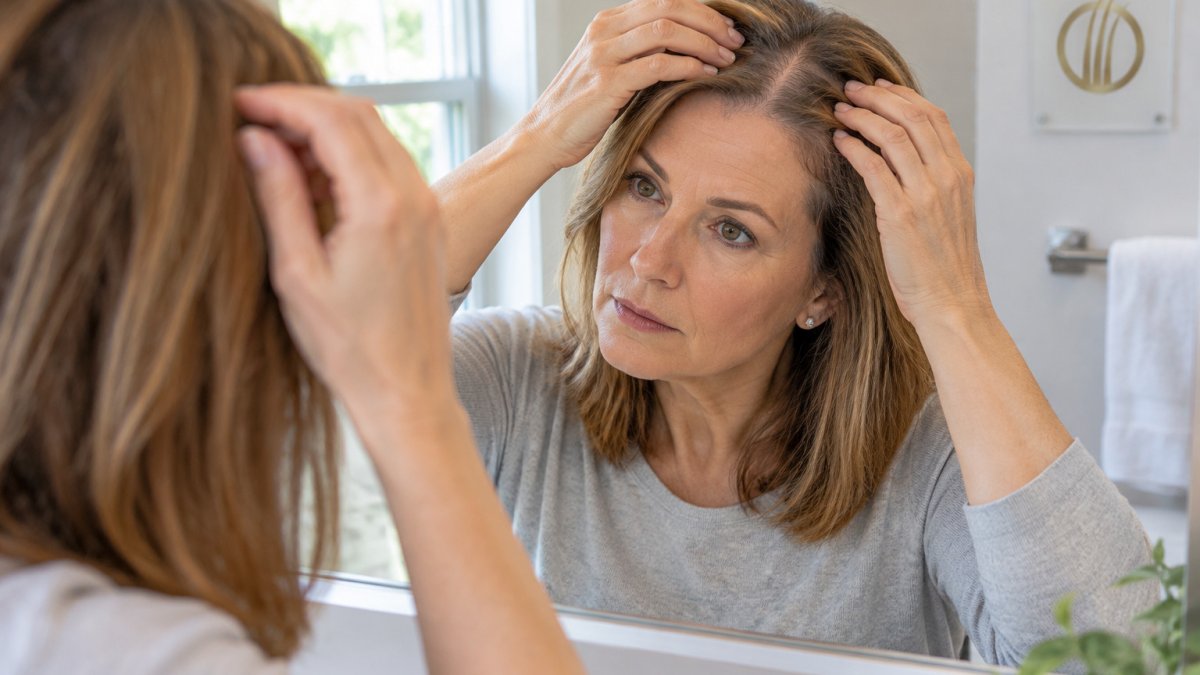
Typical signs include:
- A part that looks wider than it used to
- Thinning concentrated at the top of the head rather than the hairline
- Hair that feels finer or lies flatter
- Reduced ponytail thickness over time
Not every change means female pattern hair loss. Shedding after illness, childbirth, or a major stressor can look similar. A clinician can help tell these patterns apart.
!A woman in her 50s looking at her reflection in a bathroom mirror with natural light, gently parting her hair to view her scalp
A Practical Diagnostic Pathway for Women Over 50
A structured approach helps separate common causes from ones that need prompt attention. Many women benefit from working through a simple sequence with a clinician, and the order matters because it prevents assuming every change is hormonal.
- Track the change. Note when you first noticed thinning, whether it is gradual or sudden, and where it appears. Gradual widening of the part over years points toward pattern hair loss; sudden shedding over weeks points toward a different set of causes.
- Review your health history. Mention recent illness, surgery, major stress, childbirth, and every medication you take, including over-the-counter products. Thyroid medication, some blood pressure drugs, and certain antidepressants are among the medications clinicians consider when hair loss begins or accelerates.
- Ask about bloodwork. Common checks in general clinical practice include blood tests for iron stores and thyroid function, which a clinician can recommend.
- Examine the scalp. A clinician looks at whether follicles are still present, whether the scalp shows redness, scaling, or smooth scarred patches, and whether the loss pattern fits female pattern hair loss or something else. This distinction between scarring and nonscarring hair loss is one of the most important steps and is often skipped in at-home assessment.
- Set realistic expectations. Understand which treatments fit your pattern and what results may look like over time, including how long monitoring should continue before a plan is changed.
Other causes beyond menopause. Not every change after 50 is hormonal. Thyroid disorders, iron deficiency, recent illness or surgery, medication effects, and significant stress can all produce shedding that looks like age-related thinning. A clinician can help sort out which factors are active in your case.
Seek prompt medical attention if you notice patches of smooth or scarred skin, redness, itching or burning on the scalp, pain, or sudden heavy shedding. These signs can point to conditions, including scarring hair loss, that need timely evaluation, because scarring forms of hair loss can become permanent if not addressed early.
A consultation is a practical place to start if you are unsure which step applies to you.
Schedule a Free Consultation →
Hair Regrowth Treatment Options and Realistic Timelines
Several approaches are used for female thinning, and the right choice depends on your pattern, health history and goals. What separates a useful treatment plan from a hopeful one is understanding how each option works, how long it takes to judge, and what monitoring it requires.
Topical minoxidil. Minoxidil is the most widely used topical treatment for female pattern hair loss. It is available over the counter in 2% and 5% strengths, and it works by prolonging the growth phase of the hair cycle and widening the follicle over time. Consistent use is generally required, and shedding can increase in the first few weeks as older hairs cycle out before new growth appears. Response is usually judged over several months.
Prescription oral options. A clinician may discuss prescription medications for appropriate candidates. Some clinicians discuss prescription medications for appropriate candidates, and a clinician-supervised review of health factors is required before any such option is considered.
In-clinic and device-based options. In-clinic treatments such as Alma TED are used to support hair health. Our guide to what Alma TED treatment for hair involves explains how it works. Alma TED uses non-invasive acoustic sound wave therapy for hair health. These approaches are often combined with topical or prescription treatment rather than used alone.
Realistic timelines. Most treatments need several months before progress is visible. A practical way to track change is to take photos under the same lighting, at the same angle, every four to six weeks, and to note part width and ponytail thickness rather than relying on memory. Regrowth is usually measured in small, gradual changes rather than dramatic shifts.
Starting a new treatment and stopping it after a few weeks because shedding increased is a common reason treatments are judged too early, so a clinician can help you tell normal cycling from a problem.
A clinician can explain which of these options may suit your pattern, health and goals, and how often follow-up should occur.
The main options for female thinning, and how long each usually takes to judge, are summarised below.
| Option | Best for | Key difference |
|---|---|---|
| Topical minoxidil | Female pattern hair loss | Available over the counter in 2% and 5%; needs consistent use |
| Prescription oral options | Appropriate candidates | Requires clinician-supervised review of health factors |
| In-clinic device (Alma TED) | Supporting hair health | Non-invasive acoustic sound wave therapy |
| Monitoring photos | Tracking progress | Same lighting and angle every four to six weeks |
Hair Transplant for Women: When It Makes Sense
A hair transplant may be an option for some women with stable, localized thinning, but it is not right for everyone. Candidacy depends on donor hair supply, the pattern of loss and overall health. You can read what success rates to expect from a transplant before deciding. Hair Restoration Clinic of Granite Bay offers FUE hair transplant, and a consultation is a practical way to learn whether it may fit your goals.
Transplants move healthy follicles from a donor area to thinning areas, and a clinician will explain expected timelines, recovery and the limits of what can be achieved. Our guide on how long FUE hair transplant results last covers what to expect over time.
Booking Your Free Consultation to Find Your Next Step
If you are wondering whether hair regrowth is possible after 50, a consultation is a practical place to start. At Hair Restoration Clinic of Granite Bay, a consultation can review your history, discuss the options that may suit you and explain what results generally look like. You can book a hair restoration consultation to start the conversation, or learn more about our hair restoration services before you decide.
The clinic is located in Granite Bay, California. Schedule a Free Consultation to talk with our team about your options.
Frequently Asked Questions
Can women regrow hair after 50?
In many cases, yes, but the answer depends on the cause. Hair follicles that are miniaturized but not yet dead may respond to treatment, while follicles that have stopped producing hair for a long time are less likely to recover. A clinician can examine the scalp, review medical history and order tests to identify contributing factors such as thyroid disorders, iron deficiency or medication effects. Early evaluation gives the best chance of a useful response. Results are gradual, and many treatments take several months before changes are visible.
What causes hair loss in women over 50?
Female pattern hair loss is common after 50 and is linked to changing hormone levels, including the drop in estrogen and progesterone during menopause and the relative increase in androgen effects. Other causes include thyroid disorders, iron deficiency, nutritional gaps, stress and certain medications. Because several causes can overlap, a diagnosis should not rest on age alone. A dermatologist or other healthcare professional can help sort out which factors apply to you.
How long does it take to see results from hair loss treatment?
Most hair treatments need consistent use for at least several months before results are judged. Topical treatments are usually evaluated over several months, and changes can appear gradually. Progress is typically measured with photographs taken under the same lighting at set intervals. Your clinician can explain what a reasonable timeline looks like for your specific treatment plan.
When should a woman see a doctor about hair loss?
See a healthcare professional if hair loss is sudden, patchy, accompanied by scalp pain, redness, scaling or itching, or if the scalp looks scarred. These signs can point to conditions that need prompt evaluation, including scarring forms of hair loss. A visit is also worthwhile if thinning is progressing, if you notice changes in your menstrual cycle or energy, or if you have been losing hair for several months without a clear explanation.