
 how-to
How to Stop Male Pattern Baldness Early: 2026 Guide
Table of Contents
- Why Early Action Matters in Male Pattern Baldness
- Early Signs of Male Pattern Baldness to Watch For
- How to Slow Hair Loss in Men: A Step-by-Step Plan
- Male Pattern Baldness Treatment Options Compared
- How Long Does Hair Loss Treatment Take to Work?
- Common Mistakes That Speed Up Hair Loss
- When to See a Doctor About Hair Loss
- Conclusion: Take Action Before It's Too Late
- Frequently Asked Questions
Last Updated: October 12, 2026
Why Early Action Matters in Male Pattern Baldness
Male pattern baldness is the most common form of hair loss in men, and it is progressive.
This guide from Hair Restoration Clinic of Granite Bay focuses on the earliest window, when thinning is mild and follicles are still active, the point at which treatment has the most to work with.
The pattern is well documented by the American Academy of Dermatology, which describes androgenetic alopecia as a genetic condition driven by hormones and age.
The goal is not a miracle, it is slowing progression while you still have hair to protect.
Early Signs of Male Pattern Baldness to Watch For
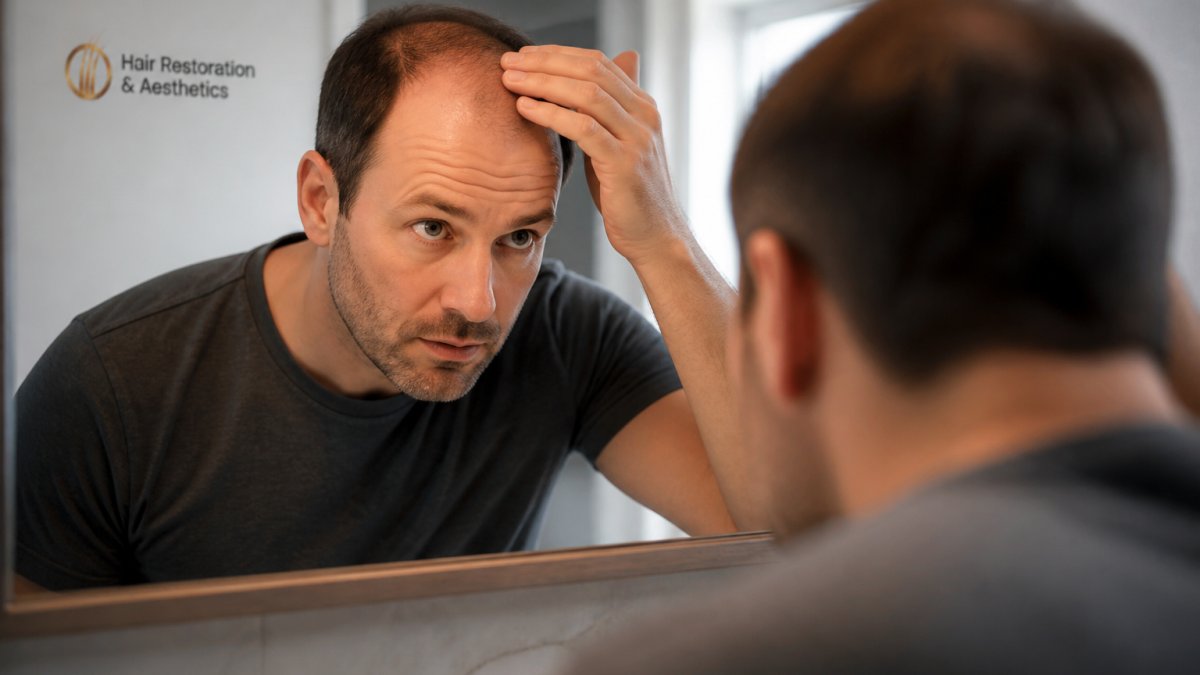
Early signs of male pattern baldness include a receding hairline, crown thinning, a wider part, and more shedding than usual, most men notice one before real baldness.
Watch for these changes:
- Your forehead looks taller in photos than it did a year ago
- The crown of your head feels thinner when you run a hand through it
- More hair than before collects on your pillow or in the shower drain
- Your part looks wider, or your scalp shows through in bright light

Hairline Recession and Crown Thinning
These patterns often move together, but not always: some men lose the hairline first, others thin at the crown while the front stays intact. A receding hairline usually starts at the temples in the classic M shape; crown thinning starts as a small patch near the back of the top of the head. Both point to hormone-sensitive follicles shrinking over time.
How to Slow Hair Loss in Men: A Step-by-Step Plan
Slowing hair loss in men comes down to four steps: confirm the diagnosis, start proven treatment, track results honestly, and adjust with a clinician. Skip one and you are guessing.
Step 1: Get a Proper Diagnosis
A diagnosis separates pattern baldness from other causes. A doctor examines the scalp under magnification, reviews your history, and may order blood work.
What that evaluation typically looks for:
- Pattern and distribution, temple recession and crown thinning in a hormone-sensitive pattern point to androgenetic alopecia; smooth round patches or diffuse shedding point elsewhere
- Scalp condition, redness, scaling, itching, or pain suggest inflammation or infection rather than pattern loss
- Pull and shed tests, a clinician can estimate how many hairs are actively shedding versus how many have already miniaturized
- Blood work, thyroid function, iron and ferritin, vitamin D, and sometimes testosterone-related markers
Shedding can come from thyroid issues, low iron, stress, or medication, causes that need different treatment. Treating the wrong problem wastes your window.
Step 2: Start Evidence-Based Treatment
Evidence-based treatment means options with real clinical backing. Minoxidil and finasteride are the two best studied, and both come in topical and oral forms.
- Topical minoxidil, over-the-counter, applied to the scalp, generally well tolerated; the most common side effect is local irritation
- Oral minoxidil, prescription only, taken as a pill; because it acts systemically it can affect blood pressure and heart rate, so it requires clinician supervision and monitoring
- Topical finasteride, prescription, applied to the scalp; used by men who want to limit systemic exposure
- Oral finasteride, prescription, taken as a pill; lowers DHT and is generally better at slowing progression than regrowing hair
Safety matters: finasteride is not appropriate for men trying to conceive with a partner, or for women who are pregnant or may become pregnant (DailyMed).
The U.S. Food and Drug Administration has approved specific formulations of these medications for hair loss, which is why they anchor most treatment plans.
Step 3: Track Progress and Adjust
Track progress with photos, not memory: same light, same angle, every month.
A simple tracking method:
- Photos, front hairline, crown, and both temples, same room, same light, same distance, same day each month
- Shed count, note roughly how many hairs you see on the pillow and in the drain; normal shedding varies day to day, so look at the trend, not a single day
- Symptoms, jot down scalp itching, irritation, or any side effects so you can bring them to your clinician
- Timeline, expect early changes at three to six months and clearer density changes at six to twelve months
If nothing shifts after six months of consistent use, a doctor can adjust the plan. Treatment adherence is the most common weak point. Missed doses mean missed results.
Step 4: Escalate Only When It Fits
If medication is holding your hair but you have lost ground in a specific area, a clinician may discuss in-office options. An FUE hair transplant moves healthy follicles from the back of the scalp to thin areas, and results look natural when done well. PRP injections and low-level laser therapy support the follicles you still have. At Hair Restoration Clinic of Granite Bay, we also use Alma TED acoustic sound wave therapy, a non-invasive option that works alongside medication rather than replacing it.
Male Pattern Baldness Treatment Options Compared
Most treatment lists present options as if they were interchangeable. They are not. The table below compares them by evidence, likely benefit, time to results, and trade-offs.
| Option | Evidence Level | Likely Benefit | Time to Results | Key Risks / Trade-offs |
|---|---|---|---|---|
| Topical minoxidil | Strong, FDA-approved | Regrowth and slowing in early thinning | 3-6 months early, 12 months full | Scalp irritation; daily, ongoing use |
| Oral minoxidil | Moderate, off-label for hair | Regrowth, often stronger than topical | 3-6 months early, 12 months full | Blood pressure and heart rate effects; prescription and monitoring required |
| Topical finasteride | Moderate, off-label for hair | Slowing progression, some regrowth | 6-12 months | Less systemic exposure than oral; still prescription |
| Oral finasteride | Strong, FDA-approved | Slowing progression; some regrowth | 6-12 months | Sexual and mood side effects in a minority; not for men trying to conceive or for women who are or may become pregnant |
| PRP injections | Moderate | Added density alongside medication | 3-6 months, series of visits | Injection discomfort; cost and visit burden |
| Low-level laser therapy | Weak to moderate | Support for mild thinning | 3-6 months of regular use | Modest effect; requires consistency |
| FUE hair transplant | Strong for restoring lost areas | Restores hair in bald or thin zones | Visible at 6-12 months | Surgical cost; does not stop native hair loss without medication |
Medications: Minoxidil and Finasteride
Minoxidil is the best-known over-the-counter treatment. It widens blood vessels near the follicle and can support regrowth in early thinning.
Schedule a Free Consultation →
Finasteride lowers DHT, the hormone that shrinks hormone-sensitive follicles. It is a prescription treatment and generally better at slowing progression than regrowing hair.
Both have side effects and need a doctor's input, not a decision to make from a forum thread.
Procedures and In-Office Therapies
Procedures help when follicles are already gone. An FUE hair transplant moves healthy follicles from the back of the scalp to thin areas and looks natural when done well.
In-office therapies like PRP injections and low-level laser therapy support the follicles you still have. At Hair Restoration Clinic of Granite Bay, we also use Alma TED acoustic sound wave therapy, a non-invasive option for scalp and hair health.
How to Choose
A simple way to think about it:
- Early thinning, no bald patches, start with a proven medication and track for six months
- Progression despite medication, discuss adding an in-office therapy or switching formulations
- Visible bald areas, consider a transplant, but only alongside medication to protect native hair
- Sensitivity to side effects, discuss topical formulations and lower-dose options with a clinician
How Long Does Hair Loss Treatment Take to Work?
Hair loss treatment typically takes three to six months for early changes and twelve months or more for full results.
A realistic timeline looks like this:
- Months 1-2: shedding may briefly increase as follicles cycle
- Months 3-6: fine new hairs appear, shedding settles
- Months 6-12: density changes become visible in photos
- Beyond 12 months: maintenance becomes the main goal
Measure progress by comparing photos, not mirrors: day-to-day changes are invisible, month-to-month changes are not.
Common Mistakes That Speed Up Hair Loss
Several everyday habits can make hair-loss progression worse. Most are easy to fix once you know them.
- Stopping treatment once results appear, which reverses the gain
- Waiting years because "it's just a mature hairline"
- Using harsh hair-care products that irritate the scalp
- Ignoring nutrition, especially low iron and poor protein intake
- Skipping sun protection on a thinning scalp
Scalp health and nutrition support treatment but do not replace it. A Mediterranean-style diet and good iron levels help the follicles you have; they will not regrow a bald patch.
When to See a Doctor About Hair Loss
See a doctor when hair loss is sudden, patchy, or paired with scalp pain, itching, or scaling. Those signs point away from pattern baldness and toward another cause.
Book a visit sooner if:
- You notice rapid shedding over weeks, not years
- Hair falls out in smooth patches
- Your eyebrows or body hair are also thinning
- You have fatigue, weight changes, or other new symptoms
- You want to start prescription treatment
A proper diagnosis is the difference between a plan that works and years of wasted effort. At Hair Restoration Clinic of Granite Bay, our free consultation includes an evaluation and a clear discussion of your options.
Conclusion: Take Action Before It's Too Late
The hard truth about male pattern baldness is that time is the one resource you cannot get back. Every month you wait is a month of follicle decline that no treatment can undo. The men who keep the most hair are rarely the ones who spent the most money.
If you are seeing the first signs, get an evaluation rather than a guess. Hair Restoration Clinic of Granite Bay offers board-certified care from Dr.
Frequently Asked Questions
What can you do to slow down male pattern baldness?
Start with a diagnosis from a dermatologist or hair restoration specialist. Evidence-based options include topical minoxidil, oral finasteride, low-level laser therapy, and platelet-rich plasma injections. Combining treatments tends to work better than any single approach. Lifestyle factors like managing stress and eating a balanced diet support scalp health but cannot reverse genetic hair loss on their own. The earlier you begin, the more follicles you can preserve.
Can balding hair grow back?
Hair that has recently thinned or miniaturized can often regrow with treatment, especially in the early stages of male pattern baldness. Once a follicle has fully scarred over and stopped producing hair, regrowth is not possible without a hair transplant. This is why early action matters: treatments like minoxidil and finasteride work best on follicles that are still active but shrinking.
How long does it take to see results from hair loss treatment?
Most treatments require patience. Minoxidil typically shows visible results in three to six months. Finasteride may take six to twelve months for full effect. Procedures like PRP injections and low-level laser therapy often show early changes within two to three months, with continued improvement over six months. Track progress with consistent photos under the same lighting to measure realistic change.
When should you see a doctor about hair loss?
See a doctor if you notice a receding hairline, thinning at the crown, or sudden shedding that persists beyond a few weeks. A dermatologist can confirm whether it is male pattern baldness or another cause such as thyroid issues, nutritional deficiency, or medication side effects. Early evaluation opens more treatment options and helps you avoid wasting time on products that will not work.