 how-to
How to Maintain Hair Growth Results: A Practical Guide
Table of Contents
- Why Hair Growth Results Slip Without a Plan
- Your Hair Growth Maintenance Routine
- How Long to See Hair Growth Results (and What Changes When)
- Hair Growth Progress Tracking That Actually Shows Change
- Hair Loss Treatment Maintenance by Cause and Treatment
- Side Effects, Adherence, and Troubleshooting
- When Renewed Shedding Needs a Medical Evaluation
- Frequently Asked Questions
Last Updated: October 20, 2026
Why Hair Growth Results Slip Without a Plan
Hair growth results rarely disappear overnight. They fade slowly, usually because the routine that built them quietly stops. At Hair Restoration Clinic of Granite Bay, we see this pattern often: a patient finishes treatment, feels great, drops the daily habits, and notices thinning again months later.
The fix is a plan you can actually follow.
The Hair-Growth Cycle in Brief
Every strand moves through a growth phase, a transition phase, and a resting phase before it sheds. Most follicles sit in the growth phase at any given time, which is why steady care matters more than occasional effort. When the cycle gets disrupted by stress, poor scalp health, or stopping a treatment, shedding picks up and density drops.
Your Hair Growth Maintenance Routine
A good hair growth maintenance routine is simple, repeatable, and built around your scalp. It does not need a cabinet full of products. It needs consistency, and a schedule you can actually keep when work gets busy or you travel.
Most practitioners find that the patients who hold their density are the ones who treat maintenance like brushing their teeth: small, boring, daily actions rather than a weekly scramble. The routine below is organized by cadence so nothing piles up.
Daily Habits (5-10 Minutes Total)
- Massage your scalp for 3-5 minutes with fingertips or a soft silicone brush to support blood flow and loosen buildup
- Apply any topical treatment to a dry scalp, not wet, water dilutes the vehicle and reduces absorption
- Take a protein source at every meal; hair shafts are built from keratin, and chronic low protein shows up as slower growth and weaker strands
- Sleep 7-9 hours, since rest supports normal hair cycling and recovery
- Skip tight ponytails, braids, or clips that pull at the hairline for hours at a time
Weekly Habits
- Wash with a gentle, sulfate-light shampoo 2-3 times per week; if you use a topical treatment, wash it out on schedule rather than letting residue build up
- Rinse thoroughly, leftover shampoo and conditioner film irritate the scalp and mimic dandruff
- Do a 5-minute check of your part line and hairline in the same light each week
- Count loose hairs in the shower drain or on your brush once a week; a rough number is enough to spot a trend
- Clean your brush, comb, and any scalp-massage tool with soap and warm water
Monthly Habits
- Take progress photos from the same three angles (front, top, sides) in the same room and lighting
- Review your treatment supply and reorder before you run out, a gap of even a week can interrupt a topical routine
- Check in on heat tools: clean plates, lower the setting, and confirm you are using a heat protectant
- Book or confirm any follow-up visit with your provider
Scalp Care, Washing, and Heat Limits
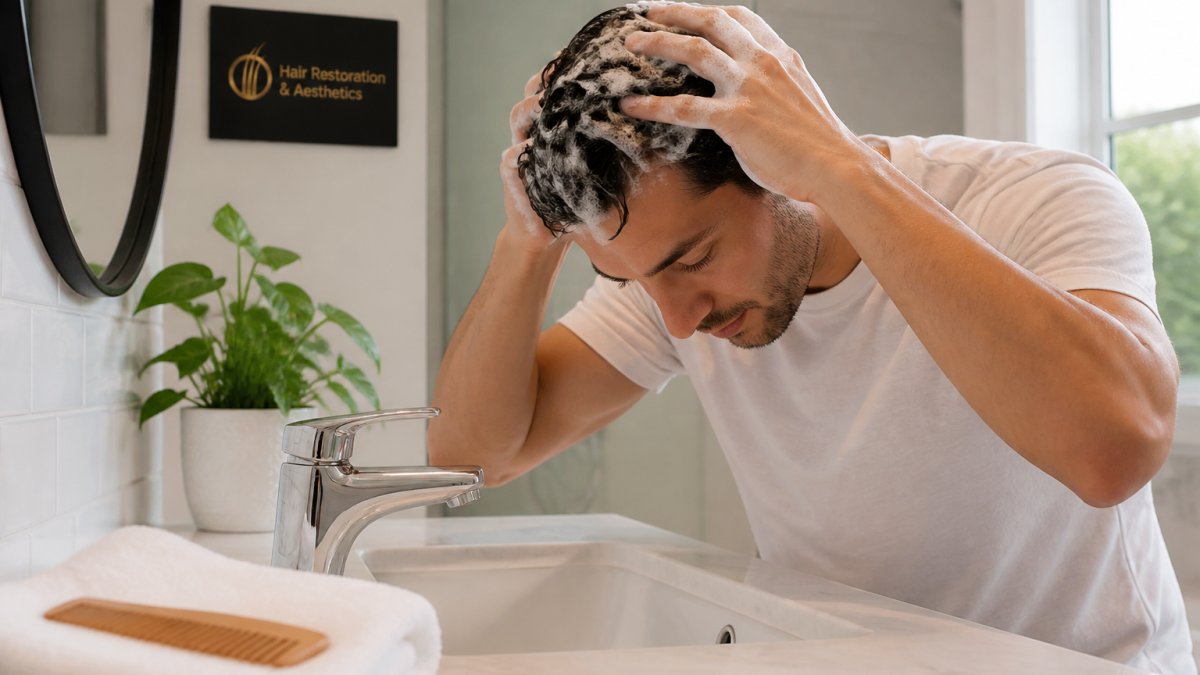
Scalp health drives everything above it. Keep washing gentle, avoid scratching with fingernails, and rinse thoroughly. Limit heat styling to low settings and always use a heat protectant; repeated high-heat contact weakens the hair shaft and creates breakage that looks like shedding. Tight ponytails and harsh coloring add the same kind of mechanical and chemical damage. Cut back on both if you want to protect your hair growth results.
A Note on Product Minimalism
You do not need a ten-step regimen. A gentle shampoo, a conditioner that suits your hair type, one topical treatment if prescribed, and a heat protectant cover most needs. Adding products faster than you can use them consistently is one of the most common reasons routines collapse, and a collapsed routine is what erodes results.
How Long to See Hair Growth Results (and What Changes When)
Most people notice early change around three to six months. Full density takes longer, often a year or more. That timeline comes from the hair-growth cycle itself: follicles need time to shift back into the growth phase and push out new strands.
What changes along the way:
- Months 1-3: less shedding, sometimes a brief "shed" as old hairs release
- Months 3-6: fine new hairs along the hairline and part
- Months 6-12: visible density and stronger hair texture
- Beyond 12 months: refinement and maintenance
If you stop a treatment early, expect the clock to reset.
Hair Growth Progress Tracking That Actually Shows Change
Photos beat memory every time. Take the same angle, same lighting, same distance, once a month. Use a phone tripod and mark your spot on the floor.
A simple tracking table keeps you honest:
| What to Track | How Often | Why It Matters |
|---|---|---|
| Photos (front, top, sides) | Monthly | Shows real density change |
| Shedding count in shower | Weekly | Flags early shedding |
| Treatment adherence | Daily | Confirms consistency |
| Scalp symptoms | Weekly | Catches irritation early |
Hair Loss Treatment Maintenance by Cause and Treatment
Maintenance depends on why you started. Pattern hair loss behaves very differently from shedding triggered by stress, illness, or a nutritional gap, and applying one-size-fits-all advice is how people lose ground. The table below separates the common scenarios so you can match your plan to your cause.
Schedule a Free Consultation →
| Cause or Scenario | What Drives the Result | What Maintenance Looks Like | What Happens If You Stop |
|---|---|---|---|
| Pattern thinning (androgenetic) | Ongoing sensitivity to hormones shrinks follicles over time | Continue the treatment your clinician prescribed; keep follow-up visits | Density typically returns toward the original pattern within months |
| Telogen shedding (stress, illness, surgery, crash dieting) | A temporary shift of follicles into the resting phase | Address the trigger, support sleep and nutrition, and monitor | Most cases recover on their own once the trigger resolves |
| Nutritional gaps (iron, vitamin D, protein) | Follicles lack the building blocks for normal growth | Correct deficiencies with lab testing, not guesswork, and recheck levels | Gains tied to correction can fade if levels drop again |
| Post-procedure growth (transplant or scalp treatment) | Grafted or stimulated follicles need a stable scalp environment | Follow your provider's follow-up schedule and protect the scalp from irritation | New growth is generally durable, but surrounding native hair still follows its own pattern |
| Postpartum shedding | Hormonal shift after delivery | Time, sleep, and nutrition; most cases resolve | Usually self-limiting |
Which Gains Depend on Continued Treatment
This is the part most people are not told clearly enough. Gains from treatments that act on an ongoing cause, pattern hair loss in particular, generally depend on continued use. Stop the treatment and the underlying process resumes, so density drifts back toward where it was heading. Gains from correcting a temporary trigger, by contrast, often hold once the trigger is resolved.
A useful way to think about it: maintenance treats the cause, not just the hair. If the cause is still active, the plan needs to stay active too.
How to Switch or Step Down Safely
Switching needs a bridge plan so you are never fully off support. A common pattern is to add the new treatment before tapering the old one, so there is overlap rather than a gap. Ask your provider before making any change, and give the new approach the same timeline you gave the first, early weeks are not the moment to judge it.
Matching the Plan to Your Case
Our team at Hair Restoration Clinic of Granite Bay builds maintenance plans around each patient's cause and treatment, including non-invasive options like Alma TED for scalp health. The goal is a plan that fits your cause, your budget, and your life, because the plan you can keep is the one that protects your hair growth results.
Side Effects, Adherence, and Troubleshooting
Consistency beats intensity. A treatment you use daily at a lower strength often works better than a strong one you skip.
Common issues and fixes:
- Scalp irritation: switch to a gentler formula or reduce frequency
- Missed doses: set a phone reminder at the same time daily
- Slow progress: check photos against your baseline, not your memory
- New shedding: give it a few weeks before worrying, then call your provider
Our team at Hair Restoration Clinic of Granite Bay builds maintenance plans around each patient's cause and treatment, including non-invasive options like Alma TED for scalp health.
When Renewed Shedding Needs a Medical Evaluation
See a clinician if shedding lasts more than a few weeks, comes with scalp pain, patches, or rash, or follows illness, surgery, or a new medication. A board-certified physician can check for thyroid issues, iron deficiency, and other causes. The American Academy of Dermatology hair loss guidance outlines when to seek care, and the National Institutes of Health hair loss overview covers common triggers.
Getting evaluated early protects your hair growth results and rules out treatable causes. If you are unsure whether your current routine is still working, you can Schedule a Free Consultation to review your plan with our team.
Frequently Asked Questions
Do you need to keep using hair loss treatments to maintain results?
In most cases, yes. Hair growth results from treatments like minoxidil depend on continued use, and stopping can lead to shedding within a few months as follicles return to their previous pattern. The same applies to many medical therapies. If you want to stop or switch, plan it with a clinician rather than quitting abruptly, so you can protect the density you have gained and adjust your hair growth maintenance routine accordingly.
How long does it take to see hair growth results?
Many people notice early changes around three to six months, with fuller results often appearing closer to nine to twelve months. The hair-growth cycle moves slowly, so patience and consistency matter. Track changes with photos taken under the same lighting and angle. If you see no change after six months of consistent use, or you notice continued shedding, ask a qualified professional whether your plan needs adjusting.
How can you tell whether a hair growth treatment is working?
Use objective hair growth progress tracking: take photos every four to six weeks in the same spot with the same lighting, note shedding counts, and compare part width or hair density over time. Avoid judging by feel alone, since daily changes are hard to see. A clinician can also assess your scalp and hair shaft. Steady improvement over three to six months is a better signal than day-to-day impressions.
When should you talk to a medical professional about continued hair loss?
Book an evaluation if shedding persists beyond a few weeks, if you notice patches, scalp itching or pain, or if hair loss continues despite consistent treatment for six months. A medical review can check for causes such as iron deficiency, thyroid issues, or stress-related shedding. A board-certified physician can confirm whether your hair loss treatment maintenance plan is still appropriate and rule out other conditions.
Hair growth takes months to build and weeks to lose without a plan. If you want a maintenance plan matched to your cause and treatment, schedule a free consultation with Hair Restoration Clinic of Granite Bay. Dr. Piyush Kumar, MD, brings over a decade of experience and board-certified care, using the Cole follicular unit extraction system and Alma TED acoustic sound wave therapy. Get started with a plan built to protect your results.