 ultimate-guide
7 Reasons FUE Beats Other Hair Transplants for Thinning Hair
Last Updated: October 29, 2026
Quick Summary
FUE for thinning hair removes individual follicular units one at a time with a small punch tool, so no strip of scalp is taken and no linear scar is left behind. This makes it a strong fit for diffuse thinning, short hairstyles, and patients planning multiple sessions over time.
- FUE leaves tiny dot-like micro-incisions instead of the linear scar FUT creates along its closure.
- Typical FUE sessions harvest roughly 1,500 to 3,000 grafts, depending on donor density.
- Visible healing after FUE usually takes days to a week, and no stitches are required.
- Diffuse thinning spreads evenly across the top of the scalp, while male pattern baldness recedes at temples and crown.
- FUE redistributes existing hair; it does not create new follicles or stop future thinning.
Table of Contents
- Why FUE for Thinning Hair Beats the Old Strip Method
- FUE vs. FUT: The Differences That Decide Your Outcome
- Diffuse Thinning vs. Male Pattern Baldness: Which One Do You Have?
- Who Is a Good Candidate for FUE?
- FUE Hair Transplant Recovery Time, Week by Week
- Alma TED Acoustic Sound Wave Therapy for Hair: Where It Fits
- The Psychological Side of Thinning Hair Nobody Talks About
- Schedule a Free Consultation
- Frequently Asked Questions
Why FUE for Thinning Hair Beats the Old Strip Method
If you are weighing why choose FUE for thinning hair over older transplant techniques, the short answer is this: follicular unit extraction removes individual hair follicles one at a time, so there is no strip of scalp taken from the back of your head and no linear scar left behind. At Hair Restoration Clinic of Granite Bay, we use the Cole follicular unit extraction system for exactly this reason. Thinning hair is a progressive problem, and the technique you pick now determines how your donor area looks and how much usable density you keep for decades. Below, we cover how FUE compares with older methods, who makes a good candidate, what recovery typically involves, and the limits of the procedure.
FUE for thinning hair is a minimally invasive surgical technique in which individual follicular units are harvested from the donor area and reimplanted into thinning zones, leaving micro-incisions rather than a linear scar.
FUE vs. FUT: The Differences That Decide Your Outcome
FUE and FUT differ in how grafts are harvested, and that single difference drives scarring, recovery, session limits, and how many procedures you can have over a lifetime. FUT removes an elliptical strip of scalp from the donor area and closes it with stitches; surgeons then dissect the strip into individual grafts under a microscope (Donor Harvesting: Strip Dissection). FUE skips the strip entirely and extracts each follicular unit individually with a small punch tool (Follicular Unit Extraction Hair Transplant).
| Factor | FUE | FUT (Strip) |
|---|---|---|
| Harvest method | Individual follicular units via small punch | Elliptical strip of scalp, dissected under microscope |
| Scarring | Tiny dot-like micro-incisions | Linear scar along the closure |
| Stitches | None | Yes, along the closure; suture removal required |
| Typical session size | Roughly 1,500-3,000 grafts per session, depending on donor density | Often higher per session because the strip yields many grafts at once |
| Recovery period | Days to a week for visible healing | Longer; suture removal and donor-area tenderness |
| Hairstyle flexibility | Short hairstyles fine | Linear scar may show when hair is short |
| Repeat procedures | Donor area re-harvestable across sessions | Scar tissue limits future strips |
| Anesthesia | Local anesthesia | Local anesthesia |
| Best fit | Diffuse thinning, patients who wear hair short, patients planning multiple sessions | Patients with high graft needs in a single session and good scalp laxity |
Scarring: Linear Scar vs. Micro-Incisions
The scar question is where most patients make their decision. FUT leaves a linear scar across the back of the scalp, and while it can heal well, it is permanent and may become visible if you wear your hair short. FUE leaves small circular micro-incisions that heal into faint dots scattered across the donor area rather than a single line. Neither technique is truly scarless, and any clinic promising a scarless procedure is overselling. For a deeper comparison of what each approach leaves behind, read our guide to hair transplant scarring versus non-surgical options.
Graft Survival and Hair Density
Graft survival depends more on handling and technique than on harvest method alone. FUE requires surgical precision because each graft is extracted individually and is out of the body briefly, which is why the skill of the operator matters so much. Density depends on your donor supply, the size of the treatment area, and how many follicular units can be safely harvested in one session. A common pattern is that patients with diffuse thinning need grafts blended into existing hair rather than a dense hairline rebuild, which changes how the surgeon plans density. If you want realistic expectations on graft survival and hair density, our breakdown of FUE success rates covers what the numbers actually mean.
Donor Management Over a Lifetime
The decision is not just about one procedure. Donor area management over time is a consideration, and the specifics should be discussed with a qualified physician during a consultation.
Diffuse Thinning vs. Male Pattern Baldness: Which One Do You Have?
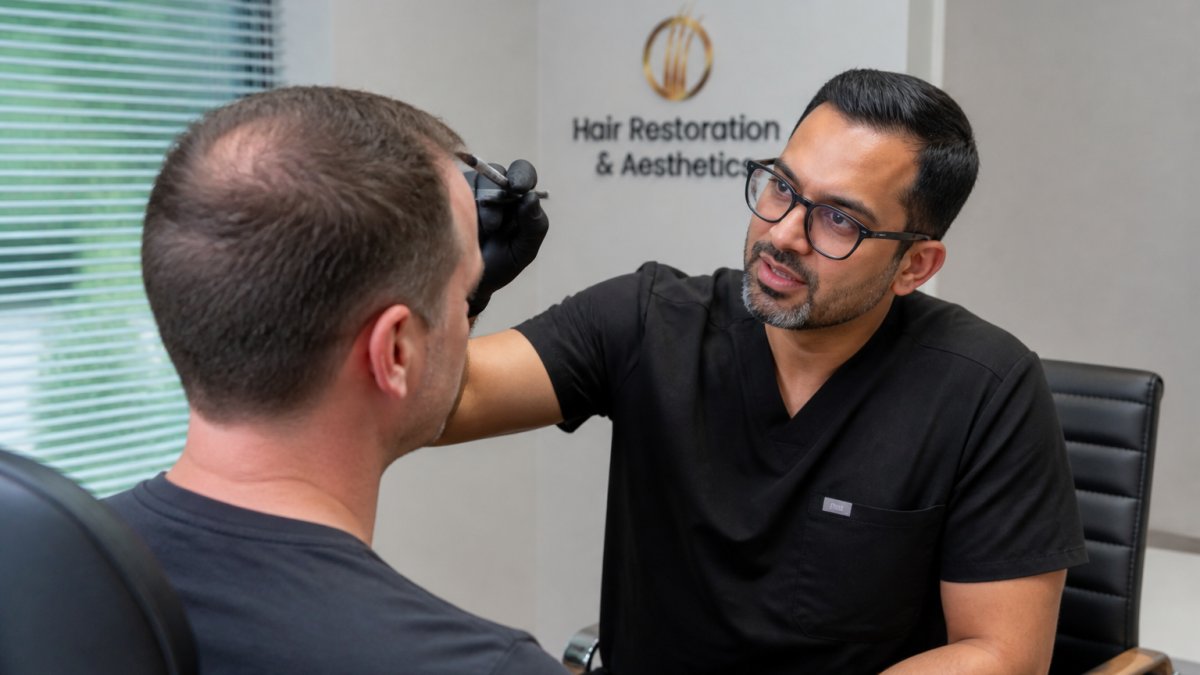
Diffuse thinning spreads evenly across the top of the scalp, while male pattern baldness follows a recognizable recession at the temples and crown (Male and female pattern hair loss). The distinction matters because it changes both candidacy and technique. Diffuse thinning, which also appears in female pattern hair loss, leaves follicles miniaturized but still present across a broad area, so grafting has to blend into existing hair rather than rebuild a hairline from scratch. Male pattern baldness typically leaves a stable donor area at the back and sides, which makes grafting more predictable. A proper scalp evaluation with magnification separates the two, and it is the first thing we check in consultation.
Who Is a Good Candidate for FUE?
Candidacy for FUE generally depends on factors such as donor hair density, scalp laxity, general health, and whether hair loss is still progressing. Individual suitability is determined through a consultation with a qualified physician.
FUE Hair Transplant Recovery Time, Week by Week
Recovery varies by individual. For the full detail, see our FUE hair transplant recovery timeline. Healing and the emergence of new growth generally unfold over several months, and your physician will provide specific timing guidance.
- Days 1-3: Mild swelling and tenderness in the donor and recipient areas. Sleep elevated, avoid strenuous activity.
- Week 1: Tiny scabs form around each graft. Gentle washing begins per your clinic's instructions.
- Weeks 2-3: Scabs shed. Post-transplant shedding of transplanted hairs is normal and expected.
- Months 2-4: New growth begins. This is the slow, quiet phase that tests patience.
- Months 6-12: Density fills in and the aesthetic outcome matures.
Following your physician's post-operative instructions is important for healing. Ask your provider for detailed aftercare guidance.
Schedule a Free Consultation →
Alma TED Acoustic Sound Wave Therapy for Hair: Where It Fits
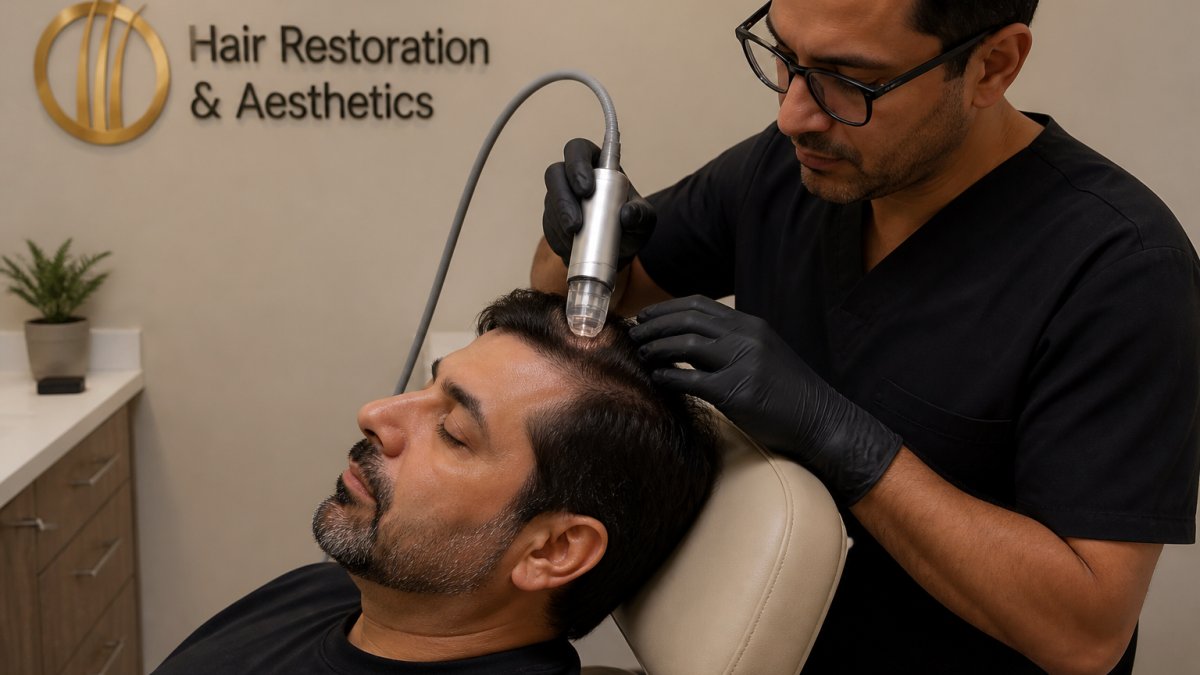
Alma TED is a non-invasive acoustic sound wave treatment that supports scalp health and hair quality without surgery or downtime, and it fits best as a complement to FUE rather than a replacement. It is a non-invasive therapy and is not a cure for hair loss. We offer Alma TED hair restoration as a standalone option for early thinning and as an adjunct for post-transplant scalp care.
The Psychological Side of Thinning Hair Nobody Talks About
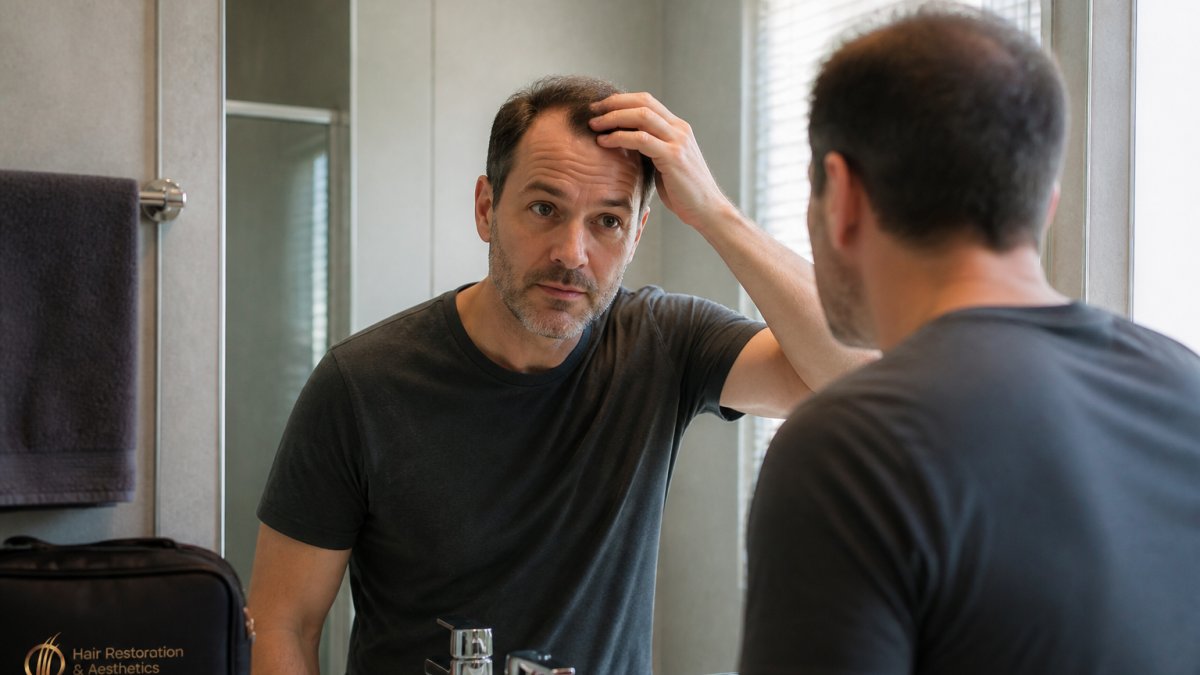
Thinning hair changes how people see themselves, and that emotional weight rarely gets addressed in clinical guides. Hair thinning progression is visible and public in a way few other conditions are, which is why timing matters: treating earlier often preserves more options and reduces the years spent managing the anxiety. We raise this because the decision to pursue FUE is rarely purely cosmetic. Naming the psychological cost helps patients make a decision from clarity rather than panic, and it sets realistic expectations for what restoration can and cannot fix. Aesthetic outcome matters, but so does how you feel walking into a room.
Why the Emotional Timeline Matters as Much as the Surgical One
Some people delay evaluation for personal reasons. Progressive thinning can change donor and recipient considerations over time, so earlier evaluation can preserve options; a physician can advise on this.
The 5-10 Year View: Investment vs. Temporary Fixes
Costs vary depending on the treatment plan, and pricing is best confirmed with the clinic directly or through the website.
Female Pattern Thinning Deserves Its Own Conversation
Most psychological content around hair loss is written for men, but female pattern thinning carries a different social weight. Female pattern thinning has its own considerations, and donor stability and treatment planning are assessed individually during consultation. Naming this separately matters because the emotional and clinical decisions are not the same as they are for male pattern baldness.
What Restoration Can and Cannot Fix
FUE redistributes existing hair; it does not create new follicles or stop future thinning. Expectations are best set during consultation, where realistic outcomes for your situation can be discussed. Setting that expectation before surgery is part of the psychological preparation, not separate from it. The goal is a result that looks like you on a good hair day, not a result that looks like someone else.
Schedule a Free Consultation
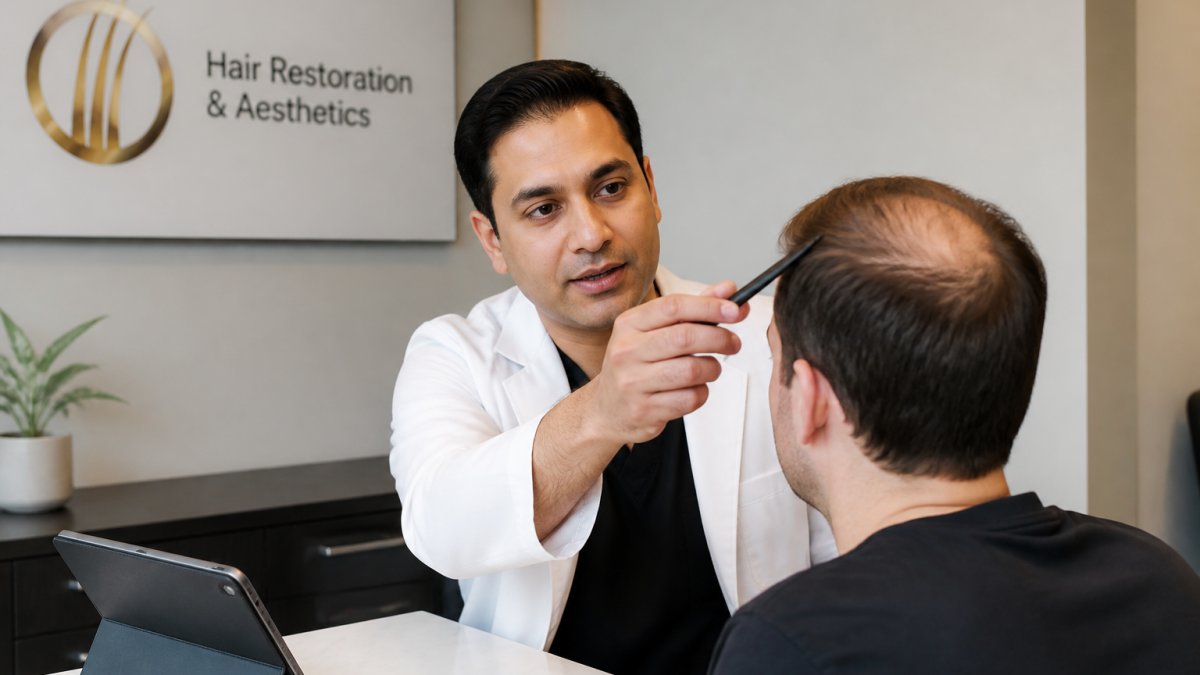
Choosing a surgical technique for thinning hair is a medical decision, and it deserves a real evaluation. At Hair Restoration Clinic of Granite Bay, Dr. Piyush Kumar, MD, is board-certified and has over a decade of experience, using the Cole follicular unit extraction system for FUE hair and eyebrow transplants. We offer a free consultation and payment plans.
Frequently Asked Questions
How does FUE differ from traditional hair transplant methods?
Traditional FUT removes a strip of scalp from the donor area and closes it with stitches, leaving a linear scar. FUE for thinning hair extracts individual follicular units with a small punch tool, so there is no strip removal and no linear scar. FUE is a minimally invasive procedure that uses local anesthesia. Its specifics, including session length and recovery, should be reviewed with a qualified physician.
Is FUE effective for diffuse thinning or only for bald spots?
FUE works for both, but diffuse thinning needs careful planning. In diffuse thinning, hair is miniaturizing across a wide area rather than receding from one spot, so the surgeon must place grafts between existing hairs without damaging them. That requires surgical precision and a realistic density target. A consultation with a board-certified physician will confirm whether your donor area has enough healthy follicles and whether your thinning has stabilized enough for predictable results.
What is the recovery process like after an FUE procedure?
Recovery varies by individual. Your physician will provide specific post-operative care instructions, which are important to follow for healing.
Can FUE be combined with non-invasive treatments like Alma TED?
Yes, and the combination is often worth discussing. Alma TED acoustic sound wave therapy for hair is a non-invasive option that supports scalp health and hair quality without incisions. Your physician can advise whether combining treatments is appropriate for you and on timing.
The hardest part of thinning hair is not the procedure; it is deciding whether to act at all. Get started with Hair Restoration Clinic of Granite Bay and schedule a free consultation to find out what your donor area can actually support.