 comparison
Hair Transplant Scarring vs Non-Surgical: 2026 Guide
Table of Contents
- Understanding Surgical Hair Restoration and Scarring
- Types of Hair Transplant Scars and What Causes Them
- FUE Hair Transplant Recovery and Scar Visibility
- Non-Surgical Hair Restoration Alternatives
- Alma TED Hair Restoration Benefits for Hair Health
- Surgical vs. Non-Surgical: Cost and Long-Term Outcomes
- What to Expect From a Hair Restoration Consultation
- Minimizing Scarring and Optimizing Results
Last Updated: August 27, 2026
Understanding Surgical Hair Restoration and Scarring
Hair transplant scarring represents one of the most significant concerns for anyone considering surgical hair restoration. At Hair Restoration Clinic of Granite Bay, we help patients understand that scarring depends entirely on the technique used, the surgeon's precision, and realistic healing expectations.
Surgical hair restoration works by harvesting healthy hair follicles from areas resistant to pattern baldness, typically the back and sides of the scalp, and transplanting them to thinning or bald areas. This process involves creating both a donor site (where hair is removed) and recipient sites (where hair is implanted). The key distinction lies in whether you choose follicular unit transplantation (FUT), which creates a linear scar, or follicular unit extraction (FUE), which produces multiple tiny scars that are less visible in most cases.
Types of Hair Transplant Scars and What Causes Them
Hair transplant scarring occurs through two primary mechanisms: the harvesting technique and the body's natural wound-healing response.
Linear Scars from Follicular Unit Transplantation
Follicular unit transplantation (FUT), also called strip harvesting, removes a thin linear strip of scalp from the donor area. The donor site is closed with sutures, creating a linear scar that typically runs horizontally across the back of the scalp, usually between 1-3 millimeters wide.
For many patients, this scar is hidden by surrounding hair, especially if hair density in the donor area remains adequate. However, if significant hair loss occurs in the donor region or if you wear your hair very short, the scar becomes visible. Collagen production during wound healing determines scar appearance. In some individuals, the body produces excess collagen, creating a raised or thickened scar (hypertrophic scarring). In others, keloid formation, an abnormal overgrowth of scar tissue, can occur, though this is less common on the scalp.
The advantage of FUT is that it allows surgeons to harvest a larger number of grafts in a single session. The disadvantage is the permanent linear scar, which some patients find psychologically difficult even if it remains hidden under hair.
Dot Scars from Follicular Unit Extraction
Follicular unit extraction (FUE) uses a different approach. Individual follicular units are extracted one at a time using a small punch tool, typically 0.8-1.0 millimeters in diameter, creating multiple tiny circular scars in the donor area rather than one long line (peer-reviewed research).
These dot scars are usually less noticeable than linear scars, particularly if you maintain moderate hair length in the donor area. However, if you have light-colored hair, fair skin, or prefer to shave your head completely, these dot scars become more visible. Skin type plays a significant role: individuals with darker skin tones may experience hypopigmentation (lightening of the scar area), while those prone to keloid formation face increased risk.
FUE also creates recipient-site scarring from the small incisions made to implant grafts. These typically heal with minimal visible marks, but the cumulative effect of hundreds or thousands of tiny wounds can affect scalp appearance.
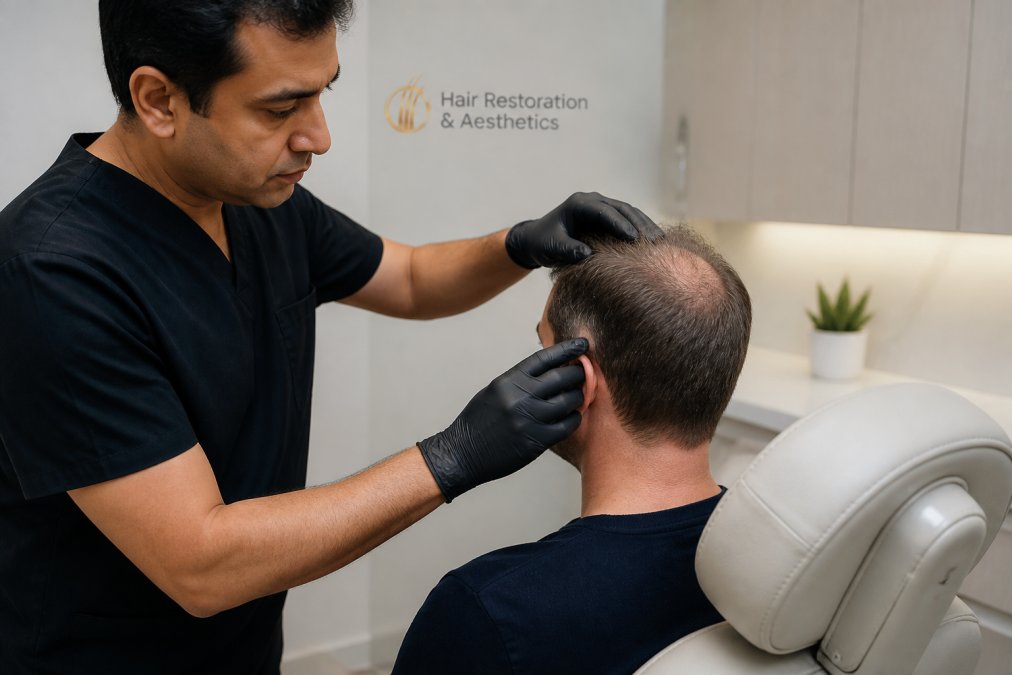
FUE Hair Transplant Recovery and Scar Visibility
FUE hair transplant recovery follows a predictable timeline, though individual variation is significant.
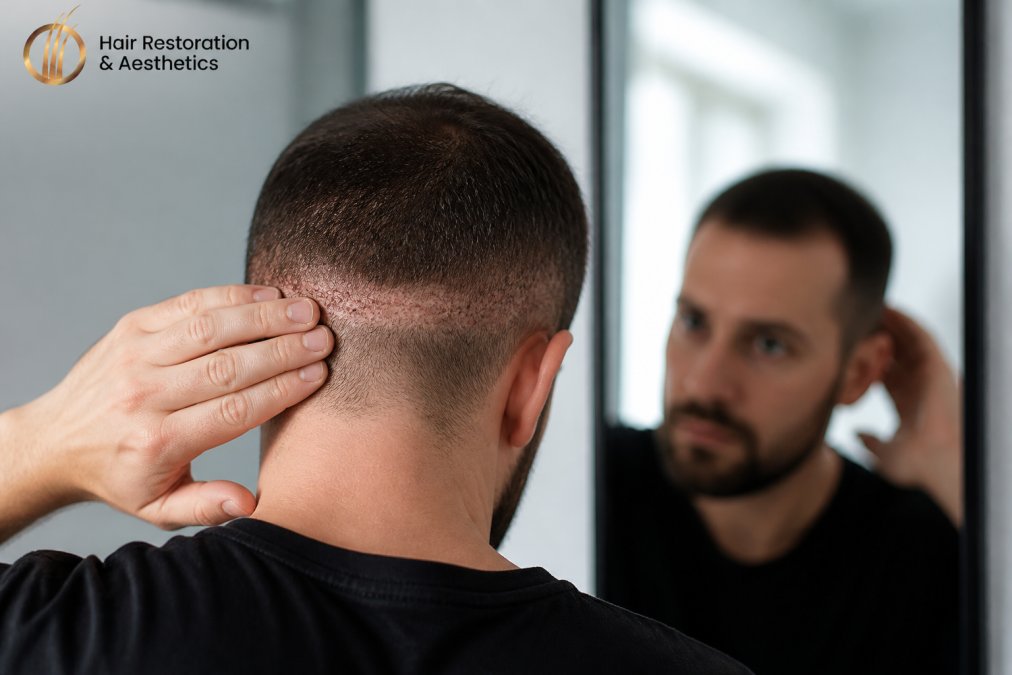
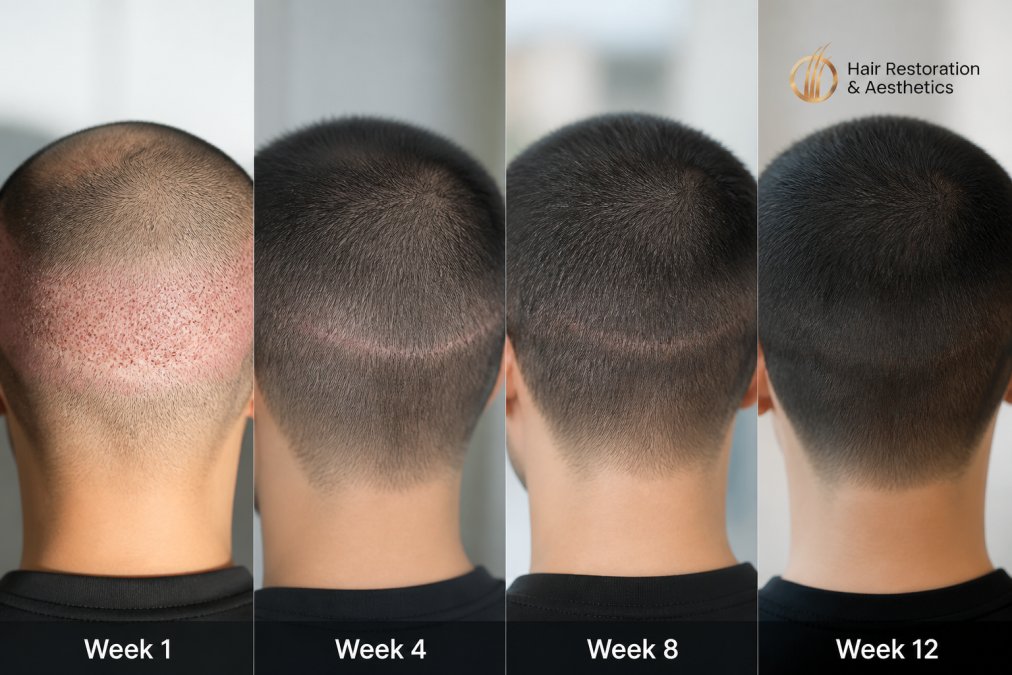
Immediately after FUE extraction, the donor area appears red with small scabs forming over each extraction site. These scabs typically fall off within 7-10 days (peer-reviewed research). By week two, most scabs have shed and the scalp appears less inflamed, though healing continues at the cellular level.
Weeks three through eight mark the most active phase of wound healing. Collagen production peaks, and the scar tissue begins to mature. By three to four months post-procedure, the majority of acute healing is complete (peer-reviewed research). Scars begin to fade in color, becoming less red and more closely matching surrounding skin tone. However, true scar maturation continues for up to 12-18 months.
Hair growth from transplanted grafts typically begins around month three, becoming more obvious by months four through six. By month nine to twelve, transplanted hair has grown long enough that donor-area scars are largely obscured by surrounding hair. This timing is crucial: the scars fade while transplanted hair grows, creating a window where scarring is most visible.
Factors influencing scar visibility include age (younger skin often heals with less noticeable scarring), skin tone (darker skin types may show hypopigmentation more obviously), hair color (light hair makes scars more visible), and individual healing response.
Non-Surgical Hair Restoration Alternatives
Non-surgical hair restoration options offer genuine benefits for many patients, particularly those with mild to moderate hair loss or those unwilling to accept any scarring risk.
Topical treatments like minoxidil (Rogaine) work by extending the growth phase of hair follicles and increasing blood flow to the scalp. These treatments require ongoing use; stopping them results in hair loss resuming within months. Oral medications like finasteride (Propecia) address the hormonal basis of male pattern baldness by inhibiting DHT production. For many men, finasteride slows or halts hair loss progression, with some experiencing modest regrowth.
Scalp micropigmentation creates the illusion of denser hair by tattooing tiny dots on the scalp that mimic hair follicles. This technique works well for creating the appearance of a closely-shaved head or adding density to thinning areas. Results are permanent, though the technique doesn't actually restore hair, it's a cosmetic camouflage strategy.
Platelet-rich plasma (PRP) therapy involves extracting growth factors from your own blood and injecting them into the scalp. Some patients report improved hair density, though clinical evidence remains limited and results are variable.
Hair Restoration Clinic of Granite Bay also offers Alma TED hair restoration, a non-invasive acoustic sound wave therapy that benefits hair health by stimulating cellular activity in hair follicles and improving scalp blood flow without surgical intervention.
Alma TED Hair Restoration Benefits for Hair Health
Alma TED represents a non-invasive alternative that addresses hair health at the cellular level. Unlike topical treatments that work on hair shaft growth or oral medications that target hormonal mechanisms, Alma TED uses acoustic sound wave technology to stimulate the scalp's vascular supply and follicular activity.
The mechanism involves delivering precise acoustic pulses to the scalp, which promotes neovascularization, the formation of new blood vessels. Improved blood flow delivers more oxygen and nutrients to hair follicles, supporting their function. Additionally, the acoustic stimulation triggers cellular responses that enhance collagen production and tissue regeneration in the scalp.
Treatment sessions are brief, typically 15-20 minutes, with no downtime. A typical protocol involves multiple sessions spaced over several weeks, with maintenance treatments recommended to sustain results. Results typically emerge over several months as follicles respond to improved scalp health. Some patients experience thicker, stronger hair growth; others see slowed hair loss progression.
For patients with early-stage hair loss or those seeking to optimize scalp health alongside other treatments, Alma TED offers a complementary approach that works synergistically with medications or can serve as a standalone option for those preferring non-pharmaceutical intervention.
Surgical vs. Non-Surgical: Cost and Long-Term Outcomes
Comparing surgical and non-surgical hair restoration requires examining both immediate financial investment and long-term cost-benefit analysis over a realistic timeframe.
Schedule a Free Consultation →
Non-surgical options typically have lower upfront costs but require ongoing investment. Topical minoxidil and finasteride require indefinite use to maintain results. Over five years, medication costs accumulate significantly, and discontinuation results in hair loss resuming within months.
Scalp micropigmentation involves a higher upfront cost but no ongoing medication expenses. Results are permanent, though touch-ups may be needed every few years.
Alma TED hair restoration requires multiple treatment sessions followed by periodic maintenance. While cumulative expense over a year can exceed medication costs, it remains lower than surgical intervention.
Surgical hair transplantation involves substantial upfront investment but produces permanent results. The transplanted hair continues growing for life, requiring no ongoing medication or maintenance treatments. From a long-term financial perspective, surgical restoration may prove more economical over 10+ years despite higher initial costs.
For patients with mild to moderate hair loss, non-surgical options may provide satisfactory improvement. For those with extensive baldness, surgical restoration typically offers superior aesthetic outcomes despite scarring considerations.
| Approach | Upfront Cost | Ongoing Cost | Scarring Risk | Permanence | Best For |
|---|---|---|---|---|---|
| Minoxidil | Low | Ongoing | None | Temporary | Early hair loss |
| Finasteride | Low | Ongoing | None | Temporary | Slowing progression |
| Scalp Micropigmentation | Higher | Minimal | None | Permanent | Cosmetic density |
| Alma TED | Moderate | Periodic | None | Variable | Scalp health |
| FUE Hair Transplant | Higher | None | Minimal | Permanent | Advanced loss |
What to Expect From a Hair Restoration Consultation
A comprehensive hair restoration consultation establishes the foundation for successful treatment, whether surgical or non-surgical.
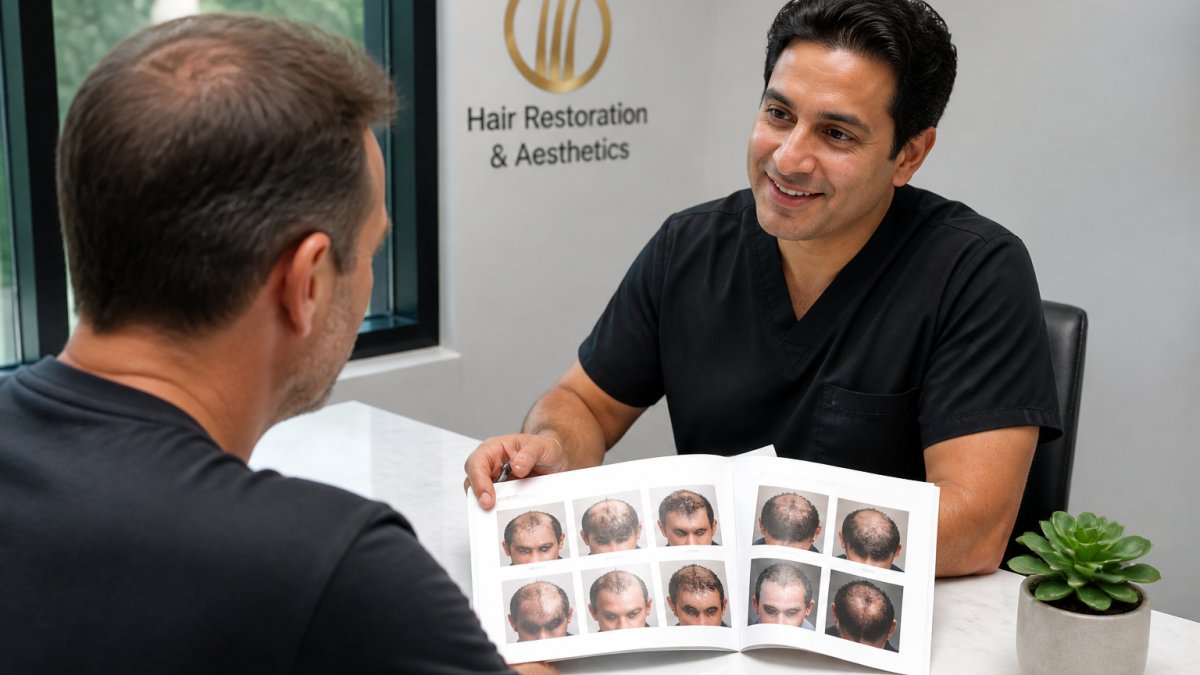
During the initial consultation, the physician evaluates your hair loss pattern, hair density in donor and recipient areas, and overall scalp health. This assessment determines candidacy for various procedures and helps identify the approach most likely to deliver your desired outcome. Photographs are typically taken from multiple angles to document current status.
The physician discusses your hair loss history, when it began, how rapidly it's progressed, and any family history of baldness. This information helps predict future hair loss patterns and whether your hair loss is likely to progress significantly over coming years.
Expectations discussion is critical. The physician should explain realistic outcomes for your specific situation, including the number of grafts you likely need, the timeframe for visible results, and potential limitations. Scarring risk assessment includes examining your skin type, healing history, and any previous scars to predict how you'll likely heal.
For non-surgical options, the consultation should include discussion of realistic outcomes based on your hair loss stage. Early-stage loss responds better to medications than advanced baldness.
A thorough consultation typically lasts 30-45 minutes and leaves you with clear understanding of recommended approach, realistic expectations, and confidence in your decision-making process.
Minimizing Scarring and Optimizing Results
If you choose surgical hair restoration, multiple strategies minimize scarring while optimizing aesthetic outcomes.
Surgeon selection significantly impacts scarring outcomes. Surgeons with extensive experience using precise extraction and closure techniques achieve better cosmetic results. Ask potential surgeons about their training, the number of procedures they've performed, and whether they can show before-and-after photos from patients with similar hair characteristics to yours.
The Cole follicular unit extraction system represents an advanced FUE approach that uses specialized instrumentation to minimize trauma during follicle extraction. Reduced extraction trauma translates to smaller wounds that heal with less visible scarring.
Post-operative care dramatically influences scarring. Following physician instructions regarding wound care, activity restrictions, and medication use supports optimal healing. Patients who scratch, pick at scabs, or resume strenuous activity too quickly risk compromising wound healing and worsening scarring.
Sun protection during the healing phase prevents hyperpigmentation of developing scars. Wearing hats or using sunscreen on the scalp for several months after surgery helps scars blend with surrounding skin tone.
Scar treatment options exist for patients who develop noticeable scarring despite preventive measures. Microneedling stimulates collagen remodeling and can improve scar appearance over multiple sessions. Laser therapy addresses scar redness and texture by promoting tissue remodeling. These treatments work best on scars that have fully matured (12+ months old).
For linear scars from FUT, scar revision surgery can improve appearance by refining the scar line. For FUE dot scars, camouflage through scalp micropigmentation can create the appearance of denser hair that obscures the scars.
Realistic expectations matter most. Even optimal surgical technique produces some scarring; the goal is minimizing visibility, not achieving complete invisibility. Most patients find that transplanted hair growth adequately obscures donor-area scars within 12 months, making scarring a temporary rather than permanent concern.
Hair transplant scarring remains a legitimate consideration when evaluating surgical restoration, but scarring severity depends heavily on technique, surgeon skill, and individual healing response. At Hair Restoration Clinic of Granite Bay, we use the Cole follicular unit extraction system and provide comprehensive pre-operative consultation to help you understand realistic scarring outcomes for your specific situation. If you're concerned about surgical scarring or want to explore whether non-surgical options like Alma TED hair restoration might address your hair loss, schedule a free consultation with our board-certified physician to discuss your goals and learn which approach aligns with your expectations.
Frequently Asked Questions
Q: Does hair transplant scarring go away completely?
A: Hair transplant scarring does fade over time, but complete disappearance depends on scar type, skin tone, and healing. FUE scars, small dot-like marks in the donor area, typically become nearly invisible within 12-18 months as hair regrows and the scalp heals. Factors like surgical precision, post-operative care, and individual wound healing affect final visibility. Scar revision techniques and treatments like laser therapy can further minimize appearance if needed.
Q: What is the actual recovery timeline for FUE hair transplant recovery?
A: Most patients return to normal activities within 7-10 days after FUE. Initial healing takes 2-3 weeks, during which scabs form and shed. Full scalp healing occurs around 3-4 weeks, though the grafts continue strengthening for months. Hair growth begins around 3-4 months, with visible density improvement by 6-9 months. Complete results take 12-18 months as transplanted hair reaches full maturity and surrounding scarring fades.
Q: Can non-surgical treatments like Alma TED actually work for hair loss?
A: Alma TED uses acoustic sound wave therapy to stimulate hair follicles and improve scalp vascular supply, supporting hair health and potentially slowing hair thinning. It works best for early-stage hair loss and maintenance rather than restoring significant density. Non-surgical options are effective for mild thinning and can complement surgical procedures, but they cannot match the density results of FUE transplants for advanced baldness. A consultation helps determine if non-surgical treatment alone meets your goals.
Q: How do I know if surgical or non-surgical hair restoration is right for me?
A: Choose surgical restoration (FUE) if you have significant hair loss, want permanent density improvement, and can accept minimal scarring and recovery time. Choose non-surgical options if you have early thinning, prefer no downtime, or want to maintain existing hair health. Many patients benefit from a hybrid approach: non-surgical therapy for maintenance combined with FUE for targeted density restoration. A hair restoration consultation evaluates your hair loss pattern, goals, and candidacy for each option.
This article was written using GrandRanker