 how-to
Managing Swelling After Facial Volume Filler Treatment
Table of Contents
- Why Swelling Occurs After Dermal Filler Treatment
- What to Expect: Swelling and Bruising Timeline
- How to Reduce Swelling After Facial Fillers
- How Long Does Filler Swelling Last
- Aftercare After Dermal Filler Treatment: First 48 Hours
- Signs of a Dermal Filler Complication
- When to Contact Your Provider
- Frequently Asked Questions
Last Updated: October 13, 2026
Why Swelling Occurs After Dermal Filler Treatment
Dermal filler injections create small punctures and trigger a minor inflammatory response, normal and expected.
Your healing response dilates blood vessels and causes fluid to pool at the injection site, producing visible swelling.
Swelling signals your body is integrating the filler. Hyaluronic acid fillers also attract water, amplifying swelling in the first few days.
What to Expect: Swelling and Bruising Timeline
Managing swelling after facial volume filler treatment requires knowing what happens each day. Swelling and bruising follow predictable patterns, though recovery differs by area and product.
Immediately after treatment (0-6 hours):
- Mild swelling and redness at injection sites
- Tenderness or pressure is normal
- Bruising may start forming but isn't always visible yet
Day 1-2 (peak swelling period):
- Swelling reaches its maximum, often more than expected
- Bruising becomes visible if it will occur
- Tenderness and aching are common; the face may feel heavy or tight
Day 3-5:
- Swelling declines noticeably
- Bruising starts fading but may still be visible
- Tenderness decreases; most people return to normal activities
Day 6-14:
- Swelling resolves gradually
- Bruising fades to yellow or light purple
- Results become more visible as swelling subsides
Week 3+:
- Swelling is essentially gone for most people
- Filler integration continues; final results become apparent
How the Timeline Changes by Facial Area
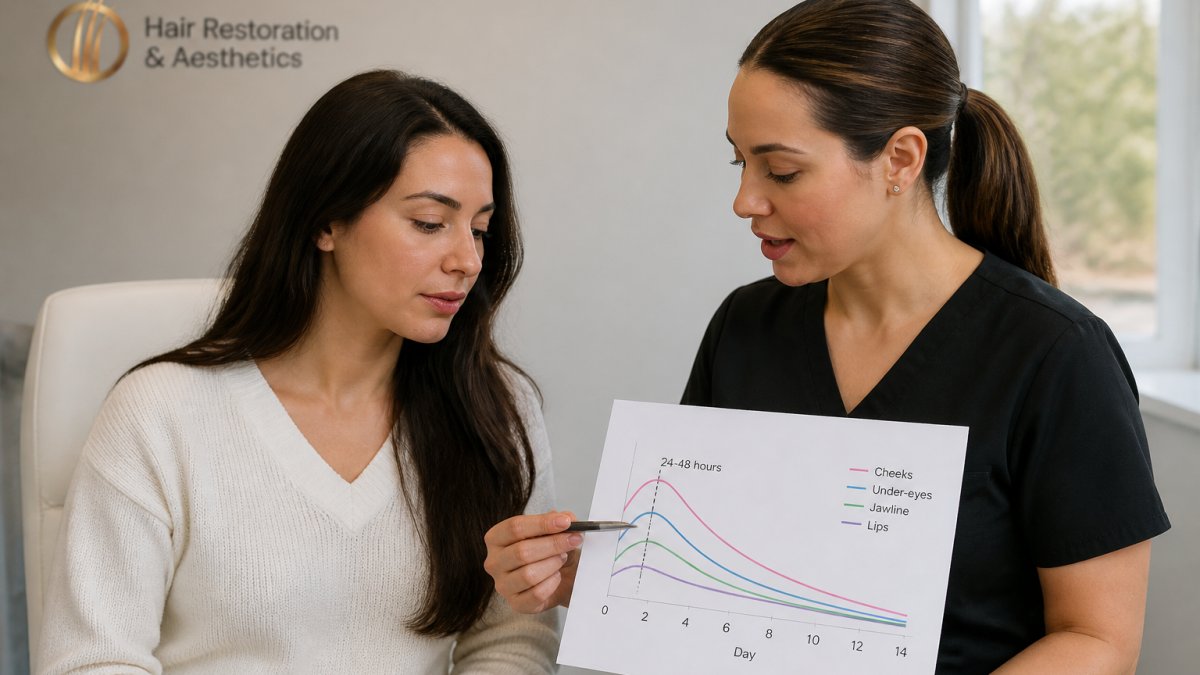
The cheeks, under-eyes, jawline, temples, and lips do not swell on the same schedule.
Under-eyes and tear troughs: The thinnest skin on the face, so even small amounts of fluid look dramatic.
Jawline and chin: Swelling can make the lower face feel wider or heavier and temporarily blur definition.
Lips: Lip swelling is the most dramatic, peaking at 24-48 hours and looking significantly larger than the final result.
Why Filler Type Affects the Timeline
Hyaluronic acid fillers attract water, and how much depends on the formulation. Firmer products for deep structural support hold their shape with less water uptake, so swelling is less pronounced. Softer, more hydrophilic formulations in superficial layers draw in more fluid and produce more visible swelling.
Areas treated with a firmer product settle faster than those treated with a softer product for fine volume. Your provider can tell you which category your treatment falls into, more useful than a generic "5-7 days" estimate.
Bruising: What to Expect and How It Progresses
Bruising follows its own arc: it appears within 24-48 hours, peaks around day 2-3, then fades through purple, green, and yellow. Most facial bruising resolves within 7-10 days, though under-eye bruising can linger.
Bruising is more likely with blood-thinning medications, fish oil, or certain supplements, and in thinner-skinned areas. It is not a sign something went wrong, but mention it to your provider if it is extensive or appears in an untreated area.
How to Reduce Swelling After Facial Fillers
Cold Compress and Ice Pack Techniques
Cold therapy constricts blood vessels and reduces inflammation, making it your most effective tool for managing swelling after facial volume filler treatment.
Use a clean, soft cloth as a barrier, never apply ice directly to your face.
Use gentle pressure only, never massage or rub the treated area. Let the cold work passively, resting between sessions if more comfortable.
Stop using ice after 48 hours. Beyond this point, cold therapy offers minimal benefit and may interfere with filler integration.
Hydration and Head Elevation
Drink plenty of water starting immediately after treatment. Hydration reduces swelling by supporting lymphatic drainage and tissue repair.
Sleep with your head elevated on extra pillows for the first 2-3 nights.
During the day, maintain good posture and avoid leaning forward or bending down repeatedly, which increases blood flow to the face and worsens swelling.
Limit salt for 48 hours after treatment. Salt promotes fluid retention and exacerbates swelling; avoid obviously salty and processed foods.
Activities and Habits to Avoid
Strenuous exercise increases blood flow to the face and worsens swelling.
Avoid hot showers, saunas, steam rooms, and direct sun for 48 hours.
Don't touch or massage the treated areas, manipulation can displace filler and increase inflammation.
Sleep on your back for the first week to prevent pressure on treated areas and support head elevation.
Skip makeup for 24 hours if possible, especially around injection sites.
How Long Does Filler Swelling Last
Most swelling from managing swelling after facial volume filler treatment resolves within 5-7 days.
The timeline depends on several factors.
Schedule a Free Consultation →
Individual healing capacity matters: sensitive skin or inflammatory conditions may prolong swelling, and younger skin typically bounces back faster than mature skin.
Filler type affects swelling patterns, since hyaluronic acid formulations vary in viscosity and water-binding capacity.
If swelling persists beyond 2 weeks or worsens after improving, contact your provider, prolonged swelling can indicate an issue requiring assessment.
Aftercare After Dermal Filler Treatment: First 48 Hours
The first 48 hours are critical for managing swelling after facial volume filler treatment and significantly impact your recovery timeline.
Immediate post-treatment (first 6 hours):
- Apply ice packs with a cloth barrier for 10-15 minutes every 1-2 hours
- Rest with your head elevated
- Avoid touching treated areas and skip makeup
- Stay hydrated
First 24 hours:
- Continue ice therapy as needed
- Maintain head elevation, especially while sleeping
- Avoid strenuous activity, hot showers, heat, alcohol, and excessive salt
- Take over-the-counter pain relief if needed (ask your provider which medications are safe)
- Keep treated areas clean but don't apply unnecessary products
24-48 hours:
- Reduce ice therapy frequency; continue if swelling is significant
- Maintain head elevation and avoid strenuous activity and heat
- Stay well-hydrated
- Gentle facial movements are fine; no massage or manipulation
- Light makeup can be reapplied with clean tools
By day 3, most people can resume normal activities, but continue avoiding intense exercise and heat for a full week.
Signs of a Dermal Filler Complication
Most swelling is normal and expected, but certain signs require contacting your provider immediately. The most useful tool is a symptom checklist organized by urgency.
Normal Reactions That Don't Require Urgent Care
- Mild to moderate swelling and bruising
- Tenderness or mild aching at injection sites
- Temporary asymmetry as swelling resolves unevenly
- Slight firmness at injection sites
- Mild redness around injection marks
- Swelling that peaks at 24-48 hours and then steadily improves
Symptom Checklist by Urgency Level
Green, monitor at home:
- Swelling that peaks in the first 48 hours and then improves daily
- Bruising that changes from purple to green to yellow
- Mild tenderness when touching the treated area
- Slight firmness or small bumps that soften over the first week
- Mild asymmetry that improves as swelling resolves
Yellow, contact your provider within 24 hours:
- Swelling still increasing after day 3, or that improved and then returned
- Redness spreading beyond the injection site, or warmth in the treated area
- A firm lump not softening after 1-2 weeks
- Bruising that is unusually extensive or appears in an untreated area
- Any concern about asymmetry or results that don't match expectations
Red, seek immediate medical evaluation:
- Severe pain disproportionate to normal treatment discomfort
- Blanching, sudden darkening, mottling, or a livedo-like pattern on the skin
- Numbness or loss of sensation in the treated area
- Vision changes, eye pain, or difficulty moving the eye
- Fever, chills, or pus or unusual discharge from an injection site
- Hives, spreading rash, or spreading itching
- Difficulty breathing, swelling of the lips or throat, or throat tightness
How to Tell Normal Swelling From Vascular Occlusion
Vascular occlusion occurs when filler enters a blood vessel and blocks blood flow (Management of a Vascular Occlusion Associated with Cosmetic Injections).
Normal swelling is soft and improves over time. Vascular occlusion is different: pain is severe and often burning or throbbing rather than a dull ache, the skin may turn white or dusky, and the change happens suddenly.
If you see blanching, sudden color change, or severe pain, do not wait. Contact your provider immediately or go to an emergency department; early treatment protects the tissue.
How to Tell Normal Swelling From Infection
Infection produces signs normal swelling does not: fever, spreading redness, warmth to the touch, and pus or discharge. Normal swelling may feel warm for a day or two, but it should not be hot or accompanied by fever.
A useful rule is the direction of change: normal swelling improves after day 2, while infection worsens. Swelling increasing after day 3, or returning with redness or heat, points toward infection and warrants prompt assessment.
Other Complications to Recognize
Allergic reactions are rare but serious. Signs include hives or rash beyond the injection site, difficulty breathing, swelling of the lips or throat, and spreading itching. Seek immediate medical attention.
Filler migration means the product moved away from the injection site, appearing as lumps or asymmetry in unexpected locations. It requires professional evaluation and possible correction.
Granulomas are inflammatory nodules that can form weeks or months after treatment as small bumps or firmness under the skin, requiring professional assessment and treatment.
What to Do When Swelling Persists, Returns, or Worsens
If swelling persists beyond 2 weeks, or improves and then worsens, the next step is an in-person assessment rather than more home care. Bring a timeline of when it peaked and changed, plus any medications or supplements taken, so your provider can identify the cause.
If you cannot reach your provider and have any red-flag symptom, do not wait, seek urgent medical care.
When to Contact Your Provider
Reach out if you develop signs of infection, allergic reaction, or vascular occlusion.
If you're concerned about asymmetry or results that don't match expectations, contact your provider.
Contact your provider with any aftercare questions, everyone's healing is slightly different, and your provider knows your situation best.
Most providers schedule follow-up appointments 2 weeks after treatment to see final results once swelling has resolved and address any concerns.
At Hair Restoration Clinic of Granite Bay, we provide detailed aftercare instructions specific to your treatment, and our team is available to answer questions during your recovery. If you're considering dermal fillers for facial volume restoration, discuss your concerns and expectations during a consultation.
Managing swelling after facial volume filler treatment is straightforward with evidence-based aftercare. Hair Restoration Clinic of Granite Bay offers comprehensive dermal filler services with detailed aftercare guidance. Schedule a free consultation to discuss facial volume restoration and what to expect throughout your treatment and recovery.
Frequently Asked Questions
How can I reduce swelling after getting fillers?
Apply cold compresses for 15 minutes during the first 24-48 hours, keeping your head elevated while resting. Stay hydrated, avoid strenuous exercise and heat exposure, and limit alcohol and salt intake. Most swelling resolves naturally within 3-7 days. Consult your provider about over-the-counter pain relief options if tenderness persists.
How long does filler swelling last after cheek filler?
Swelling typically peaks within the first 24-48 hours after treatment and subsides noticeably by day 3-5. Most patients see significant improvement by day 7, though mild swelling may linger for up to 2 weeks. Individual recovery varies based on injection technique, filler type, and personal healing response. Personalized aftercare speeds recovery.
What symptoms after filler treatment need urgent medical attention?
Seek immediate medical care if you experience severe pain, vision changes, skin discoloration that worsens, persistent numbness, or signs of infection such as fever or pus. Extreme swelling that doesn't improve after 48 hours, asymmetry that concerns you, or difficulty breathing also warrant urgent assessment. Contact your provider or seek emergency care if symptoms suggest vascular compromise.
What should I avoid after facial filler treatment?
Avoid strenuous exercise, saunas, hot showers, and direct sun exposure for at least 24-48 hours. Skip alcohol, excessive salt, and anticoagulant medications (unless prescribed) during early recovery. Don't massage the injection site or apply heat, and avoid sleeping on your face. These precautions minimize inflammation and support optimal filler settling.