 blog
Laser Facials for Rosacea: What Works and What to Expect
Table of Contents
- Can Laser Facials Help Rosacea?
- How Laser and Light Therapy Address Rosacea Symptoms
- Best Laser for Rosacea Treatment
- IPL for Rosacea: Intense Pulsed Light as an Alternative
- Laser Treatment for Rosacea on the Nose
- Laser Facial Side Effects for Rosacea Patients
- Preparation, Recovery, and Realistic Results
- Frequently Asked Questions
Last Updated: October 14, 2026
Can Laser Facials Help Rosacea?
Rosacea causes persistent facial redness, visible blood vessels, and sometimes acne-like bumps. It's chronic, and standard skincare often doesn't work. Laser facials rosacea treatments can reduce these symptoms, but results depend on the laser type and your skin's response.
The right laser targets blood vessels and inflammation beneath the skin's surface, reducing redness and making visible vessels less noticeable over time.
Not every laser works the same way. Some address diffuse redness across large areas; others target specific vessels or inflammatory lesions. Your rosacea subtype helps determine which treatment makes sense.
Most importantly, laser facials for rosacea work best as part of a broader approach that includes gentle skincare and sun protection. Many patients still see meaningful improvement in appearance and confidence.
How Laser and Light Therapy Address Rosacea Symptoms
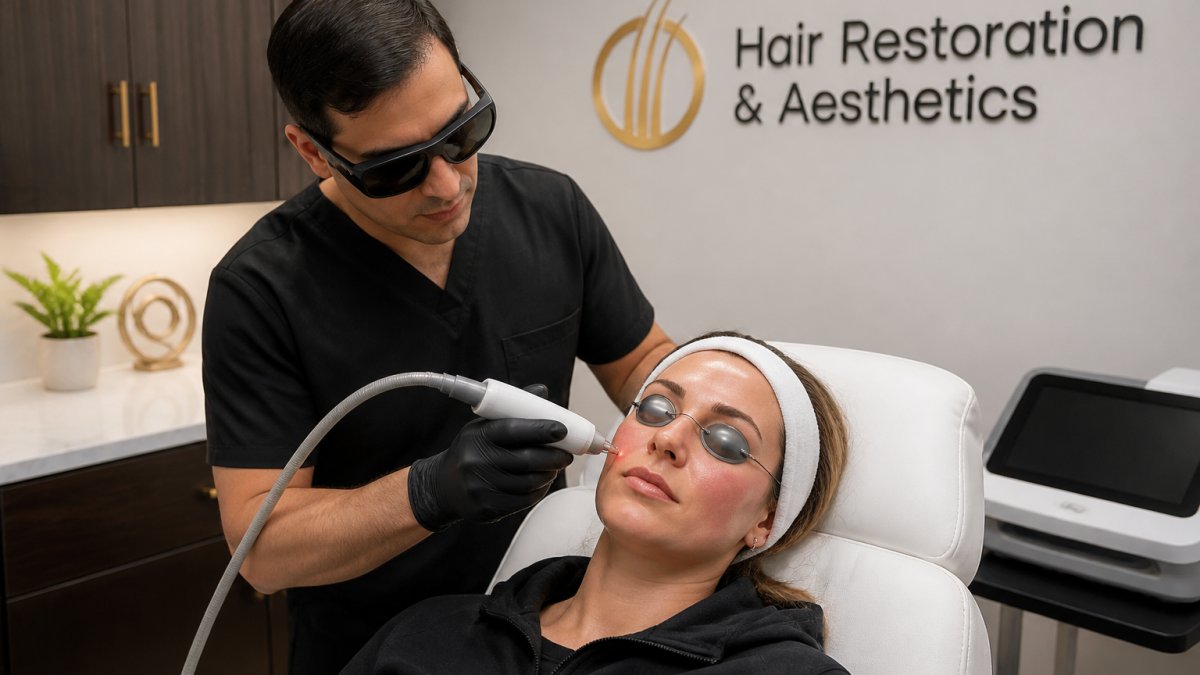
Laser and light-based treatments deliver energy into the skin to reduce inflammation and shrink blood vessels. The heat damages the dilated vessels responsible for facial redness without harming surrounding skin.
Different symptoms respond at different rates:
- Persistent facial redness, Improves gradually over multiple sessions
- Visible blood vessels, Often show noticeable reduction after 3-5 treatments
- Inflammatory bumps and pustules, May improve as inflammation decreases
- Skin texture and roughness, Can improve with certain laser types that stimulate collagen
Laser therapy treats the underlying cause, dilated vessels and inflammation, rather than masking symptoms, which is why results can outlast topical treatments.
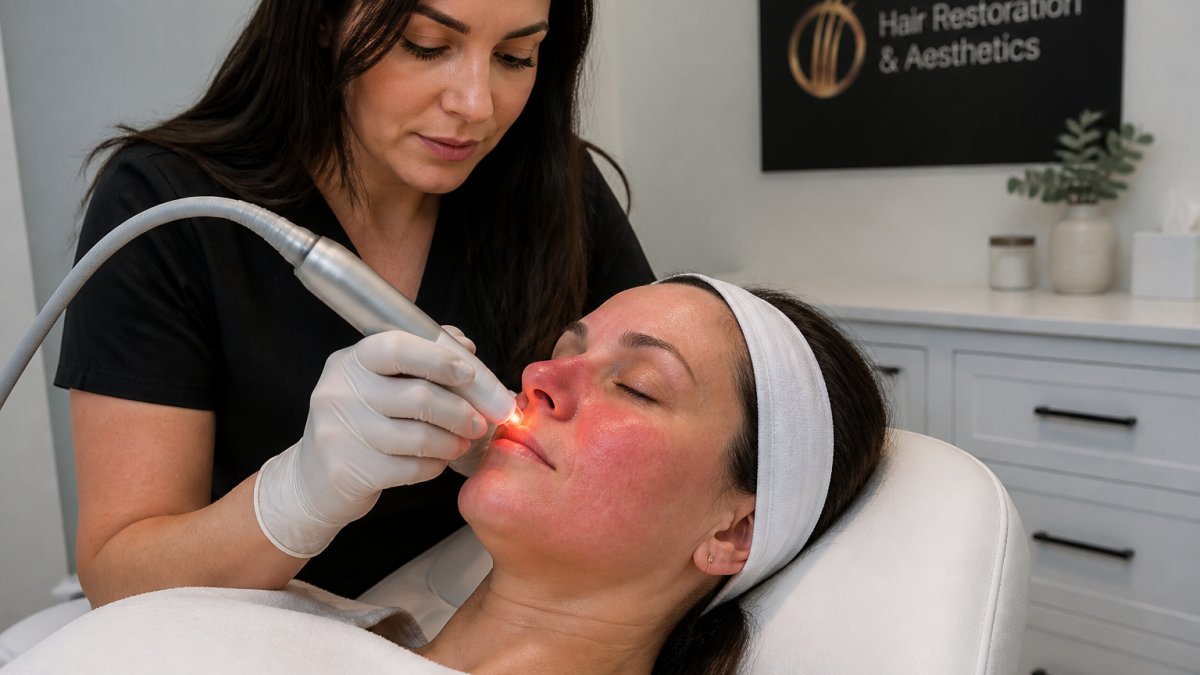
Most patients need a series spaced 3-4 weeks apart. Some see changes after the first session; others notice steady progress over 4-6 sessions.
The type of laser matters enormously. A vascular laser works differently than a general-purpose laser, and choosing the right technology for your rosacea presentation increases your chances of meaningful results.
Best Laser for Rosacea Treatment
There is no single "best" laser for rosacea. The right device depends on which symptoms you want to reduce, your skin tone and pigment risk, and how much downtime you can accept.
How the main device families compare
| Device Family | Primary Target | Best For | Skin Tone Considerations | Typical Downtime |
|---|---|---|---|---|
| Pulsed dye laser (PDL) | Oxyhemoglobin in dilated vessels | Discrete broken capillaries, moderate-to-severe persistent redness | Most studied in fair skin; higher pigment-change risk in deeper tones, so settings and cooling must be adjusted | Mild redness and swelling for hours to 1-2 days; occasional bruising for 5-10 days |
| KTP / long-pulsed 1064 nm vascular lasers | Hemoglobin, with deeper penetration | Diffuse redness, larger or deeper vessels, patients who need to avoid bruising | 1064 nm platforms are often favored for darker skin tones because they bypass surface pigment | Minimal; occasional short-lived swelling |
| Intense pulsed light (IPL) | Broad-spectrum light absorbed by hemoglobin and pigment | Mixed redness plus sun damage or texture, mild-to-moderate diffuse redness | Fair to medium tones respond most predictably; darker tones need conservative filtering | Minimal; brief flushing |
| Non-ablative fractional or 1064 nm "Genesis-style" lasers | Water and hemoglobin, gently heating dermis | Mild diffuse redness, early texture change, sensitive skin that flares easily | Generally well tolerated across tones when energy is conservative | Minimal; possible warmth and pinkness for a few hours |
What each option does well, and where it falls short
Pulsed dye laser. The 585-595 nm wavelength sits close to a hemoglobin absorption peak, targeting vessels precisely. Strength: the most reliable reduction of discrete telangiectasias and stubborn redness. Limitation: higher fluences can cause bruising (purpura), and darker skin tones carry higher post-inflammatory hyperpigmentation risk if settings aren't dialed back.
KTP and long-pulsed 1064 nm vascular lasers. The longer wavelength penetrates deeper and is absorbed less by melanin, so practitioners often use it for deeper skin tones or larger, deeper vessels. Strength: lower pigment risk and less bruising. Limitation: less precise for tiny surface capillaries.
IPL. Broad-spectrum light rather than a single wavelength. Strength: treats redness and sun-related pigment or texture in one pass, suiting patients whose rosacea sits alongside photodamage. Limitation: less selective than a true vascular laser, so isolated capillaries may not clear as completely.
Non-ablative fractional and gentle 1064 nm lasers. Strength: excellent tolerability for skin that flares easily, with collagen remodeling that can soften early textural change. Limitation: modest per-session improvement, so more sessions are usually needed for the same redness reduction a vascular laser delivers.
Matching the device to your rosacea presentation
- Persistent background redness (erythematotelangiectatic rosacea): vascular lasers or IPL, chosen by skin tone.
- Discrete visible vessels: pulsed dye laser or a KTP/1064 nm vascular laser.
- Flushing alone: device treatment has limited effect on the flushing trigger itself; it addresses the visible vessels that flushing leaves behind.
- Inflammatory bumps and pustules (papulopustular rosacea): lasers are adjunctive, topical or oral therapy prescribed by your physician usually does the heavy lifting, and light devices may help residual redness.
- Thickened skin or phymatous change: this needs a different, more aggressive approach and is best assessed in person.
At Hair Restoration Clinic of Granite Bay, Dr. Piyush Kumar evaluates your rosacea subtype, skin tone, and symptom priorities before recommending a device.
IPL for Rosacea: Intense Pulsed Light as an Alternative
IPL for rosacea offers a middle ground between targeted vascular lasers and gentler non-ablative systems. IPL (intense pulsed light) uses a broad spectrum of wavelengths rather than a single laser wavelength.
IPL works well for mixed rosacea symptoms. If you have both redness and texture irregularities, IPL addresses both in one treatment, and it's also effective for visible vessels and inflammatory lesions. Consistent light therapy helps maintain this baseline clarity, though environmental triggers often require additional strategies for managing rosacea flares when humidity levels drop.
Recovery is minimal, most people return to normal activities immediately, with possible slight redness or mild swelling for a few hours.
Results appear gradually. Many patients need 4-6 sessions spaced 3-4 weeks apart, with maintenance treatments once or twice yearly to sustain results.
For very specific broken capillaries, a pulsed dye laser may work better, but for overall rosacea management, IPL is effective and well-tolerated.
Schedule a Free Consultation →
Laser Treatment for Rosacea on the Nose
The nose presents a unique challenge: it's highly visible, and the skin is thinner and more sensitive than surrounding facial skin. Laser treatment for rosacea on the nose requires careful technique and appropriate settings.
The nose often shows the most severe redness, with prominent dilated vessels and, in advanced cases, bulbous or thickened skin. Laser therapy can significantly improve this appearance.
A skilled practitioner balances effectiveness with safety on delicate nasal skin.
Results on the nose can be dramatic.
Laser Facial Side Effects for Rosacea Patients
Laser facial side effects for rosacea patients are generally mild, but understanding them helps you prepare. Rosacea skin is sensitive, so some reactions occur more readily than in non-rosacea patients.
Common temporary effects include:
- Redness and swelling, Usually subsides within hours to 1-2 days
- Mild bruising, More common with pulsed dye laser; resolves in 5-10 days
- Temporary darkening of treated vessels, Appears as small dark spots that fade over 1-2 weeks
- Slight itching or tenderness, Managed with cool compresses and gentle moisturizer
Rare but possible: temporary worsening of rosacea symptoms (flare-up) immediately after treatment, which typically resolves quickly with proper aftercare. Infection is extremely rare when post-treatment instructions are followed.
Pigmentation changes are a concern for darker skin tones. The risk is low with appropriate laser selection and settings, but it exists, which is why choosing an experienced provider matters, since they adjust treatment to minimize it.
Most side effects resolve without intervention. Your provider will give specific aftercare instructions; avoiding sun exposure, using gentle products, and staying hydrated support healing.
Preparation, Recovery, and Realistic Results
Good outcomes from laser facials rosacea treatments depend as much on preparation and aftercare as on the device. Here is a practical timeline.
Before treatment: a two-week checklist
- Two weeks out: avoid sun exposure and tanning beds. Tanned or sunburned skin raises the risk of pigmentation changes and burns.
- One week out: pause any exfoliating acids, retinoids, and strong vitamin C serums unless your provider says otherwise. These increase sensitivity.
- Three to five days out: stop retinoids and any at-home exfoliation entirely. Keep using a gentle cleanser and a broad-spectrum sunscreen with SPF 30 or higher.
- Day of treatment: arrive with clean skin, no makeup, and no alcohol-based toners. Tell your provider about any new medications, especially isotretinoin or blood thinners.
- Ongoing: if you take a photosensitizing medication, your provider may adjust settings or postpone treatment.
What recovery actually looks like
| Timeframe | What to Expect |
|---|---|
| First few hours | Warmth, pinkness, and mild swelling at treated areas |
| 1-2 days | Redness fades for most patients; pulsed dye laser may leave small bruised spots |
| 3-7 days | Any bruising or darkening of treated vessels resolves gradually |
| 1-2 weeks | Skin looks calmer; early vessel clearance becomes visible |
| 4-6 weeks | Full effect of a single session is apparent |
Aftercare basics: cool compresses, a gentle moisturizer, and daily sunscreen. Skip strenuous exercise, hot showers, saunas, and alcohol for 24 hours, heat and vasodilation can trigger a flare. Avoid scratching or picking at treated areas.
How many sessions, and how far apart
Most patients need a series rather than a single treatment. A common schedule is 3-6 sessions spaced 3-4 weeks apart, with visible vessels often responding first and diffuse background redness improving more gradually. Maintenance once or twice a year helps sustain results, since rosacea is chronic and new vessels can form over time.
Realistic results, and realistic limits
Laser and light treatments reduce visible symptoms; they do not cure rosacea. That distinction matters when deciding whether treatment is worth it.
- Mild rosacea: meaningful improvement in redness and vessel appearance is common after a full series.
- Moderate rosacea: noticeable but partial improvement; combination with medical therapy often works best.
- Severe rosacea: lasers play a supporting role, and results depend heavily on controlling the underlying inflammatory disease.
Results are not permanent. Without maintenance and trigger management, redness can gradually return. Flushing triggered by heat, spicy food, alcohol, or stress isn't addressed directly by laser, it treats the visible vessels flushing leaves behind.
Evidence versus marketing
Vascular lasers and IPL have a long track record in peer-reviewed dermatology literature for reducing erythema and telangiectasia in rosacea. Be cautious of claims of a permanent cure or guaranteed percentage improvement.
At Hair Restoration Clinic of Granite Bay, Dr. Piyush Kumar builds a schedule around your rosacea subtype and skin tone and explains what each session can and cannot achieve. If you're ready to explore whether laser facial treatment is right for your rosacea, schedule a free consultation to discuss your symptoms and goals with our team.
Frequently Asked Questions
Can laser treatment be used to treat rosacea on the nose?
Yes. The nose is a common site for rosacea redness and visible blood vessels, and laser therapy can effectively target this area. Because nasal skin is sensitive and the nose has prominent vasculature, treatment requires precision and experience. A qualified physician can assess your specific rosacea subtype and recommend appropriate treatment for safe, effective results on the nose.
How many laser sessions are needed for rosacea?
Most patients need a series of treatments, typically 3 to 6 sessions spaced 4 to 6 weeks apart, to see meaningful reduction in redness and visible blood vessels. Some patients experience improvement after one session, while others require additional maintenance treatments to sustain results. Your physician will create a personalized plan based on the severity of your rosacea and your skin's response to the first treatment.
What should you avoid before and after a laser facial for rosacea?
Before treatment, avoid sun exposure, tanning beds, and products that irritate skin (like retinoids or acids) for 1-2 weeks. Avoid blood thinners if possible. After treatment, use broad-spectrum sunscreen daily, avoid hot water and extreme temperatures, skip strenuous exercise for 24-48 hours, and avoid irritating skincare products until your skin heals. Your provider will give you detailed aftercare instructions tailored to the specific laser used.
Can laser treatment make rosacea worse?
Improperly performed laser treatment or aggressive settings can trigger a rosacea flare. Heat, certain wavelengths, and overly intense treatments may temporarily worsen redness or flushing. This is why treatment must be customized to your rosacea subtype and performed by an experienced physician. A consultation before treatment allows your provider to assess your skin and adjust the approach to minimize flare risk and maximize safety.