
 blog
blog
10 Questions to Ask Your Hair Transplant Surgeon
Table of Contents
- Why the Right Questions Change Your Outcome
- Benefits of Board Certified Hair Surgeons
- What to Expect During a Hair Transplant Consultation
- 10 Questions to Ask Your Hair Transplant Surgeon
- FUE Hair Transplant Recovery Timeline
- Non-Invasive Hair Restoration Options
- Frequently Asked Questions
Last Updated: September 30, 2026
Why the Right Questions Change Your Outcome
Choosing a hair transplant surgeon is one of the most important decisions you will make for your appearance, and the questions you ask during a consultation often reveal more than any advertisement. This guide from Hair Restoration Clinic of Granite Bay breaks down the 10 questions to ask your hair transplant surgeon before you commit.
A good consultation is a two-way conversation: you are evaluating the surgeon, the team, and the plan they propose.
The wrong questions get you a sales pitch; the right ones reveal skill, honesty, and long-term planning.
Benefits of Board Certified Hair Surgeons
Board certification confirms a surgeon has met recognized training and testing standards in a specialty. It does not guarantee a perfect result, but it means the physician has cleared a bar uncertified providers have not. Verifying these credentials remains a fundamental step in choosing a medical provider to ensure that your safety and long-term health are prioritized throughout the decision-making process.
For hair restoration, look for credentials tied to dermatology or plastic surgery, since hair and scalp health falls within those fields.
What Board Certification Actually Verifies
Certification verifies completed residency training, passed exams, and ongoing education. It does not verify how many hair transplants a surgeon has personally performed, a separate question you should always ask.
- Confirms formal specialty training
- Requires passing written and oral exams
- Mandates continuing education to maintain status
- Does not measure transplant volume or artistic skill
What to Expect During a Hair Transplant Consultation
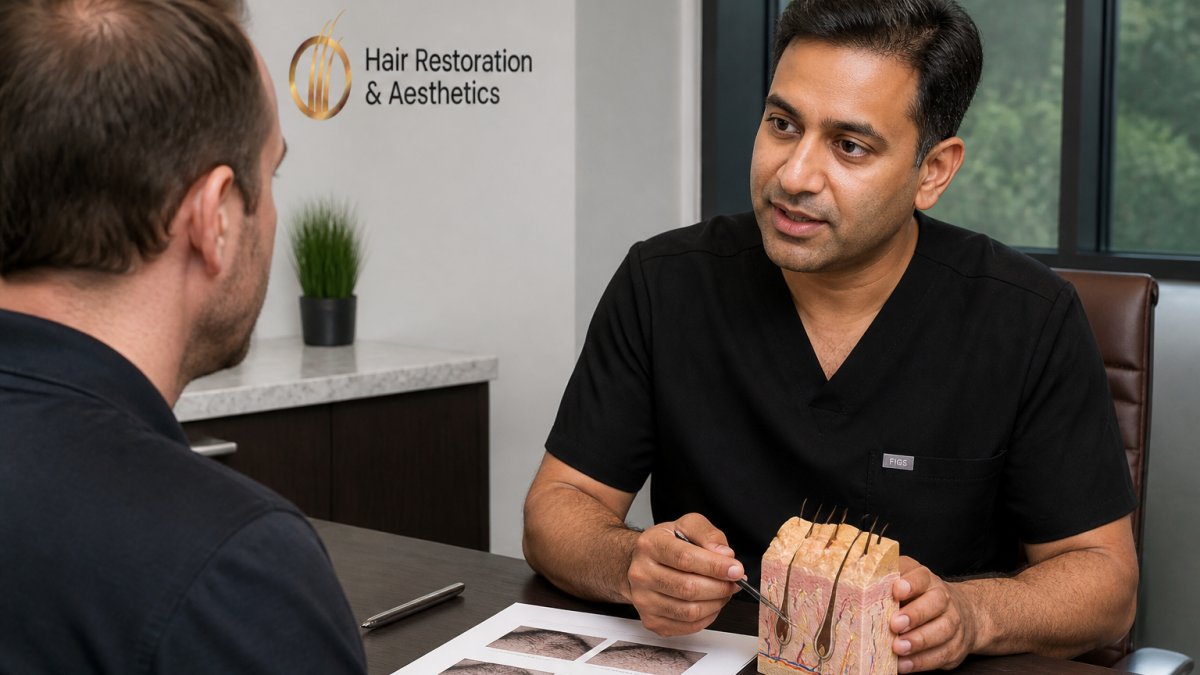
A hair transplant consultation typically includes a scalp exam, a review of your medical history, and a discussion of goals. The surgeon should assess your donor area, hair density, and pattern of thinning before recommending anything.
Expect the conversation to cover candidacy, technique, and realistic outcomes. A thorough consultation rarely takes less than 30 minutes.
The Consultation Trap: Red Flags to Watch For
The biggest trap is a consultation that turns into a same-day sales pitch. Pressure to book immediately, vague answers about who performs the surgery, or promises of guaranteed results are all warning signs.
Other red flags include:
- No discussion of risks or side effects
- No mention of graft count or hairline design
- Staff, not the surgeon, doing the entire evaluation
- Refusal to show before-and-after photos of real patients
- No clear answer on who handles follow-up care
10 Questions to Ask Your Hair Transplant Surgeon
These ten questions cover credentials, technique, donor planning, recovery, and long-term care. Ask them in order, write down the answers, and compare them against the guidance below. A surgeon who welcomes the hard ones is telling you something. So is one who deflects them.
Schedule a Free Consultation →
Questions 1-5: Credentials, Technique, and Candidacy
1. Are you board-certified, and in what specialty? Ask for the specific board name, not the word "certified." Hair restoration sits at the intersection of dermatology and plastic surgery, so a credential from one of those specialties carries real weight. Follow up with: "Do you hold a certificate of added qualification in hair restoration?" A strong answer names the board, the year, and any subspecialty recognition.
Questions 6-10: Grafts, Recovery, Risks, and Long-Term Care
6. How many grafts do you estimate, and what is your typical graft survival rate? Graft count drives fullness, session length, and cost. Ask for a range with reasoning, not a single round number, then ask how the practice measures survival, most reputable surgeons track it, and well-executed procedures see the large majority of transplanted grafts grow. If the answer is "100% every time," that is a red flag, not a selling point.
| Question Focus | What a Good Answer Sounds Like | Red Flag Answer |
|---|---|---|
| Credentials | Names a specific board and year | "I'm certified" with no detail |
| Volume | Gives lifetime and recent case counts | Deflects to years in practice |
| Technique | Explains trade-offs for your case | Pushes one method for everyone |
| Donor assessment | Cites measured density and safe zone | "You have plenty" with no numbers |
| Graft count | A range with reasoning | A single inflated number |
| Risks | Lists real complications and how they're handled | "There are none" |
| Follow-up | Names a contact and a schedule | "Call the front desk" |
| Long-term plan | Discusses maintenance and monitoring | "You won't need anything" |
FUE Hair Transplant Recovery Timeline
FUE recovery moves through predictable stages, though timing varies by patient, graft count, and aftercare. Most people return to desk work within a few days; strenuous activity waits longer.
- Days 1-3: Swelling and tenderness peak, often around the forehead and eyes. Sleep with your head elevated, use cold compresses as directed, and take prescribed medication on schedule rather than waiting for pain to build.
- Days 4-10: Scabbing forms and begins to flake. Do not scratch, pick, or scrub. Wash gently with the technique your surgeon demonstrates, and expect the donor area to feel tight and sore.
- Weeks 2-4: Shock loss may occur as transplanted hairs shed. This is normal and does not mean the grafts failed, the follicle remains, and the hair will regrow.
- Months 3-6: New growth starts to appear, often thin and uneven at first. Density fills in gradually rather than all at once.
- Months 12-18: Final results become visible. This is the point at which you and your surgeon can fairly judge the outcome.
Post-Operative Emergency Protocols
Most recovery is uneventful, but you should know exactly who to call if something goes wrong. Ask your surgeon for a written after-hours contact and clear instructions on warning signs before your procedure.
Seek prompt medical attention for:
- Heavy bleeding that will not stop with gentle pressure
- Signs of infection such as spreading redness, warmth, or fever
- Severe pain not controlled by prescribed medication
- Sudden vision changes, facial swelling, or difficulty breathing
- Grafts that appear to have been dislodged by trauma
Donor Area Preservation: The Question Almost Nobody Asks
Your donor area is a finite resource. Every graft removed is one you cannot use later, and pattern hair loss tends to progress over decades, not months. A surgeon who harvests aggressively to hit a big number today can leave you without enough reserves for a second procedure in ten years, exactly when you may need one most.
- Safe zone mapping. The donor area should be limited to the region of the scalp that is genetically resistant to pattern hair loss, typically the lower back and sides. Harvesting outside that zone risks losing transplanted hair later.
- Density thresholds. Reputable surgeons leave a minimum density in the donor area so it does not look thin or patchy when you wear your hair short. Ask what minimum they target.
- Spread, not concentration. Extracting evenly across the safe zone preserves the appearance of fullness better than concentrating grafts in one spot.
- A staged plan. If your loss is likely to progress, a surgeon may recommend a smaller first session and a second procedure later, rather than maximizing grafts in one sitting.
- A realistic ceiling. Ask how many grafts your donor area can reasonably support over your lifetime. If the answer is a number far above what your density measurements suggest, ask them to show you the math.
Non-Invasive Hair Restoration Options
Not everyone needs surgery, and not everyone is a candidate for it. Non-invasive hair restoration options can slow thinning and support scalp health, often alongside medical treatment.
Frequently Asked Questions
What qualifications should I look for in a hair transplant surgeon?
Look for a physician who is board-certified and can document a high volume of follicular unit extraction procedures. Ask how many grafts they place per session, how long they have performed hair restoration, and who on the surgical team handles the grafts. Request before-and-after photos from patients with hair loss similar to yours, and confirm whether the surgeon or a technician performs the incisions. A free consultation lets you verify credentials in person before committing.
How long does recovery take after a follicular unit extraction procedure?
Most patients return to desk work within two to three days, though strenuous exercise should wait longer. Scabbing typically clears in seven to ten days, and shock loss, a temporary shedding of transplanted hair, can occur in the first few weeks. New growth usually appears around three to four months, with fuller results visible at twelve months. Your surgeon's FUE hair transplant recovery timeline may vary based on graft count and scalp health.
How does a surgeon design a natural-looking hairline?
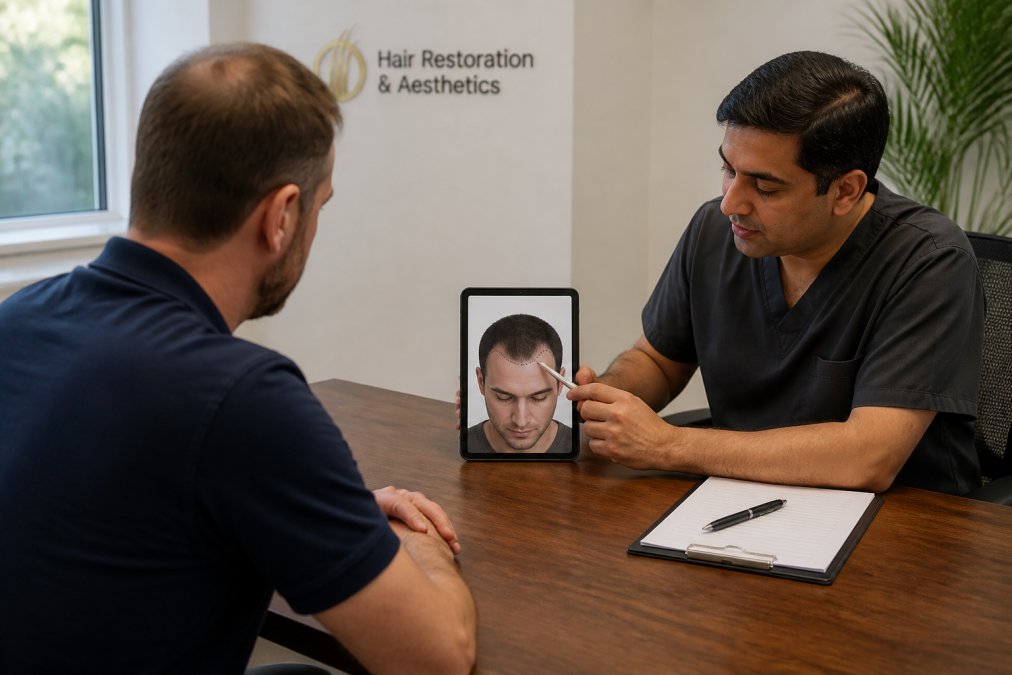
A natural hairline follows the existing pattern of your hair, uses single-hair grafts at the front edge, and angles each follicle to match surrounding growth. The surgeon should assess donor density, scalp laxity, and facial proportions before drawing the design. Ask to see the proposed hairline marked on your scalp during the consultation, and request photos of past patients with similar hair thinning so you can judge the result yourself.
What non-invasive hair restoration options exist besides surgery?
Non-invasive options include acoustic sound wave therapy, such as Alma TED, which uses sound waves to support scalp health and improve the environment for hair follicle growth. These therapies work best for early hair thinning or as support after a transplant. They do not replace surgery for advanced alopecia, but they can slow progression and complement a restoration plan. Ask your physician whether you are a candidate during a consultation.