 how-to
How to Reduce Redness After Laser Treatment
Table of Contents
- Why Redness Occurs After Laser Treatment
- Immediate Post-Treatment Skin Care
- How Long Does Redness Last After Laser Treatment
- What to Put on Skin After Laser Treatment
- Laser Treatment Aftercare for Face
- Warning Signs and When to Seek Medical Advice
- Tailoring Aftercare for Your Skin Type
- Frequently Asked Questions
Last Updated: October 7, 2026
Why Redness Occurs After Laser Treatment
Laser treatments heat the targeted area and trigger your skin's healing response. Redness is the natural reaction to this controlled injury, and knowing how to reduce redness after laser treatment speeds your recovery.
Laser light intentionally damages the outer layers, and your body responds with increased blood flow, which means more redness. This inflammation signals healing.
Ablative lasers remove the outer skin layer and cause more visible redness; non-ablative lasers work beneath the surface with less. Deeper, more aggressive treatments also produce more redness than lighter ones.
Lighter skin shows redness more obviously, while darker skin may show purple or brown tones. Either way, healing is happening beneath the surface.
Immediate Post-Treatment Skin Care
The first hours after treatment are critical. Your skin is raw and sensitive, so treat it gently.
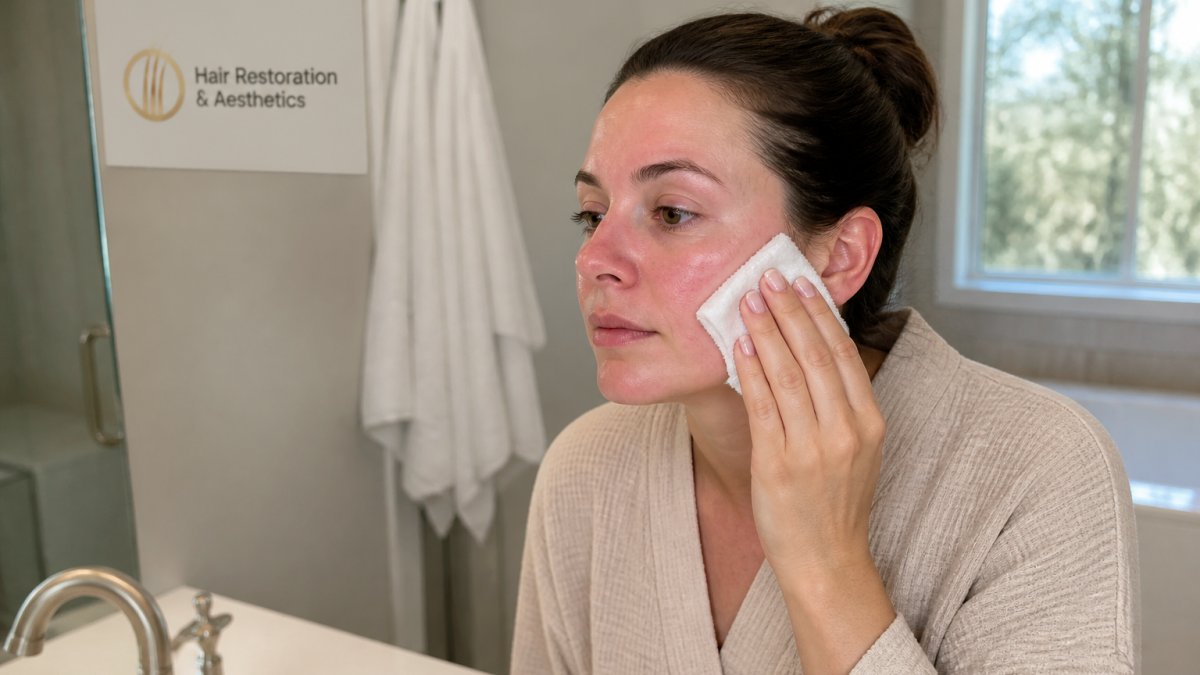
Avoid touching the treated skin. Your hands carry bacteria. Even gentle touching can introduce infection or irritate the area further.
Skip hot water. Use lukewarm water only. Hot water opens blood vessels, increases redness, and strips protective oils your skin needs right now.
Use a gentle cleanser. Choose a mild, fragrance-free option, avoid scrubbing or rubbing, and pat dry with a soft, clean towel.
Avoid these products for at least 24 hours:
- Acids (salicylic acid, glycolic acid, retinoids)
- Vitamin C serums
- Essential oils
- Fragrance
- Alcohol-based products
- Makeup
How Long Does Redness Last After Laser Treatment
Redness duration depends on the laser, treatment depth, and your skin's response. Use this timeline to set expectations and spot anything unusual.
The general arc (any laser):
- Hours 0-6: Peak heat and flushing. Skin looks sunburned, feels warm, may sting.
- Day 1: Redness is at its most intense. Swelling may begin.
- Days 2-3: Redness softens to a pink or flushed tone. Swelling typically peaks around day 2, then improves.
- Days 4-7: Most visible redness fades. Skin may feel tight, dry, or itchy as it rebuilds.
- Weeks 2-4: Residual pinkness becomes minimal. Collagen remodeling continues beneath the surface.
Now the part most guides skip, how laser type changes the timeline:
| Laser category | Typical redness duration | What to expect |
|---|---|---|
| Non-ablative fractional (e.g., 1440 nm, 1550 nm, 1927 nm) | 3-7 days of visible redness | Pink, flushed look; may feel like a mild sunburn |
| Intense pulsed light (IPL) / broadband light | 1-3 days | Often the mildest; some settings cause brief darkening of pigment |
| Pulsed dye laser (PDL) | 5-10 days | Bruising (purpura) is common and can look purple for up to 2 weeks |
| Q-switched / picosecond pigment lasers | 2-5 days | Redness is brief; pigment may darken before it fades |
| Ablative fractional (e.g., CO2, erbium) | 1-3 weeks of visible redness | Skin is raw, oozing, then pink for weeks |
| Fully ablative resurfacing | 3-6 weeks | Longest recovery; redness can persist for months in fair skin |
Treatment intensity matters as much as laser type. A single low-density pass behaves very differently from multiple stacked passes at high density, expect redness at the longer end of the range.
Skin tone shifts what redness looks like, not how long it lasts. Lighter skin shows red and pink more obviously; medium and darker skin may show purple, brown, or gray tones, post-inflammatory pigment change that still fades, but can take longer.
Factors that speed healing:
- Consistent, gentle aftercare
- Strict sun avoidance during the first two weeks
- Good hydration and sleep
- Younger age and healthier skin barrier
Factors that slow healing:
- Smoking or nicotine use (constricts blood vessels)
- Picking or scratching treated skin
- Reintroducing acids, retinoids, or exfoliants too early
- Sun exposure during the first two weeks
- Certain medications (ask your provider)
What to Put on Skin After Laser Treatment
The right products speed healing; the wrong ones extend redness and irritate skin.
Best products to use:
Use a gentle, fragrance-free cleanser such as Cetaphil or CeraVe, these won't strip your skin or cause irritation.
Products to avoid completely:
Skip anything with fragrance, even "natural" fragrance. Fragrance irritates healing skin. Avoid essential oils, perfumed lotions, and scented creams.
Don't use acids or retinoids. Salicylic acid, glycolic acid, lactic acid, and retinol all irritate freshly treated skin.
Avoid vitamin C serums temporarily. Normally great for skin, they can irritate laser-treated skin, wait 5-7 days before resuming.
Skip alcohol-based products. Toners, astringents, and alcohol-containing moisturizers dry out healing skin and increase irritation.
Don't use heavy oils on the treated area, immediately after treatment they can trap heat and bacteria.
Laser Treatment Aftercare for Face
Facial skin is delicate and visible. Your aftercare approach should be extra careful.
Cleansing your face: Use lukewarm water and a gentle cleanser twice daily, and pat dry gently.
Moisturizing: Apply ointment or barrier cream while skin is still slightly damp, and reapply throughout the day as needed. Your face may feel tight or dry as it heals.
Sleep position matters: Sleep on your back if possible, side or stomach sleeping puts pressure on the treated area and increases swelling.
Schedule a Free Consultation →
Manage swelling: Some facial swelling is normal, especially around the eyes and cheeks, and peaks around day 2.
Pain management: Most people feel mild discomfort rather than severe pain.
Sun Protection and Sunscreen
Sun exposure is your biggest enemy during healing. UV rays can darken treated skin, extend redness, and cause permanent discoloration.
Avoid direct sun for at least 1-2 weeks. If you must go outside, wear a wide-brimmed hat and protective clothing. Long sleeves and pants offer better protection than sunscreen alone during the first week.
Apply sunscreen after day 3-5. Wait until your skin has calmed down and your provider confirms it's safe.
Reapply sunscreen every 2 hours outdoors, more frequent reapplication is necessary during healing because your skin is more vulnerable.
Avoid tanning beds completely. They're off-limits for at least 2 weeks after treatment, the UV exposure can cause serious complications and permanent damage.
Makeup and Coverage During Recovery
Covering redness with makeup is tempting. Just be smart about it.
Wait 24-48 hours before applying makeup. Your skin needs time to calm down. Makeup traps bacteria and heat on freshly treated skin.
Use green-based makeup to neutralize redness. Green pigment cancels out red tones.
Choose mineral makeup over liquid. Mineral formulas are less likely to irritate healing skin and easier to remove without rubbing.
Never use heavy foundation or powder. Light, breathable coverage is better. Your skin needs to breathe as it heals.
Remove makeup gently. Use a soft cloth or cotton pad with a gentle cleanser, and pat off makeup rather than wiping or scrubbing.
Skip makeup on days you can. If you can stay home, go makeup-free. Let your skin breathe and heal faster.
Warning Signs and When to Seek Medical Advice
Most post-laser redness is expected and self-limiting. The challenge is knowing when a symptom crosses from normal healing into something that needs a call, or urgent care. Use this three-tier framework.
Tier 1: Call your provider within 24 hours (non-urgent, but don't wait)
- Redness that worsens after day 3 instead of steadily improving
- Swelling that increases after day 3 rather than peaking and resolving
- Itching severe enough to disrupt sleep or that you cannot stop scratching
- New dark spots or patches appearing several days after treatment, especially in medium or darker skin tones
- Redness that plateaus for more than a week without any visible improvement
- Small pinpoint blisters that are not spreading
Tier 2: Contact your provider the same day
- Redness extending beyond the treated area into surrounding skin
- Increasing warmth, tenderness, or firmness in the treated zone
- Yellow or green drainage or pus from any area
- Fever of 100.4°F (38°C) or higher (the CDC)
- Large blisters or open sores larger than a pinpoint
- Severe pain that does not respond to over-the-counter pain relief
Tier 3: Seek urgent medical care
- Red streaks spreading from the treated area toward the trunk
- Fever with chills, confusion, or rapid heart rate
- Rapidly expanding redness or swelling over hours
- Difficulty breathing, facial swelling affecting the airway, or hives, possible allergic reaction
- Any vision change if the treatment was near the eyes
What is almost always normal
- Redness that is worst on day 1 and improves from there
- Mild swelling that peaks around day 2 and resolves by day 4-5
- Dryness, flaking, or a sandpaper texture during days 3-7
- Mild itching as the skin barrier rebuilds
- Temporary darkening of pigmented lesions before they lighten
How to describe symptoms when you call
Have these details ready so your provider can triage quickly:
- Laser type and date of treatment (ask your provider for the exact device name)
- Day of recovery you are on
- What changed and when it changed
- What you have applied to the area since treatment
- Any medications you are taking, including over-the-counter pain relievers
- Photos taken in consistent lighting, if your provider accepts them
Tailoring Aftercare for Your Skin Type
Your skin type affects how you should care for treated skin.
Fair skin: Redness will be most visible.
Medium skin: Redness is moderately visible. Follow standard aftercare carefully; your skin may show temporary darkening that fades as healing completes.
Darker skin: Your redness may appear less obvious, but your skin is still healing.
Sensitive skin: Use the gentlest products available. Fragrance-free, hypoallergenic options are safer. Patch test any new product on a small area first.
Oily skin: You still need moisturizer, but choose lightweight, oil-free, gel- or water-based formulas.
Combination skin: Treat different areas differently, heavier moisturizer on dry areas, lighter formulas on oily zones. Be consistent with sun protection across your entire face.
Laser treatments deliver real results for skin texture, tone, and clarity. If you're considering laser skin rejuvenation or laser facials, schedule a free consultation with Dr.
Frequently Asked Questions
How long does redness last after laser treatment?
Redness duration depends on the laser type and treatment intensity. After fractional laser resurfacing, expect redness for 3-7 days on average, though some patients see improvement within 24-48 hours. CO2 laser treatments typically produce longer-lasting redness, often persisting for 1-2 weeks. Phototherapy and lighter laser treatments may resolve in just a few days. Individual healing varies based on skin tone, sensitivity, and post-treatment care adherence. Your provider can give you a more specific timeline based on your treatment.
What should I put on my skin after laser treatment?
Use a gentle, fragrance-free moisturizer and an occlusive ointment like petroleum jelly to support your skin barrier. Apply cool compresses for the first 24 hours to reduce inflammation. Avoid active ingredients (retinoids, vitamin C, acids) for at least one week. Use a broad-spectrum sunscreen with SPF 30 or higher daily, even indoors. Your provider may recommend specific products or prescribed creams if your skin shows signs of irritation. Always follow your clinic's aftercare instructions, as they are tailored to your specific treatment.
Is redness after laser treatment normal?
Yes, redness is a normal and expected response after laser treatment. It reflects the skin's healing process as the laser stimulates collagen production and removes damaged skin layers. Most redness is mild to moderate and resolves within days to weeks. However, if redness is severe, spreads beyond the treated area, or is accompanied by blistering, pus, or intense pain, contact your provider immediately. These could signal infection or an adverse reaction requiring medical attention.
Can I wear makeup while my skin is red after laser treatment?
Wait 24 hours before applying makeup to allow your skin to begin healing. When you do wear makeup, choose oil-free, non-comedogenic products and apply gently without rubbing. Green-tinted makeup can neutralize redness if you need coverage. Remove makeup thoroughly each night with a gentle cleanser and avoid heavy or waterproof formulas that require harsh removal. If your skin feels irritated or sensitive, skip makeup for a few more days and let your skin breathe.