 how-to
7 Things That Decide How Long Alma TED Treatment Lasts
Last Updated: October 24, 2026
Quick Summary
Alma TED treatment results typically hold for six to twelve months after a completed series, though some patients report benefits lasting longer. There is no single guaranteed number, because individual response varies with age, hair-loss pattern, scalp condition, and genetics. Results are not permanent for most people, and maintenance sessions help preserve gains.
- Each session runs roughly 20 to 30 minutes with no downtime.
- The initial series is usually three sessions spaced a few weeks apart.
- Visible improvement typically appears three to six months after the initial series.
- Peak density tends to arrive between six and twelve months.
- Call your clinician if you see no change at all after six months.
Table of Contents
- What "How Long Does Alma TED Treatment Last" Actually Means
- The Alma TED Treatment Timeline: From First Session to Peak Density
- How Long Do Alma TED Results Last Without Maintenance?
- Alma TED Maintenance Treatments: What to Schedule and What Happens If You Stop
- Alma TED Side Effects and Aftercare: What to Expect After Each Session
- What Shortens or Extends Your Results: Diagnosis, Hair-Loss Cause, and Daily Care
- How to Track Progress and When to Call Your Clinician
- Book a Free Consultation to Map Your Alma TED Plan
- Frequently Asked Questions
What "How Long Does Alma TED Treatment Last" Actually Means
Ask how long does Alma TED treatment last and you will get three different answers, because the question hides three separate clocks. At Hair Restoration Clinic of Granite Bay, we separate them before any patient starts a plan.
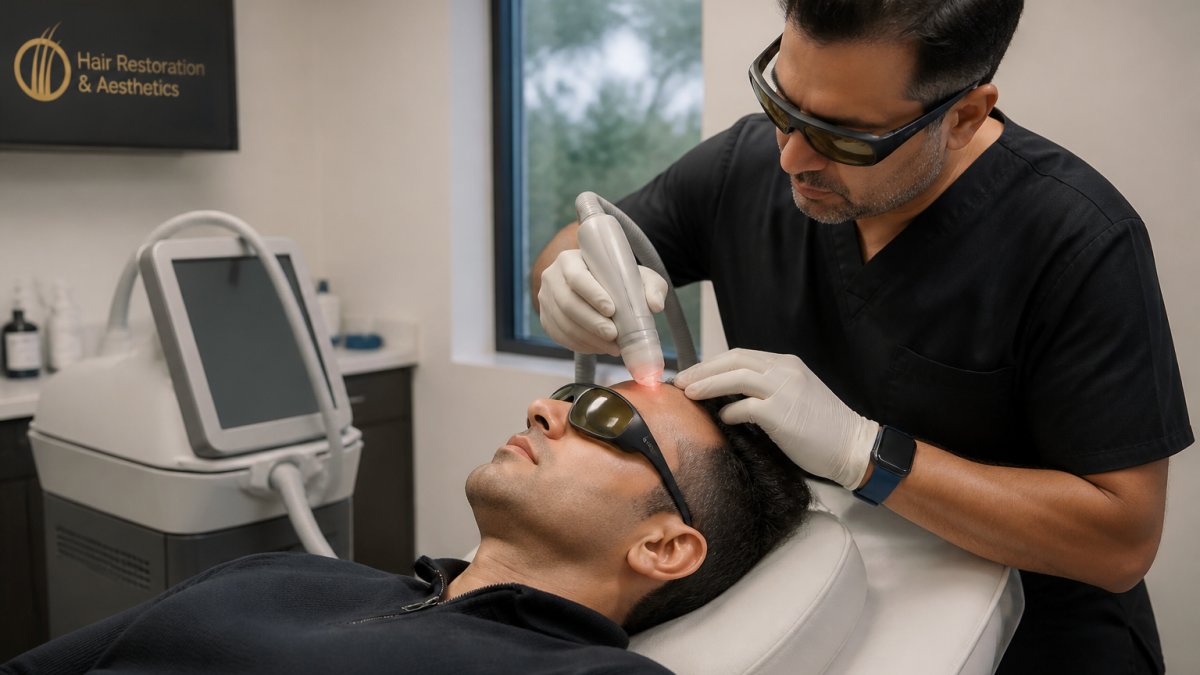
Alma TED treatment is a non-invasive hair restoration therapy that uses acoustic sound waves to support scalp health and hair growth. No incisions, no anesthesia, no downtime.
Here is the distinction that matters:
- Session length: how long you sit in the chair, typically 20 to 30 minutes
- Treatment course: the full initial series, usually three sessions spaced weeks apart
- Results duration: how long the improvement holds after your course ends
Most confusion about Alma TED results comes from mixing these up. A short session does not mean short-lasting results, and a long course does not guarantee permanent ones. You can also explore what the treatment involves before booking.
The Alma TED Treatment Timeline: From First Session to Peak Density
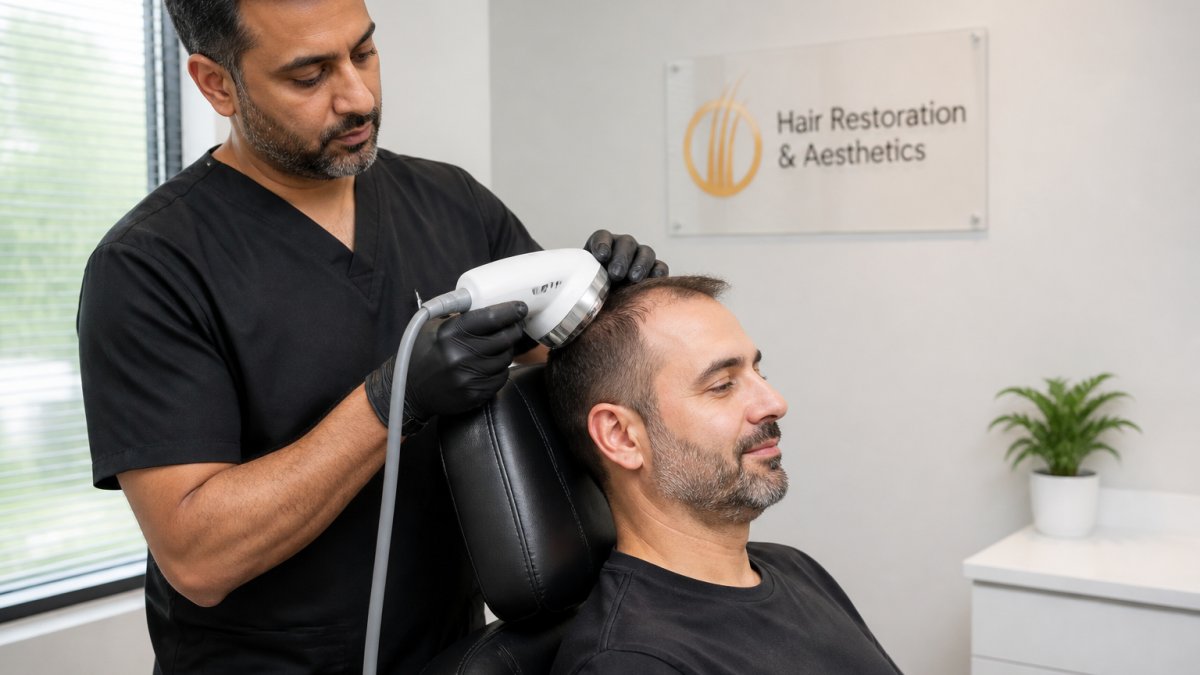
The Alma TED treatment timeline runs in stages, and the first visible changes usually appear around three to six months after your initial series. Peak density tends to arrive between six and twelve months. That is a wide window, and it is wide for a reason: hair grows on its own schedule, and no device can speed up the biology of a follicle moving through its growth cycle.
Here is the general sequence, with what each stage actually looks like:
- Sessions (weeks 0 to about 8): three treatments, spaced a few weeks apart. Each session runs roughly 20 to 30 minutes. You sit in a chair, the handpiece moves across the scalp, and you leave without downtime.
- Early phase (first one to two months): many patients notice reduced shedding and a calmer scalp before they notice new hair. This is the least dramatic stage and the one most likely to make people think nothing is happening. It is also when the scalp environment is being supported, which is the groundwork for later growth.
- Visible improvement (three to six months): new growth becomes noticeable, usually first at the hairline and part line where thinning is easiest to see. Density gains at this stage are typically subtle in photos and more obvious in person.
- Peak results (six to twelve months): the fullest density most patients will see from the initial series. This is the point to judge whether the plan is working and whether maintenance makes sense.
Why the visible change is delayed
Hair follicles cycle through growth, rest, and shedding phases, and a follicle that has been miniaturizing takes time to produce a thicker shaft again. Acoustic sound wave therapy is thought to support circulation and the scalp environment rather than force immediate growth, so the payoff shows up after the follicle has had time to respond. That is why a patient who looks unchanged at week six is not necessarily a non-responder.
What the timeline does not promise
The stages above are a common pattern, not a guarantee. Someone with early, mild thinning often sees visible change sooner than someone with long-standing pattern hair loss. Age, scalp condition, and whether an underlying cause is being addressed all shift the clock. A realistic expectation is a range, and your clinician should tell you which end of the range fits your case.
Hair grows slowly, so patience is part of the process. For a deeper look at the mechanism, read our guide to how Alma TED works.
Here is the general sequence, with what each stage actually looks like.
| Stage | Timing | What to expect |
|---|---|---|
| Sessions | Weeks 0 to about 8 | Three treatments, spaced a few weeks apart |
| Session length | Each session | Roughly 20 to 30 minutes, no downtime |
| Early phase | First one to two months | Reduced shedding and a calmer scalp |
| Visible improvement | Three to six months | New growth noticeable, first at hairline and part line |
| Peak results | Six to twelve months | Fullest density most patients will see |
How Long Do Alma TED Results Last Without Maintenance?
Alma TED results typically hold for six to twelve months after a completed series, though some patients report benefits lasting longer. There is no single guaranteed number.
What the evidence can and cannot tell you about longevity
Be careful with any source that promises a fixed duration. Individual response varies with age, hair-loss pattern, scalp condition, and genetics. Published evidence on acoustic wave therapy for hair supports improvement in density and shedding, but long-term durability data is limited (pubmed.ncbi.nlm.nih.gov).
What we can say honestly:
- Results are not permanent for most people
- Ongoing hair-loss causes continue after treatment ends
- Maintenance sessions help preserve gains
Anyone quoting an exact figure without knowing your case is guessing.
Alma TED Maintenance Treatments: What to Schedule and What Happens If You Stop
Maintenance for Alma TED usually means periodic follow-up sessions, often monthly or every few months, decided with your clinician. The right schedule depends on how your hair responds and what caused your thinning. There is no universal calendar, and any clinic that hands you a fixed schedule before examining your scalp is guessing.
A practical way to think about the schedule
Instead of a fixed number, most practitioners use a decision framework built around what they see at each check-in:
- Months 1 to 3 after the course: assess density and shedding. This is the baseline period. Take photos under the same lighting and angle so later comparisons are honest.
- Months 4 to 6: first maintenance session if density is holding or still improving. If shedding has increased, the clinician may adjust the plan rather than simply repeat it.
- Ongoing: adjust frequency with your clinician. Some patients settle into a session every few months; others need less frequent touch-ups because their underlying hair loss is stable.
The schedule should follow your response, not the other way around. A patient whose thinning is driven by an active, ongoing cause may need a different rhythm than someone whose hair loss has been stable for years.
What happens if you stop maintenance
If you stop maintenance, expect a gradual return toward your baseline over time. Gains do not vanish overnight, but they soften. The key point most guides skip: maintenance is not the only variable. Ongoing causes like genetics or hormonal shifts keep working whether or not you treat them, so stopping maintenance while an underlying cause is still active tends to accelerate the fade.
Schedule a Free Consultation →
A useful way to frame it:
- Stopping after a stable course with a controlled cause: gains may hold longer, and the decline is usually gradual.
- Stopping while an active cause is untreated: the return toward baseline is typically faster, because two things are now working against you.
Maintenance is not the same as a cure
Alma TED supports the scalp environment and hair growth, but it does not remove the reason your hair was thinning in the first place. That is why a maintenance plan should sit alongside a diagnosis and, where appropriate, other care your clinician recommends. If you are weighing whether maintenance is worth it, the honest question is not "how many sessions" but "what is driving my hair loss, and is that being managed?"
For a fuller plan, see our guide to maintaining hair growth results.
Alma TED Side Effects and Aftercare: What to Expect After Each Session
Alma TED side effects are generally mild. Most patients return to normal activity right after a session, which is why the treatment suits people with busy schedules.
Common experiences include:
- Mild warmth or tingling on the scalp
- Slight redness that fades within hours
- No incisions, no stitches, no anesthesia
Aftercare is simple. Keep the scalp clean, avoid harsh products for a day, and follow your clinician's instructions. Watch out: skipping follow-up visits because you feel fine can let early shedding go unnoticed, which makes it harder to judge whether the plan is working.
What Shortens or Extends Your Results: Diagnosis, Hair-Loss Cause, and Daily Care
The biggest factor in how long results last is the diagnosis behind your thinning. Pattern hair loss, stress-related shedding, and nutritional gaps respond differently, and untreated causes shorten any benefit.
Daily care matters too. Gentle cleansing, sun protection on the scalp, and avoiding tight hairstyles all help. So does getting the right diagnosis first. Our overview of non-surgical hair restoration explains how clinicians separate these causes.
What most guides miss: two patients with identical sessions can see very different timelines because their underlying hair-loss drivers differ.
How to Track Progress and When to Call Your Clinician
Track progress with photos, not memory. Take scalp photos monthly under the same lighting and angle. Note shedding counts and any scalp changes.
Call your clinician if you notice:
- Sudden increase in shedding
- New scalp pain, rash, or irritation
- No change at all after six months
Early check-ins catch problems while they are still easy to adjust. If you are unsure whether what you are seeing is normal, schedule a free consultation and have your scalp assessed rather than guessing from photos alone.
Book a Free Consultation to Map Your Alma TED Plan
Every timeline above is a range, not a promise. Your actual course, maintenance schedule, and results depend on your scalp, your diagnosis, and how your hair responds.
At Hair Restoration Clinic of Granite Bay, Dr. Piyush Kumar, MD leads a board-certified practice with over a decade of experience. We use non-invasive Alma TED acoustic sound wave therapy and offer a free consultation to map your plan.
Best for: adults with early thinning who want a non-surgical option. Skip if: you expect permanent results without maintenance.
Frequently Asked Questions
Does Alma TED regrow hair, or does it only slow shedding?
Alma TED uses acoustic sound waves to support the scalp environment around existing hair follicles. In practice, patients typically report reduced shedding and improved hair density rather than regrowth on completely bald areas. It works best on thinning hair where follicles are still active. Your clinician can assess whether your pattern of loss is a good fit during a consultation, and set realistic expectations for your case.
How long does an Alma TED treatment session take?
Most sessions run about 20 to 30 minutes, though a full scalp pass can take closer to 30 minutes to an hour depending on the treatment area and your clinician's protocol. There is no downtime, so you can return to work or normal activities right after. The session length is separate from the treatment course itself, which usually involves a series of visits spaced over several weeks.
How many Alma TED treatments are typically recommended?
A common starting point is a series of about three treatments, spaced according to your clinician's plan, followed by periodic maintenance visits. The right number depends on your diagnosis, how much density you have lost, and how your scalp responds. Some patients add maintenance every few months to hold results. Ask for a written schedule so you know what completion looks like before you begin.
Is Alma TED a permanent hair restoration treatment?
No. Alma TED is non-invasive and supports hair health, but it does not permanently stop hair loss, and ongoing genetic or hormonal thinning can continue without maintenance. Results tend to fade gradually if you stop treatment, especially when the underlying cause is still active. Think of it as a maintained result rather than a one-time fix, and discuss maintenance intervals with your clinician.
Ready to stop guessing about your timeline? Schedule your free consultation with Hair Restoration Clinic of Granite Bay and get a plan built around your hair, your goals, and your schedule.