 ultimate-guide
Is Non-Surgical Hair Restoration Effective? A 2026 Guide
Table of Contents
- What Is Non-Surgical Hair Restoration?
- How Non-Surgical Hair Restoration Works
- Hair Loss Treatment Options That Don't Involve Surgery
- Non-Surgical Hair Restoration Results: What the Evidence Shows
- Who Is a Good Candidate?
- Non-Surgical vs. Surgical Hair Transplant: Key Differences
- Frequently Asked Questions
Last Updated: September 12, 2026
What Is Non-Surgical Hair Restoration?
Non-surgical hair restoration is a category of treatments that aim to slow hair thinning and support regrowth without incisions, sutures, or donor-site surgery. These approaches range from acoustic sound wave therapy and microneedling to physician-prescribed topical and oral medications.
The question "is non surgical hair restoration effective" gets a frustratingly vague answer from most clinic blogs, which tend to promise the world and cite nothing. This guide from Hair Restoration Clinic of Granite Bay takes a different approach: what each option actually does, who tends to respond well, and where the honest limits sit.
Effectiveness depends heavily on the cause of your hair loss. Androgenetic alopecia, the inherited pattern most people are dealing with, responds differently than telogen effluvium, the temporary shedding triggered by stress, illness, or nutritional gaps.
That distinction matters more than any single treatment name.
How Non-Surgical Hair Restoration Works
Most non-surgical options work by improving scalp health and stimulating the follicle during its growth window. The goal is to extend the anagen phase, the active growth stage, and shorten the resting telogen phase so more follicles are producing hair at any given time.
The mechanisms vary by treatment:
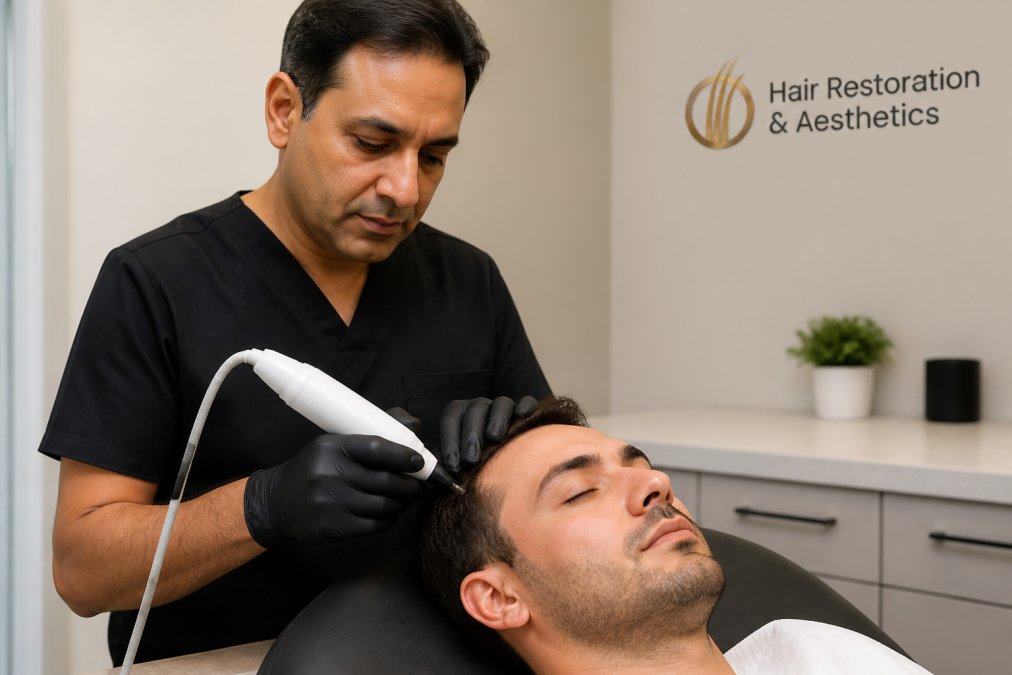
- Acoustic sound wave therapy delivers low-frequency energy that supports microcirculation in the scalp
- Microneedling creates controlled micro-channels that can improve absorption of topical treatments
- Platelet-rich plasma uses a concentrated portion of your own blood to support follicle stimulation
- Topical and oral medications work on hormone pathways and blood flow to the follicle
The Regrowth Cycle: Anagen and Telogen Phases
Hair grows in cycles, and each follicle moves through them independently. Roughly 85 to 90 percent of scalp hairs sit in the anagen phase at any time, with the remainder in telogen (peer-reviewed research).
Treatments that support regrowth generally need to catch follicles early, before scar tissue replaces the follicle entirely. This is why timing matters and why a consultation with a qualified professional is the sensible first step, you can Schedule a Free Consultation to have your scalp assessed and your options mapped out.
Hair Loss Treatment Options That Don't Involve Surgery
Treatment options fall into three broad groups: energy-based therapies, topical and oral medications, and combination protocols that layer two or more approaches.
The evidence base differs sharply between them. Medications have the longest track record. Energy-based therapies have grown quickly, with newer devices earning clearance from the U.S. Food and Drug Administration for specific indications. Combination protocols are where many clinicians see the most consistent results, though head-to-head research remains limited.
Alma TED Hair Restoration: Acoustic Sound Wave Therapy
Alma TED hair restoration is a non-invasive treatment that uses acoustic sound waves to support scalp health and follicle stimulation. It involves no needles, no incisions, and no downtime, which makes it a reasonable option for patients who want to avoid surgery or add a non-invasive layer to their routine.
Hair Restoration Clinic of Granite Bay offers Alma TED as part of its hair restoration menu, alongside the Cole follicular unit extraction system for patients who need surgical density.
What most guides miss is that Alma TED works best as part of a plan, not as a standalone fix. Patients typically need a series of sessions followed by a maintenance protocol to hold results.
Non-Surgical Hair Restoration Results: What the Evidence Shows
Non-surgical hair restoration results vary widely by treatment type, cause of hair loss, and how early you start. The honest answer is that no non-surgical option regrows a full head of hair on a bald scalp, and any provider who says otherwise is overselling.
What these treatments can realistically do:
- Slow or pause further thinning in many patients
- Improve hair density and hair shaft thickness modestly
- Increase hair volume in areas where follicles are still active
- Support scalp rejuvenation and reduce scalp inflammation
What the Timeline Actually Looks Like
One of the biggest gaps in most guides is the timeline. Patients want to know when they will see something, and vague answers like "results vary" are not useful. A realistic pattern most practitioners observe:
- Weeks 2 to 6: Shedding may briefly increase with microneedling or certain topicals as follicles shift cycles. This is expected and not a sign of failure.
- Months 2 to 4: Early changes in scalp condition and hair texture. Density changes are usually not yet visible to the eye.
- Months 4 to 6: The first meaningful cosmetic changes appear in responders, finer hairs filling in at the hairline or part, and less shedding in the shower or brush.
- Months 6 to 12: Peak results for most non-surgical protocols. This is the window where before-and-after photos are most honest.
- Beyond 12 months: Results plateau without maintenance. Stopping treatment typically leads to a gradual return toward baseline over several months.
Regrowth vs. Cosmetic Appearance: Managing Expectations
This is the distinction most articles skip. "Regrowth" in a clinical sense means new terminal hairs emerging from follicles that were miniaturized. "Cosmetic appearance" means the hair you already have looks fuller, thicker, and healthier. Many patients get the second without much of the first, and that is still a meaningful outcome.
A useful way to frame it: non-surgical treatment is closer to holding the line and improving quality than to reversing baldness. Patients who understand that distinction report higher satisfaction, because they are measuring the right thing.
The Maintenance Reality
Most non-surgical treatments are not one-and-done. A common pattern is an initial series of sessions over several months, followed by maintenance sessions at a reduced frequency. If you stop, the underlying cause of hair loss, usually androgenetic alopecia, keeps progressing. That means the realistic question is not "does it work" but "can I sustain it." Ask any provider to map out the first 12 months and the ongoing schedule before you commit.
Skipping a proper diagnosis is the most common mistake. If your thinning is caused by a thyroid issue, iron deficiency, or medication side effect, no amount of follicle stimulation will fix it. Get the cause identified first.
| Option | Mechanism | Downtime | Best For |
|---|---|---|---|
| Acoustic sound wave therapy | Microcirculation, follicle stimulation | None | Non-invasive add-on, early thinning |
| Microneedling | Transepidermal delivery, collagen response | 1-2 days of redness | Boosting topical absorption |
| Platelet-rich plasma | Growth factor delivery | 1-2 days | Patients wanting a biologic option |
| Topical medication | Hormone pathway, blood flow | None | Long-term maintenance |
| Oral medication | Hormone pathway | None | Pattern hair loss, physician-guided |
Combination Therapy: Where Results Improve
Stacking treatments tends to outperform any single approach. A common protocol pairs microneedling with a topical medication, or acoustic sound wave therapy with a topical and oral regimen. The logic is straightforward: one treatment improves delivery or scalp environment, another addresses the hormone pathway driving the loss. Head-to-head studies are limited, but the pattern in clinical practice is consistent enough that most physicians now build layered plans rather than recommending a single modality.
Judge results at 6 to 12 months, not 6 weeks. And judge them against the right benchmark, improved density and quality in areas that still have active follicles, not a full head of new hair.
Who Is a Good Candidate?
The best candidates for non-surgical hair restoration are adults with early to moderate hair thinning and active follicles in the treatment area. If a follicle has fully scarred over, no non-surgical treatment will bring it back.
Candidates generally share these traits:
- Visible thinning but not full baldness in the target area
- A diagnosis of androgenetic alopecia or a reversible cause
- Realistic expectations about density and timeline
- Willingness to follow a maintenance protocol
Who Should Not Get These Treatments
This is the part most clinic blogs leave out, and it matters. Certain conditions and medications make specific non-surgical treatments unsafe or ineffective. A physician-supervised evaluation is the only reliable way to know which options are appropriate for you, but the categories below are the ones that come up most often:
- Pregnancy and breastfeeding: Many topical and oral medications used for hair loss are not appropriate during pregnancy or while nursing. Energy-based treatments may also be deferred.
- Active scalp infections or inflammation: Conditions like seborrheic dermatitis flares, fungal infections, or open lesions on the scalp should be resolved before starting treatment.
- Certain autoimmune conditions: Some autoimmune diseases affecting the skin or follicles, including active alopecia areata, lupus affecting the scalp, and lichen planus, change the treatment calculus entirely and may require dermatology involvement first.
- Blood-thinning medications: Patients on anticoagulants or with bleeding disorders may not be candidates for microneedling or platelet-rich plasma, which involve controlled micro-injury.
- Active cancer treatment: Chemotherapy and radiation alter hair cycling in ways that make standard non-surgical protocols unreliable during treatment.
- Uncontrolled thyroid disease or severe nutritional deficiencies: These need to be addressed first, because follicle stimulation will not overcome an ongoing systemic cause.
- Realistic expectations mismatch: A patient with extensive scarring alopecia or long-standing full baldness in the target area is not a good candidate, regardless of how many sessions they are willing to commit to.
Why the Diagnosis Comes First
Hair loss has more than one driver, and they are not treated the same way. Androgenetic alopecia responds to hormone-pathway treatments. Telogen effluvium often resolves on its own once the trigger is removed. Alopecia areata is an immune-mediated condition that needs a different approach entirely. Treating all three with the same protocol is how patients end up disappointed.
A proper evaluation usually includes a scalp exam, a personal and family history, and in some cases bloodwork to rule out thyroid, iron, vitamin D, or hormone issues. That step is what separates a plan that works from a plan that just costs time.
Before booking any treatment, ask two questions: what is the diagnosis, and what is the plan if I do not respond in six months? A provider who cannot answer both clearly is not the right fit.
Non-surgical hair restoration works best as an early intervention in the right candidate. The sooner you address thinning while follicles are still active, and the more carefully you screen for contraindications, the more room you have to preserve density.
Non-Surgical vs. Surgical Hair Transplant: Key Differences
Non-surgical and surgical approaches aren't competitors so much as different tools for different stages of hair loss. Non-surgical treatments aim to preserve and support existing follicles. A hair transplant relocates healthy follicles to areas where they've stopped growing.
The trade-offs:
- Non-surgical: No downtime, lower commitment per session, but ongoing maintenance and modest regrowth
- Surgical: Higher upfront commitment and recovery, but permanent relocation of follicles for lasting density
Many patients at Hair Restoration Clinic of Granite Bay combine both, using non-surgical therapy to support scalp health before and after a transplant. That combination protocol is where the field is moving, and it's a conversation worth having with a board-certified physician.
American Academy of Dermatology guidance on hair loss notes that treatment plans should be tailored to the type and stage of hair loss, which is exactly why a one-size-fits-all protocol rarely delivers.
Frequently Asked Questions
How effective is non-surgical hair restoration?
Effectiveness depends on the treatment type and the stage of hair loss. Options like Alma TED acoustic sound wave therapy, low level laser light therapy, and platelet rich plasma can improve hair density, hair shaft thickness, and follicle stimulation in appropriate candidates. Results vary by individual, and a consultation is the best way to determine what might work for your specific pattern of thinning.
What are the most common non-surgical hair loss treatments?
Common hair loss treatment options include Alma TED acoustic sound wave therapy, microneedling with transepidermal delivery, and topical or oral medications. Each approach targets different aspects of scalp health, microcirculation, and follicle stimulation. Some patients benefit from combining modalities for a more comprehensive approach.
How does Alma TED hair restoration work for hair thinning?
Alma TED hair restoration uses acoustic waves to stimulate microcirculation in the scalp and support follicle health. The non-invasive, painless procedure is designed to improve scalp health and create an environment that supports the regrowth cycle. It is often used alongside other therapeutic modalities for hair thinning and can complement a broader hair loss prevention plan.
Who is a good candidate for non-surgical hair restoration?
Good candidates are typically adults with early to moderate hair thinning, androgenetic alopecia, or scalp inflammation who want a non-invasive approach. Those with significant bald areas or inactive follicles may see limited benefit. A physician evaluation can assess follicle activity, scalp condition, and medical history to determine candidacy.
How long does it take to see results from non-surgical hair treatments?
Timelines vary by treatment. Some patients notice changes in hair volume and scalp condition after a few months, while others may need six months or longer. The regrowth cycle involves anagen and telogen phases, so patience is important. Booster sessions and a maintenance protocol are often recommended to sustain improvements.
Can non-surgical treatments be combined with hair transplants?
Yes. Many physicians use non-surgical therapies as part of a combination therapy protocol before or after a hair transplant. Non-surgical options can support scalp health and follicle stimulation, while a transplant addresses areas of permanent follicle loss. Your physician can recommend a sequence that fits your goals and medical history.
Hair thinning rarely resolves on its own, and the window for preserving active follicles closes over time. Hair Restoration Clinic of Granite Bay offers board-certified evaluation with Dr. Piyush Kumar, MD, non-invasive Alma TED acoustic sound wave therapy, and the Cole follicular unit extraction system for patients who need surgical density, all backed by over a decade of experience. Schedule a free consultation and get a plan built around your actual diagnosis, not a generic protocol.