 Ultimate guide
Hair Transplant in Sacramento: Candidacy, FUE and Recovery
Last Updated: November 7, 2026
Quick Summary
A good candidate for a hair transplant is usually an adult whose hair loss is stable and who has enough healthy donor hair at the back and sides of the scalp. Candidacy is decided through an in-person consultation, with realistic expectations about density and results. Some patients with active or diffuse thinning need a medical workup first.
- Surgeons look for stable hair loss and thick, stable donor hair at the back and sides.
- FUE removes follicular units one at a time, avoiding a linear incision across the scalp.
- Shock loss of transplanted hairs between weeks 3 and 8 is normal and does not mean failure.
- Early new growth usually appears around months 3 to 6, with final results judged near 12 months.
- Graft count is the largest cost driver, and a free consultation is available in Granite Bay.
Table of Contents
- Who Is a Good Candidate for a Hair Transplant?
- How FUE Hair Transplant Works
- Hair Transplant Recovery Timeline Week by Week
- Natural-Looking Results and Realistic Expectations
- Pricing, Payment Plans and What Affects Cost
- What to Ask at Your Hair Restoration Consultation
- Booking Your Free Consultation in Granite Bay
- Frequently Asked Questions
Who Is a Good Candidate for a Hair Transplant?
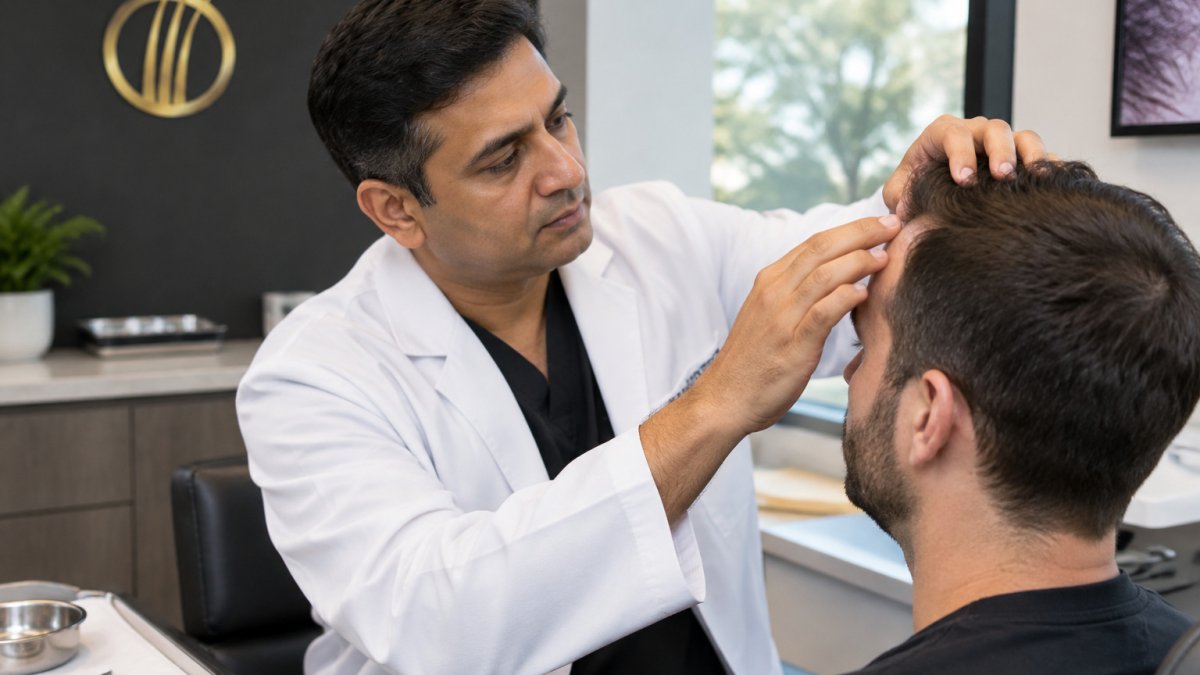
A good candidate for a hair transplant is usually an adult whose hair loss is stable, who has enough healthy donor hair at the back and sides of the scalp, and who has realistic expectations about density and final results. The decision depends on an in-person examination rather than a checklist.
Candidacy is about two things: the pattern of loss and the supply of donor hair. Hair restoration surgeons generally look for hair that is thick and stable at the donor site, since those follicles are moved to the thinning areas and are expected to keep growing where they are placed.
Pattern Hair Loss and Donor Supply
Androgenetic pattern hair loss is the most common reason people seek transplants, and it tends to follow a predictable progression. The key question for a surgeon is how much donor hair is available and whether the loss is still advancing, because a transplant that does not account for future loss can leave an uneven result.
In practice, a consultation will typically assess the hairline, the crown, the density of the donor area and the overall extent of thinning. Those findings shape how many grafts are realistic in a single session and whether a staged plan makes more sense than one large procedure. When donor density or the extent of thinning limits graft coverage, a scalp micropigmentation procedure may be another option to consider alongside a staged transplant plan.
When Evaluation Comes Before Surgery
Not everyone with thinning hair is a surgical candidate today. Diffuse thinning, hair loss linked to illness, medication or nutritional problems, and rapidly changing shedding all call for a medical workup before any surgical decision. A consultation is the place to raise these possibilities rather than assume that surgery is the answer.
Non-surgical options may be discussed for patients who are not ready for surgery or who need to stabilize their hair first. Timing matters, because hair that is still actively falling out can change the result after surgery.
How FUE Hair Transplant Works
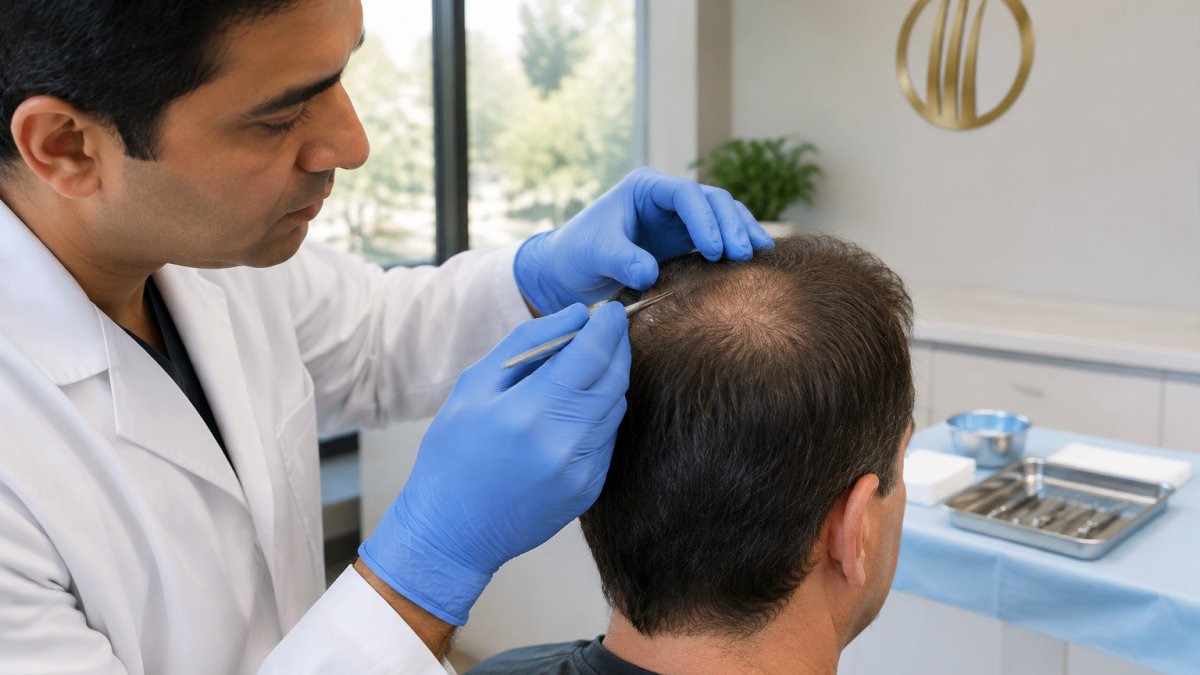
Follicular unit extraction, or FUE, is a method in which individual follicular units are removed from the donor area one at a time and transplanted into small recipient sites in the thinning zone (the NHS). The approach avoids a linear incision across the scalp, which is one reason many patients choose it.
The practice performs FUE using the Cole follicular unit extraction system.
Extraction, Site Creation and Graft Placement
The procedure generally moves through three stages: extraction of the grafts from the donor area, creation of tiny recipient openings in the balding region, and placement of each graft into its opening (the NHS).
The article describes three stages of the FUE procedure, which are summarised below.
| Stage | What happens | Key detail |
|---|---|---|
| Extraction | Follicular units are removed from the donor area one at a time | Avoids a linear incision across the scalp |
| Site creation | Tiny recipient openings are made in the balding region | Openings are small and placed in the thinning zone |
| Graft placement | Each graft is placed into its opening | Uses the Cole follicular unit extraction system |
Hair Transplant Recovery Timeline Week by Week
Recovery after FUE varies between individuals. Your surgeon will advise on the timeline for your procedure.

Days 1-3. Expect tenderness, tightness and mild swelling that often drifts down the forehead. Most patients sleep with the head elevated for the first few nights to limit swelling. The donor area may ooze slightly and form small crusts. Avoid touching, scratching or bumping the grafts. Light walking is fine; strenuous exercise, bending, and heavy sweating are not.
Days 4-7. Swelling usually peaks and then subsides. Crusts begin to loosen. Most surgeons allow the first gentle wash around day 3 to 5 using a cup of lukewarm water and a mild shampoo, patting, never rubbing, the recipient area. Many patients return to desk work within this window, and hats are typically permitted once the surgeon clears them.
Week 2. Crusts are largely gone. Sutures, if any were used at the donor site, are usually removed around days 10-14. Strenuous activity can often resume around two weeks, but check with your surgeon first. This is also when many patients notice the transplanted hairs beginning to shed.
Weeks 3-8. Shock loss, shedding of transplanted hairs, is normal and expected. It does not mean the grafts failed; the follicle remains and will produce new growth. Some patients also see temporary shedding in the donor area. Avoid harsh products, tight hats and direct sun on the recipient zone.
Months 3-6. Early new growth appears, often fine and uneven at first. Density builds gradually. Most patients schedule a follow-up around this point so the surgeon can assess progress.
Months 6-12. The bulk of visible maturation happens here. Hair thickens, texture normalizes, and the hairline softens. Final results are typically judged around 12 months, with some patients continuing to see refinement into month 14 or 15.
Follow your surgeon's aftercare instructions and attend every follow-up.
Natural-Looking Results and Realistic Expectations
A natural result depends on hairline design, graft placement and the density chosen for each zone. A conservative, individualized plan is the approach to discuss rather than maximizing the number of grafts.
Expectations also matter. Transplanted hair does not restore the density of youth in every case, and the outcome depends on donor supply, the extent of loss and how the scalp responds. A consultation is the right place to discuss the realistic range of results for your specific situation.
Pricing, Payment Plans and What Affects Cost
Hair transplant pricing is not a single number, it is the sum of several variables, and understanding them helps you compare quotes fairly. Pricing depends on the plan. Current prices are listed on our pricing page, and a personalized quote can be discussed after your assessment.
What moves the total:
- Graft count. The number of follicular units needed to restore density in the hairline, mid-scalp and crown is the largest driver. A small hairline refinement and a large crown restoration are very different procedures.
Payment. Payment plans are available. Ask during your consultation how they apply to your situation, and confirm the terms before committing.
A free consultation is a good place to discuss your situation.
What to Ask at Your Hair Restoration Consultation
A productive consultation is a two-way conversation. Patients should ask how many procedures the surgeon has performed, what results look like for people with a similar pattern of loss, how the donor area will be preserved for future work, and what the realistic density outcome is.
It also helps to ask about the recovery schedule, the possibility of non-surgical alternatives, and what follow-up care is included. Bring a list of questions and any prior medical information, including medications and past hair treatments.
Booking Your Free Consultation in Granite Bay
If you are considering a hair transplant, the first step is a free consultation at our Granite Bay clinic. The visit gives you a clear picture of whether surgery, a non-surgical option or a period of monitoring makes the most sense for your hair. Patients from nearby areas are welcome.
Hair Restoration & Aesthetics is led by board-certified physician Dr. Piyush Kumar, MD, who has over a decade of experience. Schedule a free consultation today to start a conversation about your options.
Frequently Asked Questions
Who is a good candidate for a hair transplant?
Good candidates usually have stable pattern hair loss and enough healthy donor hair, typically at the back and sides of the scalp. Candidacy depends on the pattern of loss, hair density, scalp health and overall medical history. Hair loss that is still active, or that has an undiagnosed cause, may need evaluation first. A consultation with a qualified physician is the way to find out whether a hair transplant is suitable for your situation.
How long does it take to see results after a FUE hair transplant?
Transplanted hair typically sheds in the weeks after the procedure, which is expected. New growth generally begins over several months, and the final result can take up to a year to fully develop. Timelines vary between individuals, so your provider can explain what to expect based on your case. Results are not guaranteed and depend on individual factors.
What should I ask during a hair restoration consultation?
Ask about the physician's training and experience with hair restoration, how the donor supply will be assessed, and which technique is recommended and why. Request to see before-and-after photos from patients with similar hair loss. Also ask about the recovery schedule, possible risks and limitations, and how the total cost is itemized and whether payment plans are available.
Can a hair transplant restore eyebrows?
Eyebrow restoration is one of the services offered at Hair Restoration Clinic of Granite Bay, using a follicular unit extraction approach for sparse or over-plucked brows. Suitability depends on the donor hair available and the goals for shape and density. A consultation can confirm whether eyebrow restoration fits your needs.