 comparison
Is PRP or Stem Cell Better for Hair Loss?
Last Updated: November 3, 2026
Quick Summary
PRP uses a concentrated portion of your own blood, centrifuged and injected into the scalp to deliver platelet growth factors. A stem cell hair treatment is a broader and less standardized term that can describe anything from a same-day autologous cell concentrate to a product with no living cells. PRP has the larger research base, so a prp hair treatment is easier to compare directly.
- PRP is prepared from a sample of your own blood spun in a centrifuge.
- The term stem cell hair treatment covers several categories that should not be treated as equivalent.
- Ask a clinic what material is used, how it is processed, and whether it contains living cells.
- PRP has been studied more often, while stem cell treatments have less consistent documentation.
- Results are usually assessed over several months using consistent progress photographs.
Table of Contents
- What PRP and Stem Cell Hair Treatments Actually Are
- How PRP and Stem Cell Treatments Work Differently
- Side-by-Side Comparison of PRP and Stem Cell Hair Treatments
- stem cell vs PRP for hair loss: Which Types of Hair Loss May Respond
- PRP Hair Treatment Results Timeline: When Changes May Appear
- PRP Hair Treatment Sessions and What the Evidence Shows
- Booking a Free Consultation to Choose Your Hair Loss Treatment
- Frequently Asked Questions
What PRP and Stem Cell Hair Treatments Actually Are
If you have started researching hair loss treatments, you have probably seen both platelet-rich plasma (PRP) and stem cell therapy promoted as options for thinning hair. They are often discussed as if they were interchangeable, but they are different approaches. Understanding the difference can help patients ask better questions before choosing a treatment. Both are often discussed in the context of androgenetic alopecia, the most common form of pattern hair loss.
PRP is a treatment that uses a concentrated portion of your own blood. Stem cell hair treatments are a broader and less standardized category, and the term is used in ways that deserve a closer look.
How PRP is prepared from your own blood
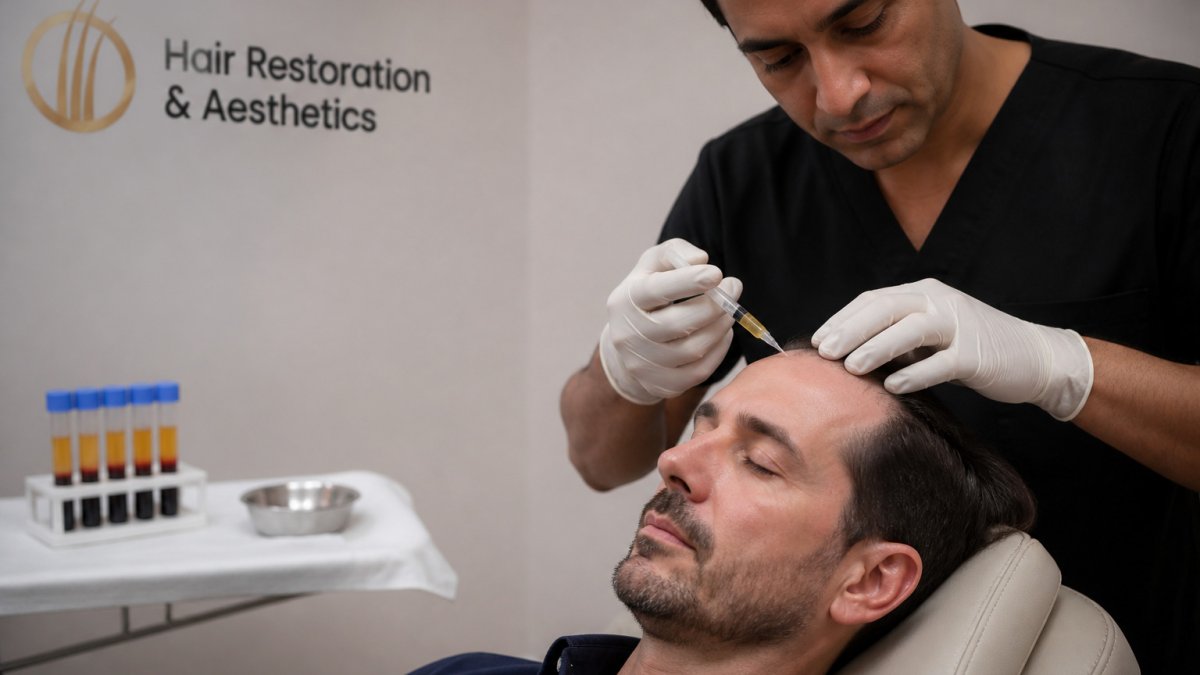
PRP is made from a sample of your own blood. A small amount is drawn, then placed in a centrifuge, which spins the sample to separate its components. The platelet-rich layer is collected and injected into the scalp. Platelets contain growth factors that are believed to support tissue repair and follicle signaling. Because the material comes from your own body, it is considered autologous.
Three preparation details matter more than most marketing suggests:
- Platelet concentration. Systems differ in how much they concentrate platelets above baseline. A higher multiple is not automatically better; very high concentrations have been reported to blunt rather than boost the response in some laboratory work, which is why protocol matters.
- Activation. Some protocols activate platelets with calcium or thrombin to trigger growth-factor release before injection; others rely on activation in the tissue. The two are not equivalent, and clinics rarely advertise which they use.
- Number of sessions and injection depth. Superficial versus deeper scalp injection and the interval between sessions change what the treatment can plausibly do.
When comparing providers, it helps to ask about the concentration, activation method, and number of sessions in a clinic's protocol.
What stem cell hair treatment means in practice
The phrase "stem cell hair treatment" does not describe one standardized procedure. In the United States, the Food and Drug Administration (FDA) regulates human cells, tissues, and cellular and tissue-based products (HCT/Ps) under a tiered framework: products that are minimally manipulated, intended for homologous use, and not combined with other articles may qualify for registration rather than premarket approval, while products that are more than minimally manipulated or marketed for a different purpose generally require an investigational new drug application or a biologics license.
In practice, the term is used for at least four different categories, and they should not be treated as equivalent:
- Autologous cell concentrates derived from a patient's own tissue, processed and reinjected in the same visit. These are the closest in spirit to PRP, same-day, same-patient, but the processing steps and cell counts vary widely.
- Expanded or cultured cells, which involve growing cells outside the body before reintroduction. These generally fall into a stricter regulatory pathway and are not offered in a typical clinic setting.
- Cell-derived products such as conditioned media or exosome-labeled preparations. These are not cells; they are products of cells, and their regulatory status and composition are often the least clear to patients.
- Devices and topicals marketed with "stem cell" language that contain no living cells at all.
Patients should ask exactly what material is being used, where it came from, how it was processed, whether it contains living cells, and what regulatory category the clinic believes it falls under. Clear answers to those questions are worth looking for when comparing providers.
Why the terminology gap matters for your decision
The practical consequence is that "PRP versus stem cell" is not a clean either/or. PRP is a defined procedure with a recognizable preparation chain; "stem cell hair treatment" is an umbrella term that can describe anything from a same-day autologous concentrate to a product with no cells in it. Before comparing outcomes, confirm that the two things being compared are actually comparable, same source, same processing, same regulatory footing. That single step resolves more confusion than any headline claim about which treatment is "better."
How PRP and Stem Cell Treatments Work Differently
PRP is centered on concentrated platelets and the growth factors they release. When platelets degranulate, they release a cocktail that includes platelet-derived growth factor (PDGF), transforming growth factor beta (TGF-β), vascular endothelial growth factor (VEGF), epidermal growth factor (EGF), and insulin-like growth factor 1 (IGF-1).
Stem cell approaches aim to introduce cells, or cell-derived signals, that are thought to help regenerate tissue. The proposed mechanisms differ by product category.
The underlying mechanisms are the subject of ongoing research, and the evidence for each is still developing. PRP has been studied more often than stem cell treatments, which remain less consistently documented.
Where the mechanisms actually diverge
The useful distinction is not "growth factors versus cells", it is what is being delivered and how reproducibly it can be characterized:
Schedule a Free Consultation →
- PRP delivers a measurable platelet count and a defined set of released growth factors. Its variability comes from donor biology and preparation, but the input is at least quantifiable.
- Autologous cell concentrates deliver a mixed cell population whose composition depends heavily on processing. Two clinics can use the same label and deliver different cell counts and viabilities.
- Cell-derived products deliver a formulation whose active components are often incompletely characterized, which makes dose and comparability difficult to establish.
How each may affect hair follicles
The two may also affect hair follicles in different ways. PRP is generally thought to influence existing follicles and their surrounding environment. Stem cell treatments are proposed to support follicle regeneration more broadly, though this claim needs careful evidence review. Neither should be presented as a guaranteed way to regrow hair.
How researchers actually measure whether either works
Claims about mechanism are only as good as the endpoints used to test them. Hair research typically relies on a small set of standardized measures, and knowing them helps you read any study or clinic claim critically:
- Hair density, hairs per square centimeter, usually counted in a defined target area under magnification.
- Hair shaft diameter (caliber), measured because thickening of existing hairs can register as improvement even when follicle number does not change.
- Anagen-to-telogen ratio, the proportion of follicles in active growth versus resting phase, often assessed by trichogram or phototrichogram.
- Shedding counts, the number of hairs collected during a standardized wash or comb test.
- Patient-reported outcomes and photographic assessment, standardized global photography under consistent lighting, angle, and hair length, plus validated satisfaction questionnaires.
Watch out: a clinic that reports "thicker hair" without naming the endpoint, the target area, and the time point is giving you an impression, not a measurement. The same caution applies to published studies, small sample sizes, short follow-up, and inconsistent measurement methods are common in both PRP and cell-based hair research, which is why no single trial should be treated as definitive.
Side-by-Side Comparison of PRP and Stem Cell Hair Treatments
The table below summarizes the general differences. Details vary by clinic and by product.
| Factor | PRP Hair Treatment | Stem Cell Hair Treatment |
|---|---|---|
| Source material | Your own blood | Varies: fat-derived cells, cell-derived products |
| Preparation | Centrifuged blood sample | Varies widely by method |
| Evidence base | More established in published research | Less standardized; evidence still developing |
| Regulatory clarity | Procedure-specific rules apply | Product status can vary considerably |
| Typical pros | Uses own blood; widely studied | Potentially broader regenerative aim |
| Typical cons | Results vary; repeat sessions often discussed | Inconsistent definitions; limited long-term data |
Pros and cons at a glance:
- PRP: Pros include a clearer preparation process and a larger body of research. Cons include variable results and the need for repeat sessions.
- Stem cell treatments: Pros include a broader regenerative goal. Cons include unclear product standards and limited long-term evidence.
stem cell vs PRP for hair loss: Which Types of Hair Loss May Respond
Pattern hair loss is the condition most often discussed with both treatments, but response depends on the individual. Alopecia areata, an autoimmune condition, is a different situation, and treatment choice depends on how it presents. A clinician can assess the pattern, duration, and overall health before recommending anything. Treatment is not appropriate for everyone, and some people have conditions that make either option unsuitable.
PRP Hair Treatment Results Timeline: When Changes May Appear
Results from PRP are typically assessed over several months rather than weeks, since hair grows slowly and the growth cycle has to be reflected in the scalp. Results are not guaranteed, and the outcome differs from person to person. Progress is usually tracked through photographs taken under consistent conditions, which gives a more reliable picture than memory alone.
PRP Hair Treatment Sessions and What the Evidence Shows
PRP is generally delivered as a series of sessions, with maintenance treatments often discussed afterward. The exact schedule depends on the clinic's protocol and your individual response. Studies on PRP for hair loss vary in design, sample size, and how outcomes are measured, so it is difficult to give one definitive number for improvement. Patients should ask how progress will be measured and what results the clinic can realistically expect for a case like theirs. Pricing depends on the number of sessions and the treatment plan; contact our office for current details.
Booking a Free Consultation to Choose Your Hair Loss Treatment
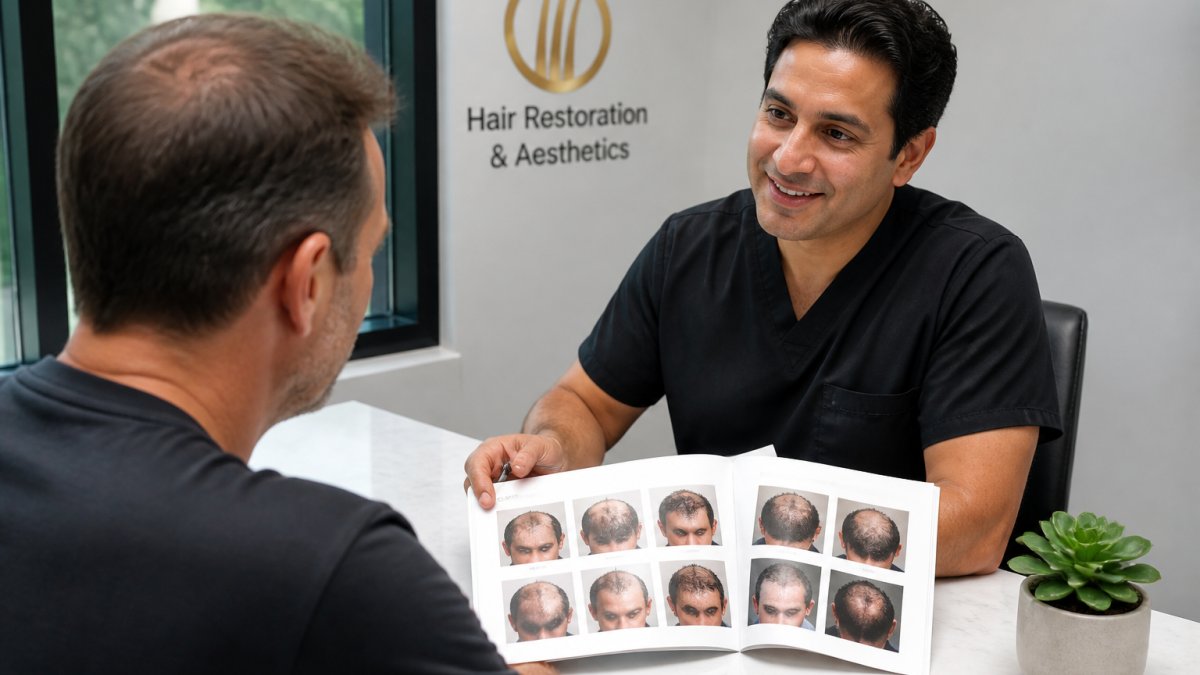
Choosing between PRP and a stem cell approach is easier after a proper examination. A consultation allows a clinician to review your hair loss pattern, medical history, and goals, and to explain which options may be appropriate and which are not. You can schedule your free consultation with Hair Restoration Clinic of Granite Bay to discuss your options with a physician.
If you are not sure whether your hair loss is early-stage or whether another cause should be ruled out first, a consultation is a good place to start. Speak to a qualified professional before making a decision, and bring a list of questions about the material used, the protocol, and how results will be measured.
Frequently Asked Questions
Which is better, stem cell or PRP for hair?
The answer depends on your hair loss type, its stage and your goals, and the evidence for both approaches is still developing. PRP uses a concentration of your own platelets, prepared from a small blood draw, and has been studied more often for androgenetic alopecia. Stem cell treatments vary widely in preparation and regulatory status, so the label alone does not tell you what you are receiving. A consultation can review your history, your scalp and the options that fit your situation.
How long does PRP hair treatment take to show results?
Many people look for changes over several months, because hair follows a growth cycle that is slow to shift. Results are typically assessed across a series of sessions rather than after one visit. Individual response varies, and some people notice little change. Your provider can explain what a realistic timeline looks like for your hair and set expectations before you begin.
How many PRP sessions are typically recommended for hair loss?
Treatment plans commonly involve a series of sessions spaced over several weeks, followed by maintenance sessions. The exact number depends on the protocol your provider uses, the extent of your hair loss and how you respond. Because protocols differ, ask for the specific plan, the expected session frequency and how progress will be measured before committing.
What should I ask a provider before choosing a hair restoration treatment?
Ask about the provider's training and credentials, how the treatment is prepared and what product source is used, what outcomes are realistic for your type of hair loss, and what the total cost of care looks like over a year. Ask how progress is measured and what side effects are possible. A medical consultation is the right place to review your individual suitability.