 listicle
Common Myths About Board Certified Cosmetic Physicians
Table of Contents
- Myth: Board Certification Doesn't Matter for Cosmetic Procedures
- Myth: All Board Certifications Are Equivalent
- How to Verify a Physician's Board Certification
- Myth: Cosmetic Physicians and Plastic Surgeons Are the Same
- Myth: Experience Doesn't Impact Results Quality
- Questions to Ask a Cosmetic Physician Before Treatment
- Myth: Board-Certified Physicians Charge More for No Reason
- Frequently Asked Questions
Last Updated: October 10, 2026
Myth: Board Certification Doesn't Matter for Cosmetic Procedures
When considering cosmetic procedures, many people prioritize cost or convenience over the credentials of board certified cosmetic physicians, a dangerous assumption. Board certification is not a marketing badge; it's evidence that a physician has met rigorous standards in training, knowledge, and patient safety through specialized education beyond medical school, comprehensive exams, and ongoing professional development.
Board certification demonstrates competency in specific procedures, expert anatomical knowledge, and the ability to manage complications, directly affecting whether you achieve natural-looking results or face corrective treatment.
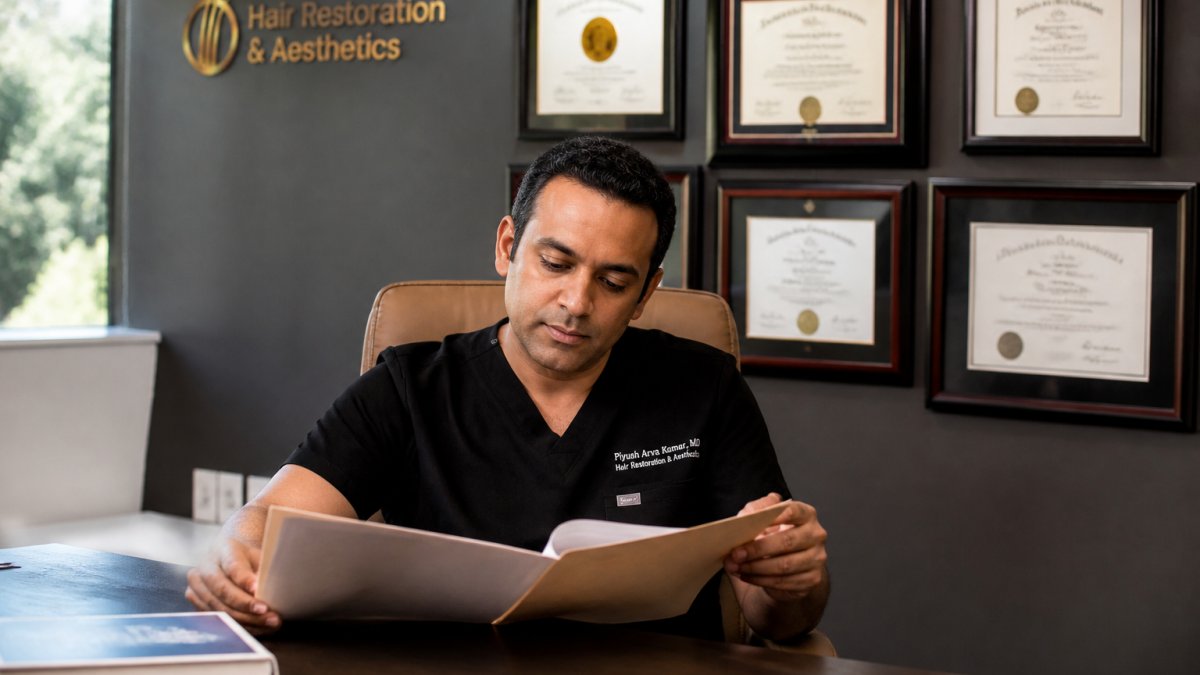
At Hair Restoration Clinic of Granite Bay, Dr. Piyush Kumar's board certification reflects years of specialized training and shapes every decision during your consultation and treatment.
Myth: All Board Certifications Are Equivalent
Not all board certifications carry equal weight. The American Board of Medical Specialties (ABMS) recognizes certifications meeting the highest standards, while other boards operate with looser requirements or minimal oversight.
Credible certifications come from ABMS-recognized boards, which require accredited residency training, rigorous exams, and continuing education to ensure physicians stay current with evolving techniques and safety standards.
When evaluating a cosmetic physician, verify which board issued their certification. Physicians certified by the American Board of Dermatology or American Board of Plastic Surgery have met significantly higher standards than less rigorous certifying bodies, affecting training depth and accountability.
How to Verify a Physician's Board Certification
Thorough credential verification protects you from practitioners who misrepresent qualifications or operate outside their scope of training.
Start with the American Board of Medical Specialties (ABMS) directory. Visit abms.org and search the physician's name and specialty. Legitimate board certification appears as "currently certified" with an expiration date. If a physician claims certification but does not appear in this directory, that is a red flag.
Verify state medical licensure and disciplinary history. Search your state's medical board database to confirm active licensure and check for disciplinary actions, malpractice settlements, or license restrictions, information board certification alone will not reveal.
Confirm facility accreditation. Ask which facility the physician uses and verify accreditation through The Joint Commission (jointcommission.org) or the American Association for Accreditation of Ambulatory Surgery Facilities (AAAASF). A physician who cannot name their facility or whose facility lacks accreditation is a significant concern.
Ask directly and request documentation. During consultation, ask: "Are you board certified? By which board? When does your certification expire?" Request a copy of the certificate. A qualified physician will provide this without hesitation; evasiveness is a warning sign.
Check for fellowship training in your specific procedure. Ask: "Did you complete a fellowship in cosmetic procedures? How many of this specific procedure have you performed?" Verify the fellowship program's name and accreditation status.
Review before-and-after photos. Consistent, natural-looking results across many patients suggest refined technique through extensive practice. Ask to see results from similar cases and be cautious of heavily filtered or unrealistic-looking photos.
Myth: Cosmetic Physicians and Plastic Surgeons Are the Same
The terms "cosmetic physician" and "plastic surgeon" describe fundamentally different training pathways and scopes of practice. Understanding these differences helps you match the right provider to your procedure and avoid the assumption that all cosmetic credentials are equivalent.
Plastic Surgeon Training and Scope
A plastic surgeon completes a surgical residency (5-7 years) followed by a fellowship in plastic and reconstructive surgery (2-3 years), including surgical techniques, wound healing, and both cosmetic and reconstructive procedures.
Plastic surgeons certified by the American Board of Plastic Surgery (ABPS) have passed rigorous exams and maintain certification through continuing education (ABPlasticSurgery.org). Their scope includes surgical procedures and often non-surgical treatments.
Cosmetic Physician Training and Scope
A cosmetic physician is a licensed physician who has pursued additional training in cosmetic procedures.
Cosmetic physicians certified by the American Board of Dermatology (ABD) in cosmetic dermatology have demonstrated expertise in these specific procedures.
Key Differences in Practice
Surgical capability: Plastic surgeons perform surgical procedures under general anesthesia; cosmetic physicians focus on non-surgical treatments. Choose a plastic surgeon for surgery, a cosmetic physician for non-surgical procedures like injectables, lasers, or microneedling.
Anesthesia management: Plastic surgeons manage general anesthesia; cosmetic physicians typically use local anesthesia or topical numbing. This affects risk profile and recovery time.
Procedure volume and specialization: A cosmetic dermatologist performing injectables and lasers daily has higher volume and refined technique than a plastic surgeon performing them occasionally. Conversely, a plastic surgeon specializing in a surgical procedure has greater surgical expertise.
Complication management: A cosmetic physician manages complications from injectables or lasers; a plastic surgeon manages surgical complications. Choose a provider trained for your procedure's specific risks.
Schedule a Free Consultation →
The Right Choice for Your Procedure
For non-surgical treatments, neurotoxins, dermal fillers, laser skin rejuvenation, microneedling, PDO threads, and laser hair removal, board certified cosmetic physicians with specialized training and high procedure volume are ideal.
For surgical procedures, a board certified plastic surgeon with extensive experience in that specific surgery is the appropriate choice.
What matters most is not the title alone, but the physician's board certification in their specialty, their specific training in your procedure, and their demonstrated track record of safe, natural-looking results.
Myth: Experience Doesn't Impact Results Quality
The number of procedures a physician has performed directly affects the quality of your results. Experience teaches what textbooks cannot. A physician who has performed hundreds of procedures understands subtle variations in anatomy, knows how to customize treatment to individual features, and can anticipate and prevent complications.
When evaluating a cosmetic physician's experience, ask how many procedures they've performed in the specific treatment you're considering. A physician who specializes in a particular procedure will have performed it far more frequently than one who offers it as one of many services. This specialization matters because techniques, product knowledge, and artistic judgment improve with volume.
Experience also builds judgment about candidacy. An experienced cosmetic physician can assess your anatomy, skin type, and goals to determine whether a procedure will deliver the results you want. They know when a procedure isn't right for you and can recommend alternatives that better suit your needs.
Before-and-after photos are one of the best indicators of experience and skill. Ask to see results from patients with similar anatomy or concerns to yours. Consistent, natural-looking results across many patients suggest a physician who has refined their technique through extensive practice.
Questions to Ask a Cosmetic Physician Before Treatment
Your consultation is your opportunity to assess whether a physician is qualified and whether you feel confident in their care. Prepare specific questions that address your concerns and help you evaluate their expertise.
Start with credentials: "Are you board certified? By which board?" Request documentation and verify it independently. Ask about their training: "What additional training have you completed in this procedure? How many have you performed?"
Discuss the procedure itself: "What results should I realistically expect? What are the potential complications, and how would you manage them?" A knowledgeable physician will give you honest, specific answers rather than guarantees of perfection.
Ask about their approach to patient safety: "What is your facility's accreditation status? What anesthesia options are available? How do you manage complications?" These questions reveal whether they prioritize safety and have systems in place to handle unexpected issues.
Inquire about their aesthetic philosophy: "How do you approach natural-looking results? Can you show me before-and-after photos that match my goals?" This helps you understand whether their style aligns with what you want to achieve.
Finally, ask about follow-up care: "What is included in aftercare? How do I reach you if I have concerns? When will I see final results?" Good physicians provide clear guidance on recovery and maintain contact with patients throughout the healing process.
Myth: Board-Certified Physicians Charge More for No Reason
Board certification does affect pricing, but not arbitrarily. A board certified cosmetic physician has invested years in specialized training beyond medical school. They've passed rigorous exams, maintain continuing education, and often carry higher malpractice insurance due to their specialty focus. These costs are real and legitimate.
More importantly, board certification correlates with better outcomes. A physician with extensive training and experience produces more consistent, natural-looking results, which means fewer complications, less need for corrective treatment, and higher patient satisfaction. When you pay for a board certified physician, you're paying for expertise that reduces your risk of problems.
Pricing also reflects the quality of the facility and the care standards maintained. Board certified physicians often practice in accredited facilities with proper equipment, safety protocols, and emergency preparedness. These standards cost money to maintain.
That said, board certification alone doesn't determine whether pricing is fair. Compare what's included in the treatment cost: consultation, facility fees, anesthesia, follow-up care, and any touch-up treatments. A comprehensive package from a board certified physician may offer better overall value than a lower price from someone less qualified, even if the upfront cost is higher.
The real question isn't whether board certified physicians charge more, it's whether the results and safety standards justify the investment. For cosmetic procedures, where the outcome affects your appearance and confidence, choosing based solely on price often leads to regret.
Choosing a board certified cosmetic physician is one of the most important decisions you'll make about your appearance and health. Board certification verifies that a physician has met rigorous training standards, maintains current knowledge, and prioritizes patient safety. Piyush Kumar, MD, a board certified physician offering advanced cosmetic treatments including neurotoxins, dermal fillers, laser skin rejuvenation, and physician-supervised medical weight management with non-surgical body contouring. Schedule a Free Consultation to discuss your goals with a qualified, board certified physician who listens to your concerns and delivers natural-looking results.
Frequently Asked Questions
What does board certification actually mean for a cosmetic physician?
Board certification means a physician has completed specialized training in their field, passed rigorous examinations, and meets ongoing education requirements set by their specialty board. For cosmetic physicians, this demonstrates they have the knowledge and skills to perform aesthetic procedures safely and achieve natural-looking results. Board-certified physicians are held to higher standards of accountability and must maintain their credentials through continuing education.
How can I verify a physician's board certification?
Check the American Board of Medical Specialties (ABMS) website or visit the specific specialty board's site directly. Ask your physician which board certified them, then verify that certification independently rather than relying on their word. Request to see their certificate, and ask how long they've maintained their certification. A qualified physician will welcome this verification and provide documentation without hesitation.
What questions should I ask a cosmetic physician during my consultation?
Ask about their board certification, how many procedures of your specific type they've performed, what complications they've encountered and how they handled them, what your realistic expectations should be, and what the recovery timeline looks like. Request before-and-after photos from patients with similar concerns. Ask about their facility's safety standards, emergency protocols, and whether they use FDA-approved technology. A knowledgeable physician will answer thoroughly and honestly.
Is a cosmetic physician different from a plastic surgeon?
Yes. Plastic surgeons complete surgical residency and focus on surgical procedures. Cosmetic physicians typically have other specialties (dermatology, family medicine, or internal medicine) and have pursued additional training in aesthetic procedures. Both can perform cosmetic treatments, but their training backgrounds differ. Board certification in their respective fields indicates they meet professional standards for their specialty.