 listicle
Is Microneedling Worth It for Acne Scars? (2026)
Table of Contents
- The Verdict: Is Microneedling Worth It for Acne Scars?
- How Microneedling Treats Acne Scars (And What It Can't Fix)
- Expected Results: What Improvement Looks Like
- How Many Sessions Are Typically Needed?
- Microneedling Recovery Time: Downtime and What to Expect
- Microneedling vs Laser for Acne Scars: Which Is Better?
- Microneedling Aftercare Tips for the Best Results
- Conclusion: Is It Worth the Investment?
- Frequently Asked Questions
Last Updated: September 4, 2026
The Verdict: Is Microneedling Worth It for Acne Scars?
Acne scars can linger for years, and many people wonder if microneedling is worth it before committing. The short answer is yes for many patients, but only when the scar type matches what the procedure can actually improve. Microneedling, also known as collagen induction therapy, works best on atrophic scars that sit below the skin's surface, specifically rolling and boxcar scars (peer-reviewed research).
At Hair Restoration Clinic of Granite Bay, our team sees patients regularly who have tried topical serums and chemical peels without meaningful change. Microneedling offers a different mechanism. Instead of just resurfacing the top layer, it creates controlled micro-injuries that stimulate fibroblast activity deep in the dermis, triggering new collagen and elastin production that gradually fills in depressed scars.
Below, we break down which scars respond best, what improvement looks like, how many sessions you'll need, and the recovery to plan for. We also compare microneedling against laser treatments so you can decide which path fits your skin and schedule.
How Microneedling Treats Acne Scars (And What It Can't Fix)
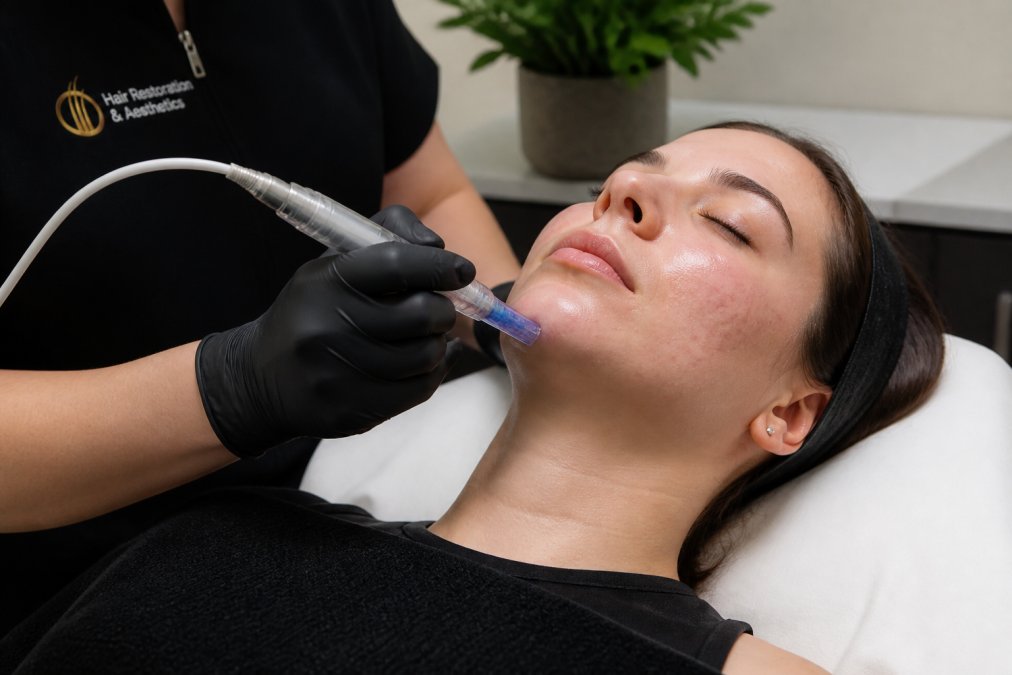
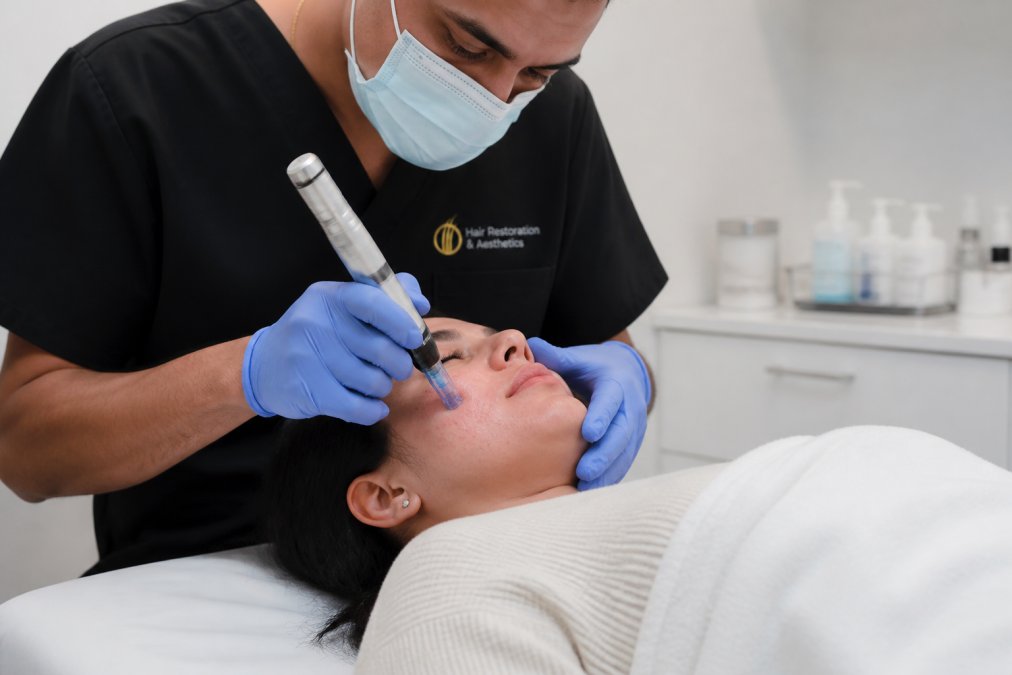
Microneedling is a minimally invasive procedure that uses a device with fine needles to create hundreds of microscopic punctures in the skin. This controlled injury triggers a wound healing response, prompting fibroblasts to produce fresh collagen and elastin. Over time, this dermal remodeling thickens the skin and reduces the visible depth of certain scars.
The key limitation is scar type. Atrophic scars, which are depressed or sunken, respond best. Hypertrophic or keloid scars, which sit raised above the skin, generally do not improve with standard microneedling and carry a keloid risk requiring a different treatment plan.
The Anatomy of Atrophic Scars: Why Depth and Shape Matter
Scar type matters because of the three-dimensional structure of the scar. Atrophic scars are not just surface discolorations; they result from collagen destruction during the inflammatory phase of a severe breakout. The dermis lost structural support, causing the surface to cave in. Microneedling rebuilds that support from the inside out, but the shape and depth of the 'cave' determine how effectively a needle can reach the bottom and stimulate repair.
Rolling Scars: The Most Responsive Candidate
Rolling scars are broad, undulating depressions with sloping edges, typically caused by fibrous bands tethering the epidermis to deeper subcutaneous tissue. Microneedling is particularly effective here for two reasons: the puncture action mechanically disrupts these fibrotic bands, and the robust collagen response in the mid-dermis plumps the area, leveling the 'valleys' closer to the 'peaks.'
Boxcar Scars: Good Candidates, But Patience is Required
Boxcar scars are round or oval depressions with sharply defined, vertical edges, resulting from tissue loss in the upper to mid-dermis rather than tethering. Microneedling stimulates collagen production directly within the scar bed, gradually filling the 'crater' from the bottom up. The sharp edges soften, but the process is slower than with rolling scars; patients should expect to need multiple sessions to see significant textural change, with improvement often more about smoothness than complete elimination.
Icepick Scars: The 'V' Shape That Defeats the Needle
Icepick scars are narrow, deep, V-shaped pits extending far into the reticular dermis. This is the critical limitation for microneedling: needles, even at their longest settings, cannot penetrate the base of these narrow channels without collateral damage to surrounding healthy skin. The needle glides over the top, stimulating collagen around the scar but not at the pit's base, which can make the scar look more prominent as surrounding skin thickens. For icepick scars, microneedling is rarely a standalone solution; a more effective protocol starts with punch excision or TCA cross to collapse the pit's wall, followed by microneedling to smooth the shallower depression.
The Verdict on Scar Types: A Quick Reference
| Scar Type | Shape | Microneedling Response | Why |
|---|---|---|---|
| Rolling | Broad, wave-like, sloping edges | High | Needles disrupt tethering bands and stimulate deep collagen to lift the depression. |
| Boxcar | Round/oval, sharp edges, shallow-mid depth | Moderate | Collagen fills the base, softening edges, but requires multiple sessions for full effect. |
| Icepick | Narrow, deep, V-shaped | Low (as monotherapy) | Needles cannot reach the base of the narrow channel; requires combination therapy first. |
Understanding this distinction is the first step in determining if microneedling is your primary tool or one part of a more complex strategy. A provider who recommends a single treatment for all scar types is not tailoring the plan to your skin's needs.
Expected Results: What Improvement Looks Like
Realistic expectations matter more than any single number. Most patients see gradual improvement rather than complete scar removal, as microneedling thickens the dermis and softens the edges of depressed scars over time.
Clinical observations generally show moderate improvement in scar depth and texture after a full course. The skin becomes smoother, though scars rarely disappear entirely. Improvement is cumulative: each session builds on the previous one, and dermal thickening continues for several months after your final appointment as new collagen matures.
How Many Sessions Are Typically Needed?
A single session will not deliver dramatic scar revision. Most patients need three to six sessions spaced four to six weeks apart, since collagen production takes time and each session builds on the remodeling triggered by the previous one (the American Academy of Dermatology).
The exact number depends on scar depth and your skin's response. Deeper rolling or boxcar scars typically require more sessions; lighter texture concerns may respond within three. After the initial series, maintenance sessions every six to twelve months help preserve results, since natural collagen production slows with age.
Microneedling Recovery Time: Downtime and What to Expect
Recovery time is one of the main reasons patients choose microneedling over more aggressive procedures. Expect noticeable redness immediately after treatment, similar to a moderate sunburn, typically resolving within 24 to 48 hours, though some patients experience mild redness for up to three days (the FDA).
The epidermal barrier is compromised for the first day or two, so avoid makeup, sunscreen, and active skincare products during that window. Most people return to work the next day, covering redness with mineral makeup if needed. By day three to five, the skin flakes lightly as it regenerates. Full healing takes about one week, at which point you can resume your normal routine.
Microneedling vs Laser for Acne Scars: Which Is Better?
The choice between microneedling and laser treatments comes down to scar type, skin tone, and downtime tolerance. Microneedling is generally safer for darker skin tones because it does not rely on heat, reducing the risk of post-inflammatory hyperpigmentation compared with many ablative lasers.
Schedule a Free Consultation →
Laser resurfacing, particularly fractional CO2 and fractional radiofrequency devices, can produce more dramatic results for deep scars in fewer sessions. However, the tradeoff is longer downtime, more discomfort, and a higher risk of pigment changes. Microneedling offers a gentler, more gradual approach with minimal downtime, making it a better fit for patients who cannot take extended time away from work or social activities.
| Treatment | Best For | Typical Sessions | Downtime | Pigment Risk |
|---|---|---|---|---|
| Microneedling | Rolling and boxcar scars, all skin tones | 3-6 | 1-3 days | Lower |
| Fractional laser | Deep scars, textural overhaul | 1-3 | 5-7 days | Higher |
| Combination therapy | Icepick scars, stubborn depressions | 4-8 | Varies by protocol | Varies |
The Real Answer: It's Often 'Both', The Power of Combination Therapy
The most common question is not which single modality is superior, but how to sequence them for the best outcome. In clinical practice, the most effective protocols for moderate-to-severe acne scarring are rarely monotherapy; they are strategic combinations targeting different aspects of the scar's pathology. This is where the real 'worth it' calculation happens.
Microneedling + Platelet-Rich Plasma (PRP)
This is perhaps the most popular and well-researched combination. PRP is derived from your own blood, spun in a centrifuge to concentrate platelets and growth factors. Applied topically during microneedling, the growth factors are delivered directly into the dermis at the moment of collagen stimulation, acting as a biological accelerant. Many practitioners report faster recovery, less redness, and more pronounced collagen production than with microneedling alone. It is not a magic bullet, but for patients with deeper rolling scars who want to maximize each session, it is a powerful adjunct.
Microneedling + Subcision for Rolling Scars
Rolling scars are often held down by fibrous bands. Microneedling alone can soften these, but subcision uses a specialized needle to physically break the bands, releasing the tether and allowing the skin to float back up. A common protocol performs subcision first, followed by microneedling in the same session to stimulate collagen in the newly released space. This combination directly addresses both the tether and the volume loss, making it significantly more effective than either procedure alone for severe rolling scars.
Microneedling + Chemical Peels for Boxcar Scars
For boxcar scars, the issue is both volume loss and textural irregularity at the edges. A superficial-to-medium depth chemical peel (like TCA or Jessner's solution) can smooth the sharp edges and exfoliate the top epidermal layers. When performed on a rotating schedule with microneedling (e.g., peel one month, microneedling the next), the peel addresses surface texture while microneedling rebuilds underlying volume, creating a smoother overall canvas.
The Sequential Approach: A Roadmap for Stubborn Scars
For patients with a mix of scar types, a sequential, staged approach is often most effective. A typical roadmap might look like this:
- Stage 1: Release. Subcision for any rolling scars to break up tethering bands.
- Stage 2: Resurface. A series of microneedling sessions (with or without PRP) to stimulate collagen and thicken the dermis.
- Stage 3: Refine. Targeted treatments like TCA Cross for any remaining icepick scars, or a light chemical peel to smooth the overall texture.
This is not a one-size-fits-all protocol, but it illustrates how a provider should think about your skin. The question is not 'microneedling vs. laser,' but rather 'what is the optimal sequence of tools to rebuild my skin's architecture?' A consultation that doesn't explore this multi-modal strategy may be too simplistic for your scar type.
Microneedling Aftercare Tips for the Best Results
Your aftercare routine directly influences how much improvement you see. The first 24 hours are critical for protecting the compromised skin barrier: use only a gentle cleanser and a bland moisturizer, and avoid touching your face unnecessarily.
For the first week, follow these guidelines to protect your skin and maximize collagen production:
- Cleanse twice daily with a gentle, fragrance-free cleanser
- Apply a barrier-repair moisturizer containing ceramides or hyaluronic acid
- Avoid direct sun exposure and apply broad-spectrum sunscreen once cleared
- Skip retinol, vitamin C, and chemical exfoliants for at least five to seven days
- Avoid vigorous exercise and heavy sweating for 48 hours
- Do not pick at flaking or peeling skin
Long-term maintenance matters too. Once your series is complete, a consistent routine with sunscreen and gentle exfoliants helps preserve the collagen you have built. Many patients find that periodic maintenance sessions keep skin texture from regressing as natural aging slows collagen turnover.
Conclusion: Is It Worth the Investment?
Microneedling is worth it for acne scars when you have the right scar type, commit to a full treatment series, and follow proper aftercare. It will not erase deep icepick scars or eliminate scarring entirely, but for rolling and boxcar scars, it offers a safe, minimally invasive path to smoother skin with minimal downtime. It is most effective when paired with realistic expectations and a provider who tailors treatment to your specific scar pattern.
If you are considering microneedling for acne scars, a consultation with a board-certified physician can help you determine whether you are a good candidate and what results you can reasonably expect. At Hair Restoration Clinic of Granite Bay, our team offers microneedling as part of a broader scar treatment menu, alongside laser skin rejuvenation and other non-surgical options. Schedule a free consultation to discuss your skin concerns and build a treatment plan designed for your scar type and goals.
Frequently Asked Questions
How many microneedling sessions are typically needed for acne scars?
Most people need three to six sessions for noticeable improvement in acne scars. The exact number depends on the depth and type of your scars. Rolling and boxcar scars usually respond faster than deep icepick scars. Your provider will assess your skin at your consultation and recommend a treatment plan. Sessions are typically spaced four to six weeks apart to let your skin rebuild collagen between visits.
Is microneedling effective for deep, pitted acne scars?
Microneedling works best on rolling and shallow boxcar scars. Deep icepick scars often require a different approach, such as punch excision or subcision, sometimes combined with microneedling. A provider who treats acne scars regularly can tell you which combination therapy will help your specific scar types. Expect realistic results: microneedling improves texture and depth, but it rarely erases deep scars completely.
Can microneedling make acne scars look worse initially?
Yes, temporary worsening can happen. Your skin goes through a wound healing response after treatment, which causes swelling, redness, and sometimes crusting. This can make scars look more pronounced for the first few days. This is normal and temporary. Once the inflammation subsides and collagen remodeling begins, your skin texture should start to improve. Follow your provider's aftercare instructions to support proper healing.
What is the microneedling recovery time for acne scar treatment?
Plan for about two to four days of visible redness and mild swelling, similar to a sunburn. By day three, most people feel comfortable going out with makeup. The skin barrier repair process continues for about a week, so you'll need to avoid harsh products and direct sun exposure. Your provider will give you specific aftercare instructions. You can typically resume your normal skincare routine within a week.
This article was written using GrandRanker
Frequently Asked Questions
Q: How many microneedling sessions are typically needed for acne scars?
A: Most people need three to six sessions for noticeable improvement in acne scars. The exact number depends on the depth and type of your scars. Rolling and boxcar scars usually respond faster than deep icepick scars. Your provider will assess your skin at your consultation and recommend a treatment plan. Sessions are typically spaced four to six weeks apart to let your skin rebuild collagen between visits.
Q: Is microneedling effective for deep, pitted acne scars?
A: Microneedling works best on rolling and shallow boxcar scars. Deep icepick scars often require a different approach, such as punch excision or subcision, sometimes combined with microneedling. A provider who treats acne scars regularly can tell you which combination therapy will help your specific scar types. Expect realistic results: microneedling improves texture and depth, but it rarely erases deep scars completely.
Q: Can microneedling make acne scars look worse initially?
A: Yes, temporary worsening can happen. Your skin goes through a wound healing response after treatment, which causes swelling, redness, and sometimes crusting. This can make scars look more pronounced for the first few days. This is normal and temporary. Once the inflammation subsides and collagen remodeling begins, your skin texture should start to improve. Follow your provider's aftercare instructions to support proper healing.
Q: What is the microneedling recovery time for acne scar treatment?
A: Plan for about two to four days of visible redness and mild swelling, similar to a sunburn. By day three, most people feel comfortable going out with makeup. The skin barrier repair process continues for about a week, so you'll need to avoid harsh products and direct sun exposure. Your provider will give you specific aftercare instructions. You can typically resume your normal skincare routine within a week.