
 ultimate-guide
Getting Hair Restoration in Northern California: 2026 Guide
Table of Contents
- Why Northern California Patients Are Choosing Hair Restoration
- FUE vs. FUT: Which Hair Restoration Procedure Fits You
- The FUE Hair Transplant Recovery Timeline, Week by Week
- Benefits of Alma TED Hair Restoration for Thinning Hair
- Your Hair Restoration Consultation Checklist
- What Hair Restoration Costs and How to Plan for It
- Post-Operative Care and Long-Term Maintenance
- Frequently Asked Questions
Last Updated: September 23, 2026
Why Northern California Patients Are Choosing Hair Restoration
Getting hair restoration in Northern California has shifted from a quiet decision to a mainstream one, for practical reasons: better techniques, shorter downtime, and results that hold up under daily scrutiny. At Hair Restoration Clinic of Granite Bay, we see adults from Roseville, Sacramento, and the surrounding foothills who want their hairline back without announcing they had work done.
FUE vs. FUT: Which Hair Restoration Procedure Fits You
Follicular unit extraction (FUE) removes individual follicular units one at a time using micro-incisions, leaving no linear scar. Follicular unit transplantation (FUT) removes a strip of donor scalp and dissects it under a microscope, yielding a higher graft count per session but leaving a linear scar.
| Factor | FUE | FUT |
|---|---|---|
| Scarring | Tiny dot scars | Linear scar |
| Graft count per session | Moderate to high | Higher |
| Downtime | Shorter | Longer |
| Best for | Short hair, active lifestyles | Advanced loss, max grafts |
| Recovery comfort | Generally easier | Tightness at donor site |
The FUE Hair Transplant Recovery Timeline, Week by Week
The FUE hair transplant recovery timeline runs roughly 12 months from procedure to final result, with the first two weeks the most noticeable. Knowing the schedule prevents panic when transplanted hair sheds around week three.
Days 1-3: What to Expect Right After Your Procedure
Mild swelling, tenderness, and tiny scabs in the donor and recipient areas are normal. Local anesthesia wears off within hours. Most patients rest at home, sleep propped up to reduce swelling, and avoid strenuous activity and direct sun.
Weeks 2-4: Returning to Work and Normal Activity
Most patients return to desk work within a few days. Scabs fall away naturally by day 10 to 14, and by week three transplanted hairs shed, expected, not a sign of failure. Light exercise resumes around week two with clearance.
Months 3-12: When You'll See Full Results
New growth begins around month three to four, density builds through month eight, and final results settle by month 12. Hair growth cycle timing makes patience part of the process.
Benefits of Alma TED Hair Restoration for Thinning Hair
Alma TED is a non-invasive acoustic sound wave therapy that supports hair health without incisions, needles, or downtime. It suits early-stage thinning, androgenetic alopecia, and patients not ready for surgery or wanting to strengthen existing follicles before or after a transplant.
Your Hair Restoration Consultation Checklist
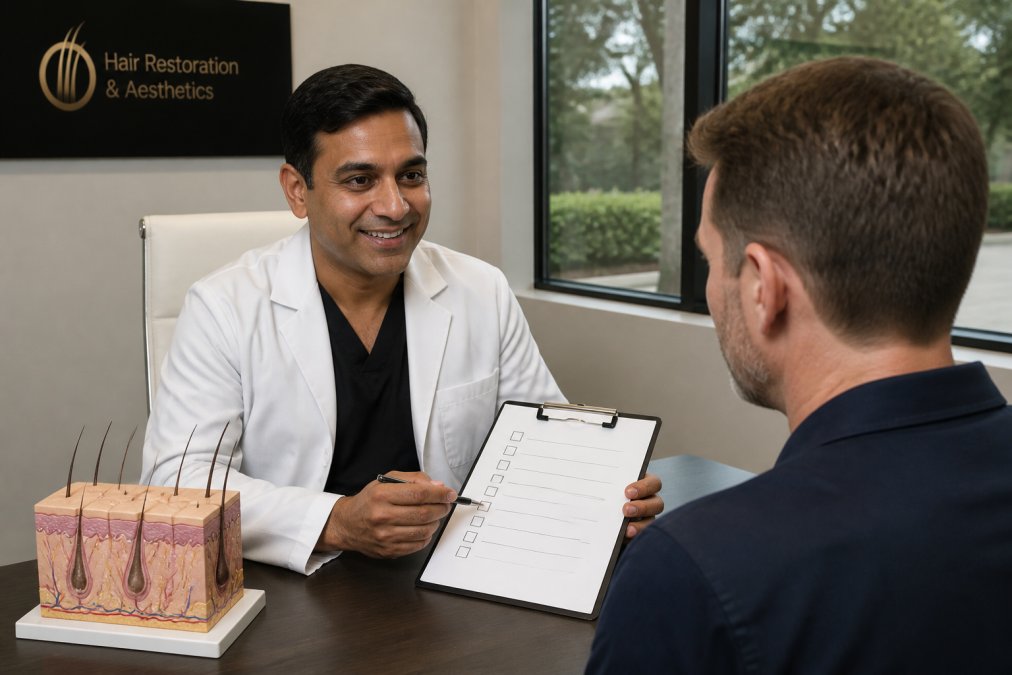
A surgical consultation is where a good outcome starts. Use this checklist to compare providers and arrive prepared.
Questions to Ask About Credentials and Experience
- Are you board-certified, and by which board?
- How many FUE procedures have you personally performed?
- Can I see before-and-afters of patients with hair loss similar to mine?
- Who performs the graft placement: you or technicians?
What to Bring and How to Prepare
- Photos of your hairline from 5-10 years ago
- A list of medications, supplements, and medical conditions
- Questions about graft count, expected density, and cost factors
- A note on travel logistics if you live outside the immediate area
What Hair Restoration Costs and How to Plan for It
Pricing is the question patients ask first and the one most clinic pages dodge. A neutral guide should explain how quotes are built, why two people with similar-looking thinning get very different numbers, and how the regional market affects what you pay.
How Graft Count Drives the Quote
Hair restoration is priced per graft in most practices, not per procedure. A graft is a single follicular unit, one to four hairs growing together. A modest hairline refinement might involve 1,000 to 1,500 grafts; restoring a receding frontal zone and mid-scalp commonly lands in the 1,500 to 2,500 range; advanced loss across the crown and frontal third can require 2,500 to 4,000 grafts or more, sometimes split across two sessions spaced months apart.
What Actually Moves the Number
- Graft count. The single largest variable. More grafts means more surgical time, more staff, and more consumables.
- Technique. FUE is more labor-intensive per graft than FUT because each unit is extracted individually, which is reflected in the quote.
- Surgeon involvement. Whether the physician performs the extractions and hairline incisions personally or supervises technicians changes both the price and, arguably, the result.
- Session count. A single large session versus two staged sessions changes total cost and total recovery time.
- Geography and overhead. This is where the regional picture matters most.
Why the Regional Market Matters
Cost of living, commercial rent, nursing wages, and malpractice premiums vary enormously across the state, and pricing follows. A dense-metro practice with high overhead typically quotes more per graft than a suburban or foothill practice with lower fixed costs, for the same graft count and technique. Patients who shop purely on the lowest advertised number often find it was quoted for a smaller graft count than their case requires.
What a Quote Should Include
Before comparing two numbers, confirm both cover the same things:
Schedule a Free Consultation →
- Pre-operative consultation and scalp assessment
- Local anesthesia and surgical facility use
- The stated graft count, in writing
- Post-operative instructions and follow-up visits
- Any revision or touch-up policy, and the conditions attached to it
- Whether post-procedure topical therapy or in-office maintenance is bundled or billed separately
Financing and Payment Planning
American Society of Plastic Surgeons, what to ask before cosmetic surgery
Post-Operative Care and Long-Term Maintenance
Most clinic pages stop at the procedure. What determines whether your result holds up over the next decade is what happens after you leave. This section covers the day-by-day protocol, warning signs worth calling about, and the maintenance plan that protects your investment.
The First 14 Days, Day by Day
Day 1. Rest with your head elevated, roughly 30 to 45 degrees, to limit swelling. Expect tenderness in the donor and recipient areas as the anesthetic wears off. Do not touch, scratch, or rinse the grafts, and sleep on your back if you can.
Weeks 3-12: The Shedding Phase
Around week three, transplanted hairs shed. This is expected, not a sign the procedure failed, the follicle remains and the hair shaft is simply cycling. Patients not warned about this often panic and assume the grafts did not take. New growth typically appears between month three and month four.
Months 4-12: Density Builds
Density fills in gradually through month eight, and the final result is usually assessed at month 12. Hair grows roughly half an inch per month, so visible length lags visible density. Photograph your hairline monthly under the same lighting, the only reliable way to judge progress, since change is too gradual to notice in the mirror.
Red Flags Worth a Phone Call
Minor issues are common and usually resolve. These are the ones that should prompt contact with your clinic rather than a wait-and-see approach:
- Folliculitis, small red bumps or pimple-like lesions in the recipient or donor area, sometimes itchy or tender. Common in the first weeks to months and generally treatable with topical or oral medication.
- Prolonged or expanding redness beyond the expected healing window, especially if warm to the touch.
- Persistent swelling that worsens after day four rather than improving.
- Unusual pain that increases instead of tapering.
- Any drainage, fever, or a wound that reopens.
Long-Term Maintenance
Transplanted follicles are typically resistant to the androgen that drives pattern hair loss, but surrounding native hair is not (pubmed.ncbi.nlm.nih.gov). That is why maintenance matters: without it, you keep the transplanted hairline while the hair behind it keeps thinning, which eventually looks unnatural.
If You Traveled for the Procedure
Patients coming from outside the area should plan logistics before booking, not after. Two practical points: stay within a short drive of the clinic for the first night or two in case of unexpected swelling or an aftercare question, and confirm in advance how the day-10 to day-14 check-in will happen, in person, by video, or with a local provider the clinic coordinates with.
Frequently Asked Questions
How much do 3,000 hair grafts cost?
Graft pricing varies by clinic, surgeon experience, and technique, so there is no single figure that applies everywhere. Most practices quote per-graft rates or flat session fees, and a 3,000-graft procedure typically falls into a higher tier than smaller sessions. Because costs depend on your specific case, ask for a written quote after your consultation. Many clinics, including Hair Restoration Clinic of Granite Bay, offer free consultations and payment plans so you can compare options before committing.
How do I choose a board-certified hair restoration specialist in Northern California?
Start by verifying the physician's board certification. Ask how many procedures they perform annually, whether they use the Cole follicular unit extraction system or another established technique, and whether they can show before-and-after photos of patients with hair loss similar to yours. A legitimate surgeon will welcome these questions and offer a free consultation to discuss candidacy, graft count, and expected outcomes.
Is Alma TED therapy effective for hair thinning?
Alma TED is a non-invasive acoustic sound wave treatment that supports hair health by improving circulation and stimulating the scalp without incisions or downtime. It works well for early-stage thinning, androgenetic alopecia, and as a complement to FUE by strengthening the donor area and existing follicles. Results build gradually over a series of sessions. It is not a replacement for a transplant when follicles are permanently lost, so a consultation helps determine whether Alma TED alone or a combined plan is right for you.
Is 40 too old for a hair transplant?
No. Age alone does not disqualify you. Surgeons evaluate donor area density, scalp laxity, overall health, and the stability of your hair loss pattern. Many patients in their 40s and beyond get excellent results because their loss has stabilized and they have realistic goals. A board-certified surgeon will assess whether FUE or a non-surgical option like Alma TED fits your situation and discuss expected density and natural hairline design during your consultation.