 blog
blog
10 Best Treatments for Fine Lines Around Eyes in 2026
Table of Contents
- Why Fine Lines Around Eyes Form and What Actually Works
- Quick Comparison: 10 Treatments for Fine Lines Around Eyes
- The Benefits of Neurotoxins for Crow's Feet
- Dermal Fillers for Tear Troughs and Volume Restoration
- Laser Skin Rejuvenation Recovery Time and What to Expect
- Microneedling and PDO Threads for Delicate Eye-Area Skin
- How Long Results Last and When to Adjust Your Plan
- Frequently Asked Questions
Last Updated: September 10, 2026
Why Fine Lines Around Eyes Form and What Actually Works
Fine lines around eyes are the earliest visible sign of facial aging, and they form because the skin in this region is among the thinnest on the body. Many individuals are frustrated that their eye area ages faster than the rest of their face. The reason is structural: the eye area has less subcutaneous fat, fewer oil glands, and constant movement from blinking and expression. Below, we break down the ten treatments that genuinely improve this area, what each one costs in time and recovery, and how to build a plan that lasts.
How the Eye Area Ages Differently
The skin around the eyes is roughly 0.5 millimeters thick, compared with about 2 millimeters on the cheek (peer-reviewed research). That thinness means collagen and elastin breakdown shows up here first. Add in roughly 10,000 blinks per day, and the mechanical stress is relentless.
Three processes drive the change. First, mid-face atrophy reduces the fat pads that support the lower lid, creating hollowing. Second, bone resorption in the orbital rim makes the eye socket appear deeper. Third, dermal thinning from collagen loss lets underlying vessels show through, producing dark circles alongside the lines.
This is why a single treatment rarely solves everything. The eye area needs a comprehensive treatment plan that addresses skin quality, volume, and muscle movement together.
Quick Comparison: 10 Treatments for Fine Lines Around Eyes
The table below summarizes options for addressing fine lines around the eyes.
| Treatment | Best For | Typical Sessions | Downtime | Results Last |
|---|---|---|---|---|
| Neurotoxins (Botox, Dysport, Xeomin) | Crow's feet, dynamic lines | 1, then every 3-4 months | None | 3-4 months |
| Dermal fillers | Tear troughs, hollowing | 1-2 | 2-5 days | 9-18 months |
| Laser skin rejuvenation | Texture, pigment, fine lines | 3-5 | 3-7 days | 6-12 months |
| Microneedling | Fine lines, skin quality | 3-6 | 1-2 days | 4-6 months |
| PDO threads | Mild lifting, structural support | 1 | 3-7 days | 12-18 months |
| Laser facials | Tone, mild texture | 3-6 | None to 1 day | 3-6 months |
| Chemical peels | Surface lines, dullness | 3-6 | 2-5 days | 3-6 months |
| Radiofrequency | Skin tightening | 3-4 | None | 6-12 months |
| Topical retinoids | Prevention, fine texture | Daily use | Adjusting period | Ongoing |
| Alma TED acoustic therapy | Periorbital skin support | 3-4 | None | Varies |
The right combination depends on whether your primary concern is movement lines, volume loss, or skin texture.
The Benefits of Neurotoxins for Crow's Feet
Neurotoxins remain the most reliable option for dynamic lines at the outer corners of the eyes. Botox, Dysport, and Xeomin all work by temporarily reducing the muscle contractions that crease the skin. For crow's feet, results typically appear within three to seven days and settle fully by two weeks (the FDA).
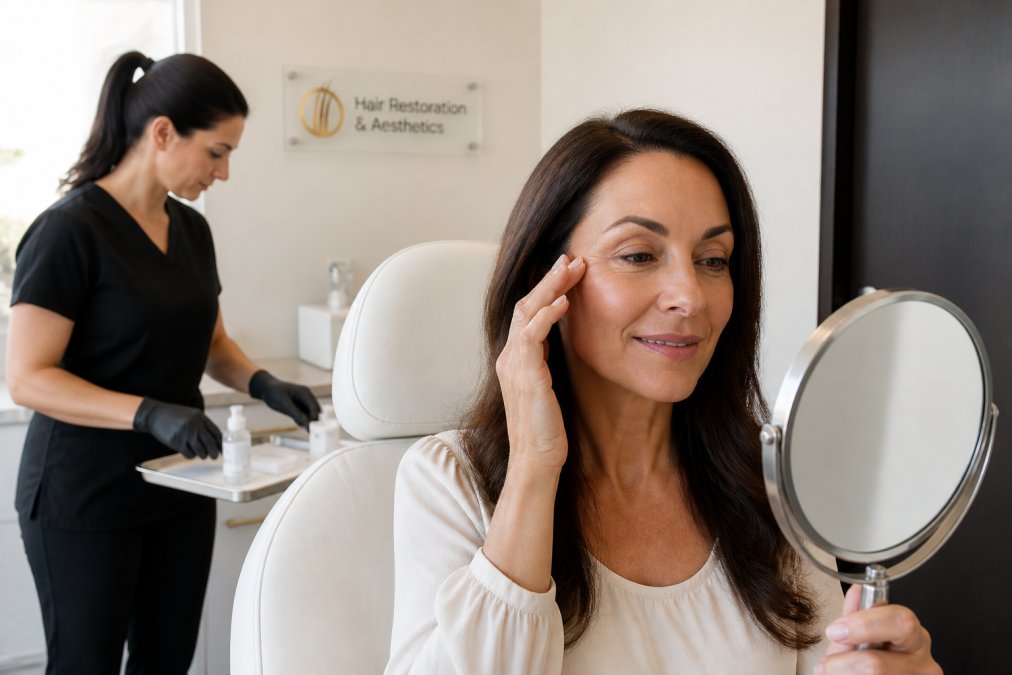
The benefits of neurotoxins for crow's feet go beyond smoothing. By limiting repeated folding, they slow the conversion of dynamic lines into static ones. A common mistake is treating only the crow's feet and ignoring the underlying volume loss, which leaves the area looking flatter rather than refreshed.
Dermal Fillers for Tear Troughs and Volume Restoration
Dermal fillers restore structural support where fat pads have diminished, most often in the tear trough. Hyaluronic acid fillers are the standard choice because they can be dissolved if needed, an important safety consideration in this delicate region.
The technique matters more here than almost anywhere else on the face. Overfilling produces puffiness that worsens under overhead lighting. Underfilling leaves the hollow untouched. A conservative, layered approach with small volumes across two sessions usually outperforms a single aggressive treatment.
Volume restoration in the mid-face also indirectly softens nasolabial folds and the lower lid, because lifting the cheek changes how the eye area drapes.
Laser Skin Rejuvenation Recovery Time and What to Expect
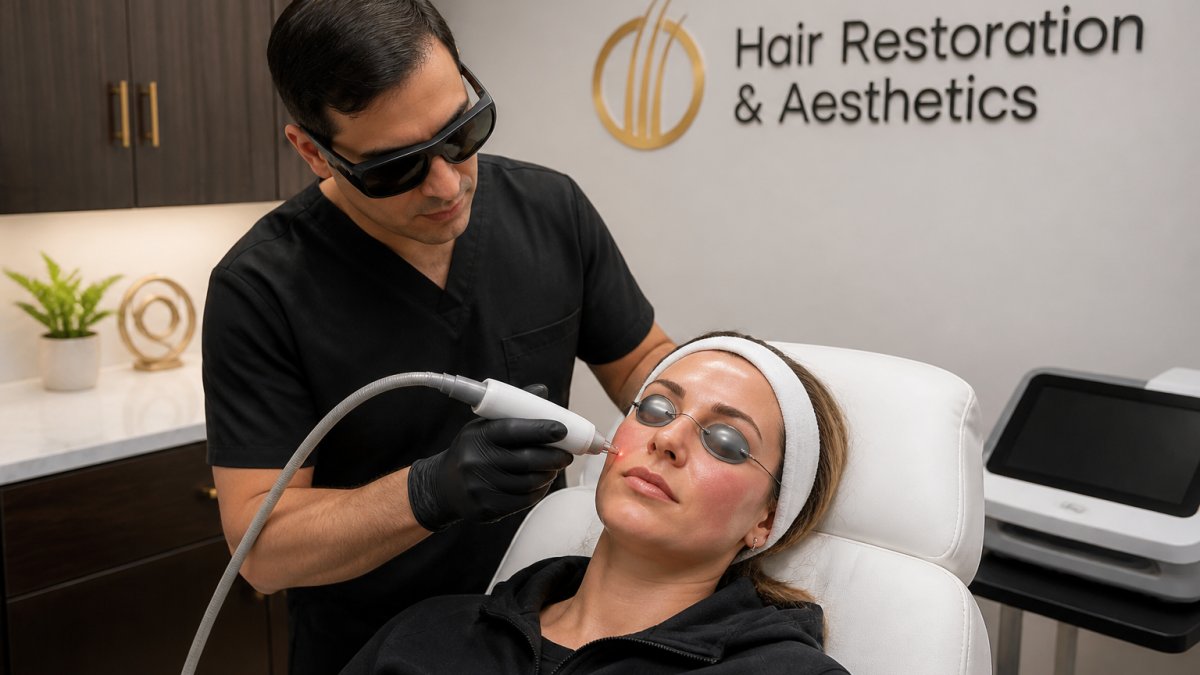
Laser skin rejuvenation recovery time depends on the device, the wavelength, and how aggressively the clinician sets the parameters. For the periorbital area, most practices use either non-ablative fractional resurfacing or a lighter ablative fractionated approach, because the skin here is roughly 0.5 millimeters thick and heals differently than the cheek.
Here is how the two main categories compare in practice:
| Device Category | What It Does | Typical Downtime | Sessions Needed |
|---|---|---|---|
| Non-ablative fractional (e.g., 1550 nm erbium-glass, 1927 nm thulium) | Heats columns of tissue below the surface, leaving the top layer intact | 3-5 days of pinkness, mild swelling | 3-5, spaced 4-6 weeks apart |
| Fractionated ablative (e.g., 2940 nm erbium, CO2) | Removes microscopic columns of surface skin while heating deeper tissue | 7-14 days of visible healing, redness can persist 3-4 weeks | 1-2 |
| Intense pulsed light (often grouped with "laser facials") | Targets pigment and vascular tone, minimal collagen effect | None to 1 day | 3-6 |
What the first 72 hours actually look like. With non-ablative fractional treatment, expect a sunburn-like sensation for 2-4 hours, then a bronzed or pink appearance the next morning. Mild swelling peaks around 24-48 hours and is usually worse in the lower eyelid than the upper. By day three, most patients can cover with tinted moisturizer if the clinician approves it. Ablative options add a phase where the treated skin darkens and flakes off over 4-7 days, and the new skin underneath is pink for one to three weeks.
Aftercare drives the result as much as the device. Aftercare recommendations often include:
- Gentle cleansing with a non-foaming cleanser starting 24 hours after treatment
- A bland occlusive moisturizer reapplied 3-5 times daily for the first week
- Strict sun avoidance and broad-spectrum SPF 30 or higher once the skin is closed
- No retinoids, acids, or exfoliants for 7-10 days
- No strenuous exercise or sauna for 48-72 hours, since heat and sweat increase swelling
The trade-off is real and worth stating plainly. More aggressive resurfacing produces more dramatic collagen remodeling, which translates to better long-term improvement in fine lines and dermal thickness. Less aggressive sessions mean faster return to normal activity but require more repeat visits and produce a more gradual change. Patient satisfaction with laser treatments tends to be highest when expectations match the downtime, not when the downtime is shortest.
One more consideration specific to the eye area: the lower eyelid skin is thin enough that overly aggressive settings can cause prolonged redness or, in rare cases, a lightening of the skin tone called hypopigmentation. That is why experienced clinicians often start conservative on the first pass and increase intensity on subsequent sessions once they see how your skin responds.
Microneedling and PDO Threads for Delicate Eye-Area Skin
Microneedling creates controlled micro-injuries that trigger collagen stimulation without removing the surface layer. Downtime is minimal, usually one to two days of pinkness. For the eye area, it is often paired with topical serums to improve penetration.
Schedule a Free Consultation →
PDO threads offer a different mechanism. They provide immediate structural support through a fine mesh under the skin, then stimulate collagen as they dissolve. Results last longer than microneedling alone, but the technique requires precision near the orbital rim.
What most guides miss is that these two treatments complement rather than compete. Threads address laxity; microneedling addresses texture. Many patients benefit from both in a staged maintenance schedule.
How Long Results Last and When to Adjust Your Plan
Treatment longevity varies widely by modality, and most guides stop there. The more useful question is what actually shortens or extends those numbers, and how to know when your current plan has stopped working.
Baseline Longevity by Treatment
- Neurotoxins fade in three to four months as the muscle gradually regains full contraction.
- Hyaluronic acid fillers last nine to eighteen months depending on the product's cross-linking, the injection plane, and the individual's metabolic rate (the FDA).
- PDO threads provide structural support for twelve to eighteen months as they dissolve and are replaced by new collagen.
- Laser and microneedling results build over three to six months and then gradually decline as new collagen turnover slows.
- Topical retinoids work continuously but only while used; stopping reverses most of the texture benefit within a few months.
Lifestyle Factors That Change the Timeline
Lifestyle factors can influence treatment longevity.
Sun exposure is the single largest accelerator of collagen breakdown. Ultraviolet radiation activates matrix metalloproteinases, enzymes that degrade collagen faster than the body replaces it. Daily broad-spectrum SPF 30 or higher, reapplied when outdoors, is the highest-return habit for holding results from every treatment on this list.
Smoking constricts dermal blood vessels and reduces oxygen delivery to the skin. Patients who smoke typically see filler and laser results fade noticeably faster than non-smokers, and the effect compounds with age.
Sleep position and quality. Sleeping face-down or on the same side night after night creates repeated compression on the periorbital skin. Side-sleepers often notice deeper lines on the compressed side over years. Poor sleep also raises cortisol, which breaks down collagen and elastin.
Alcohol and hydration. Alcohol is a diuretic and a vasodilator; heavy intake the night before a treatment can worsen swelling and prolong recovery. Chronic dehydration makes fine lines more visible even when the underlying collagen is unchanged.
Skincare consistency. A daily retinoid and a vitamin C serum in the morning do not replace in-office treatments, but patients who use both consistently tend to hold results longer and need fewer maintenance sessions.
When to Pivot or Stop
There is a point where adding more treatment stops helping, and recognizing it is more valuable than any single procedure.
Signs you may be over-treating:
- The area looks puffy or heavy at rest rather than refreshed
- Filler from a previous session is still palpable months later
- You are scheduling neurotoxin earlier than the three-month mark because the result "wore off" but the muscle still looks relaxed
- Friends or family comment that you look different rather than rested
Signs it is time to change modality, not add more:
- Significant tissue laxity where the skin itself sags rather than just creases
- Hollowing that has progressed beyond what conservative filler volumes can address
- Lines that are now static at rest and no longer respond to muscle relaxation alone
When non-surgical options reach their ceiling, the most valuable part of the visit is a candid conversation about what they can and cannot achieve. That is not a failure of the plan; it is the plan working as intended, because it prevents spending on treatments that will not deliver visible change. If you are unsure which combination suits your eye area, you can Schedule a Free Consultation to have your concerns assessed in person.
Frequently Asked Questions
What is the best treatment for fine lines around eyes?
There is no single best option because the eye area ages in layers. Neurotoxins such as Botox, Dysport, and Xeomin work well for dynamic crow's feet caused by muscle movement. Dermal fillers address hollowing and tear troughs. Laser skin rejuvenation and microneedling improve skin texture and collagen stimulation. Many patients get the best results from combining two or three treatments tailored to their anatomy after a dermatological assessment.
How do neurotoxins like Botox and Dysport improve eye-area fine lines?
Neurotoxins temporarily relax the muscles that pull the skin into crow's feet when you smile or squint. By reducing that repeated creasing, the skin has time to smooth out and existing etched lines soften. Results typically appear within a few days and last three to four months. The benefits of neurotoxins for crow's feet include prevention: starting early can slow the formation of deeper static lines over time.
What is the typical laser skin rejuvenation recovery time?
Recovery depends on the laser and settings used. Non-ablative fractional lasers often involve two to four days of redness and mild swelling. More intensive resurfacing can require seven to ten days of visible peeling before skin returns to normal. Most patients can resume work within a few days with makeup or sun protection. Your provider will give a recovery timeline based on your skin type and treatment plan.
Are PDO thread lifts suitable for the delicate skin around the eyes?
PDO threads are generally used for lifting the mid-face and brow area rather than directly on the thin eyelid skin. Threads placed along the brow or upper cheek can indirectly improve the appearance of fine lines around eyes by repositioning tissue. Direct eye-area placement carries higher risk and is not appropriate for everyone. A consultation can determine whether threads fit your anatomy and aesthetic goals.