 how-to
Natural-Looking Hair Transplants: A Step-by-Step Guide
Table of Contents
- What Makes a Hair Transplant Look Natural
- FUE Hair Transplant Benefits Over Other Techniques
- Hair Restoration Recovery Timeline and What to Expect
- Surgical Precision: Angle, Direction, and Hair Caliber
- Non-Surgical Hair Health Treatments for Long-Term Maintenance
- Managing Expectations: Realistic Goals and Touch-Up Procedures
- Long-Term Aging and Maintaining Natural Results
- Conclusion
Last Updated: August 30, 2026
What Makes a Hair Transplant Look Natural
Natural-looking hair transplants depend on three foundational elements: artistic hairline design, precise graft placement, and proper density distribution across the scalp. When these factors align, the results are virtually undetectable, even under close inspection.
The difference between a transplant that looks natural and one that screams "surgery" comes down to how the surgeon approaches the hairline. A hairline is a transition zone with specific characteristics that must respect the patient's existing hair pattern, age, and facial features. At Hair Restoration Clinic of Granite Bay, we prioritize this artistic element alongside technical precision.
The Role of Hairline Design and Artistic Placement
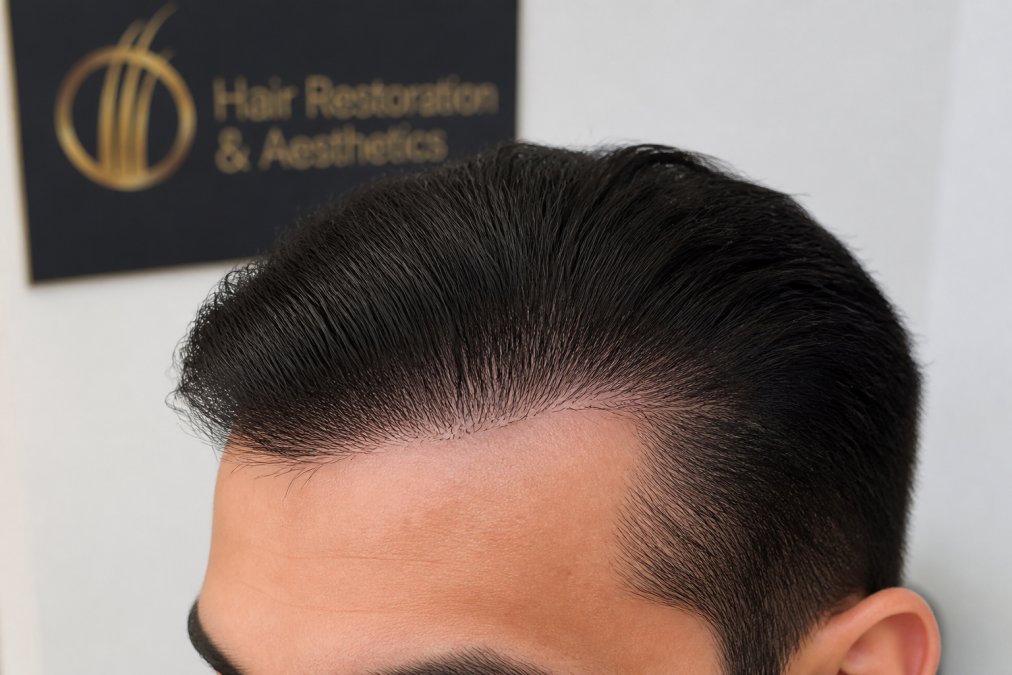
The hairline is the most visible part of any hair transplant and the hardest to get right. An unnatural hairline is thick, uniform, and obviously placed. A natural hairline has irregularity, variation in density, and follows the contours of the face.
Proper hairline design considers your age, facial structure, and natural hair growth direction. A 25-year-old needs a different hairline than a 55-year-old. The temporal points, where the hairline meets the temples, require particular attention and should angle slightly backward. Single-hair grafts at the very front create a soft, feathered edge, while thicker grafts behind create depth without looking pluggy.
Each graft must be positioned at the correct angle and direction to match your natural hair growth. This requires years of surgical practice and an artistic eye to understand how individual hairs should sit relative to one another.
Graft Survival and Density Distribution
Graft survival determines how many transplanted hairs actually take root and grow. Poor handling, delayed implantation, or incorrect recipient site preparation can reduce survival rates significantly.
Density distribution is equally important. The scalp has natural density patterns: the crown is typically denser than the temples, and the front is denser than the back. Replicating this natural variation requires careful planning and execution. Hair caliber, the thickness of individual hairs, also affects results. Finer hairs should be placed toward the hairline, while thicker hairs belong further back, creating visual harmony and preventing the transplanted area from standing out.
FUE Hair Transplant Benefits Over Other Techniques
Follicular Unit Extraction, or FUE, has become the gold standard for achieving natural-looking hair transplants. Unlike older methods, FUE allows surgeons to extract individual follicular units one at a time, preserving natural groupings and minimizing scarring in the donor area.
FUE offers several advantages that directly impact your final result: less visible scarring, more precise graft placement, and greater flexibility in transplant design.
Follicular Unit Extraction vs. DHI Methods
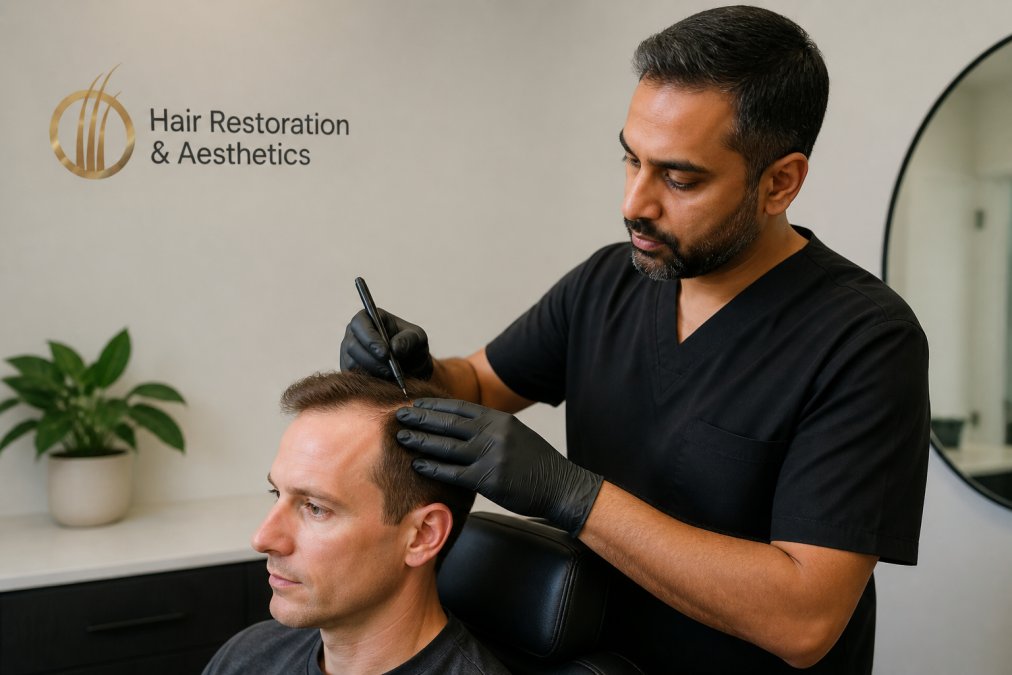
FUE involves extracting individual follicular units using a small punch tool, typically 0.8 to 1.0 millimeters in diameter (peer-reviewed research). The surgeon then creates recipient sites and places each graft, giving complete control over placement, angle, direction, and depth.
DHI (Direct Hair Implantation) uses a specialized pen-like device to extract and implant grafts in a single step. While theoretically reducing graft handling time, DHI requires more technical training and often produces results comparable to FUE. FUE remains a highly effective option for many patients because it allows strategic extraction from areas with the best hair characteristics, then precise placement with absolute control.
Minimizing Donor Area Scarring
One of the biggest patient concerns is donor area scarring. With FUE, the donor area shows minimal scarring because each extraction point is small and heals as a tiny dot, nearly invisible even with slightly longer hair.
Proper extraction technique is critical. The Cole follicular unit extraction system, used at Hair Restoration Clinic of Granite Bay, is specifically designed to minimize trauma to surrounding tissue while maximizing graft integrity. Strategic extraction from a larger donor area can produce better long-term outcomes than aggressive harvesting from a smaller zone, preserving the area for any future procedures.
Hair Restoration Recovery Timeline and What to Expect
Recovery from an FUE hair transplant follows a predictable timeline. Most patients can return to light work within a few days. Strenuous exercise and activities that cause sweating should be avoided for at least two weeks, as transplanted grafts are fragile during the first week and can be dislodged by friction, sweating, or direct contact (the American Academy of Dermatology).
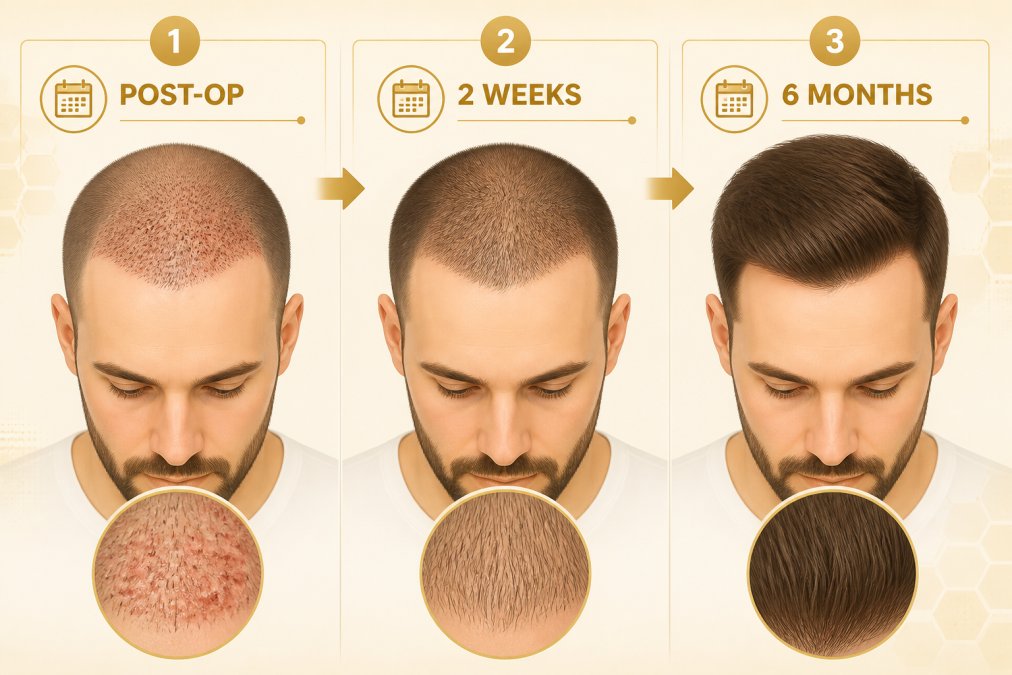
Week-by-Week Healing Milestones
Week 1: Expect redness, swelling, and small scabs around each graft site. Avoid touching, scratching, or applying pressure. Sleep with your head elevated to minimize swelling.
Week 2: Scabs begin to fall off naturally, do not pick at them. Swelling decreases noticeably. Light exercise like walking is acceptable.
Weeks 3-4: The transplanted area continues healing. Redness fades significantly. Most normal activities and gentle exercise can resume.
Weeks 5-8: Transplanted hairs enter a resting phase called telogen. This is normal; hairs will shed but follicles remain intact.
Months 3-4: New hair growth becomes visible, initially appearing thin and fine.
Months 5-6: Hair growth accelerates. Results become increasingly apparent.
Months 9-12: Full results typically appear as all transplanted hairs complete their growth cycle.
When Results Become Visible
Most patients see initial hair growth within three to four months, though hairs initially grow thin and fine. By six months, results are often noticeable. By twelve months, results are typically well-established, with transplanted hair blending seamlessly with existing hair.
Schedule a Free Consultation →
This timeline is consistent across most FUE procedures, with variations based on individual healing rates, hair characteristics, and post-operative care. Following post-operative instructions carefully accelerates healing and improves outcomes.
Surgical Precision: Angle, Direction, and Hair Caliber
The technical execution of a hair transplant determines whether results look natural or artificial. Three specific factors separate exceptional outcomes from mediocre ones: the angle at which grafts are inserted, the direction they're oriented, and how hair caliber is matched across the transplant zone.
Hair doesn't grow straight out of the scalp but emerges at specific angles that vary by location. Hairs at the hairline angle more acutely, while hairs at the crown angle more vertically. A surgeon must replicate these natural angles precisely. Direction matters equally, hair grows in specific directions across the scalp, angling downward at the hairline, backward at the temples, and radiating outward at the crown.
Hair caliber affects how results appear. Fine hairs at the hairline create a soft, natural edge, medium-thickness hairs transition the front to mid-scalp, and thicker hairs fill the crown and back. This gradation creates visual depth and prevents the transplanted area from appearing obviously different.
The surgeon's experience directly impacts their ability to execute these details consistently. This is why choosing an experienced surgeon matters profoundly.
Non-Surgical Hair Health Treatments for Long-Term Maintenance
A successful hair transplant is permanent, transplanted hairs won't fall out because they're genetically resistant to hair loss. However, your remaining native hair may continue thinning if you don't address underlying causes.
Non-surgical treatments extend the life and appearance of your transplant by maintaining your existing hair. These approaches work best when combined with the transplant rather than used alone.
Medical Therapy and Transplant Longevity
Medical therapy refers to medications like finasteride (Propecia) and minoxidil (Rogaine) that slow or stop hair loss. Finasteride blocks the hormone responsible for pattern baldness in genetically susceptible individuals (the FDA). Minoxidil stimulates blood flow to hair follicles and extends the growth phase of the hair cycle.
Using medical therapy before and after your transplant can contribute to superior long-term results. Pre-transplant therapy can help stabilize your remaining hair, making it easier to design a natural transplant. Post-transplant therapy can help prevent further loss of native hair, ensuring your transplant doesn't look isolated against continued thinning. These medications work best when started early and continued consistently.
Alma TED Acoustic Sound Wave Therapy
Alma TED (Transepidermal Delivery) uses acoustic sound waves to stimulate hair follicles and improve scalp health. This non-invasive treatment complements both transplants and medical therapy by enhancing blood flow to the scalp and promoting healthier hair growth.
Sessions typically last 20-30 minutes with no needles, downtime, or systemic side effects. Most patients benefit from a series of treatments spaced several weeks apart, followed by maintenance sessions every few months. Acoustic energy penetrates the scalp without damaging skin, improving microcirculation and enhancing nutrient delivery to hair follicles.
Managing Expectations: Realistic Goals and Touch-Up Procedures
The most satisfied transplant patients are those with realistic expectations entering surgery. A hair transplant redistributes your existing hair, it cannot create new hair or increase your total hair count beyond what you have. If you're significantly bald, even an excellent transplant won't restore you to your density at age 20. Instead, a skilled surgeon creates the illusion of fuller hair through strategic placement and artistic design.
Touch-up procedures can be a part of the overall plan. Some patients may benefit from one or more touch-up surgeries to refine results, add density to specific areas, or address recession that occurs after the initial transplant. The goal is to make people unable to tell you've had surgery, they simply notice you have better hair.
Long-Term Aging and Maintaining Natural Results
Hair transplants are permanent, but your face and scalp continue aging. A transplant designed at age 40 may look different at age 60 as your face changes and your remaining native hair continues thinning.
The best surgeons design transplants with future aging in mind. They aim to avoid transplanting too densely in areas that may thin further and preserve donor hair for potential future procedures. They consider how your hairline will look in twenty years, not just next year.
Maintaining natural results long-term requires consistent effort. Medical therapy can help prevent further native hair loss. Alma TED therapy and other non-invasive treatments support scalp health. Regular follow-up with your surgeon allows for adjustments and touch-ups as needed. Choosing a surgeon who thinks in decades, not years, matters profoundly for long-term satisfaction.
Achieving natural-looking hair transplants requires more than surgical skill, it demands an understanding of hairline design, precise technical execution, and realistic long-term planning. The difference between a transplant that looks natural and one that screams "surgery" comes down to how carefully a surgeon approaches each detail, from hairline artistry to graft angle to donor area preservation.
At Hair Restoration Clinic of Granite Bay, Dr. Piyush Kumar brings over a decade of experience and the Cole follicular unit extraction system to deliver results that blend seamlessly with your natural hair. If you're considering a transplant and want to understand whether it's right for you, schedule a free consultation to discuss your specific goals and see how natural-looking results are achieved through careful planning and expert execution.
Frequently Asked Questions
Can a natural-looking hair transplant really be undetectable?
Yes, when performed by an experienced surgeon using proper FUE technique and artistic hairline design. Natural-looking hair transplants depend on precise graft placement at the correct angle and direction to match your existing hair growth pattern. The donor area preservation, graft survival rates, and individual hair caliber all contribute to results that blend seamlessly with your natural hair. Avoiding overharvesting of the donor site can help ensure both the transplant and the back of your scalp maintain a natural appearance long-term.
What is the typical hair restoration recovery timeline after a transplant?
Most patients return to normal activities within 7-10 days, though complete healing takes several months. Initial redness and scabbing resolve in 2-3 weeks. Hair begins shedding around week 2-3 (this is normal), and new growth emerges at 3-4 months. Full results with natural-looking coverage typically appear between 9-12 months as grafts mature and hair thickens. Touch-up procedures may be considered after 12-18 months if additional density is desired.
How do non-surgical hair health treatments support transplant results?
Non-surgical treatments like Alma TED acoustic sound wave therapy and medical therapy with Finasteride or Minoxidil help preserve existing hair and support graft longevity. These complement your transplant by slowing or halting further hair loss in untransplanted areas, helping to ensure your final result remains thick and balanced. Combining surgical restoration with ongoing non-surgical maintenance can contribute to the most natural, sustainable outcome and may reduce the need for future touch-up procedures.
What should I look for in a hair restoration surgeon for natural results?
Choose a board-certified physician with extensive FUE hair transplant experience and a portfolio of natural-looking results. Ask about their surgical technique, hairline design approach, and how they determine graft density and distribution for your specific scalp anatomy. A skilled surgeon understands the importance of transplant angle, hair caliber matching, and avoiding overharvesting. Board certification, years of experience, and before-and-after examples from patients with similar hair loss patterns are key indicators of expertise.
This article was written using GrandRanker