
 blog
blog
Is Microneedling for Décolletage Worth It? A 2026 Guide
Table of Contents
- What Is Décolletage Microneedling?
- Benefits of Microneedling for the Chest
- How the Procedure Works: Collagen Induction Therapy
- Is It Worth It? Results and Realistic Expectations
- Microneedling Recovery Time: Chest vs. Face
- Microneedling Aftercare for Décolletage: A Day-by-Day Guide
- How Many Microneedling Sessions for Chest Skin?
- Long-Term Maintenance and Combination Therapy
- Frequently Asked Questions
Last Updated: September 24, 2026
What Is Décolletage Microneedling?
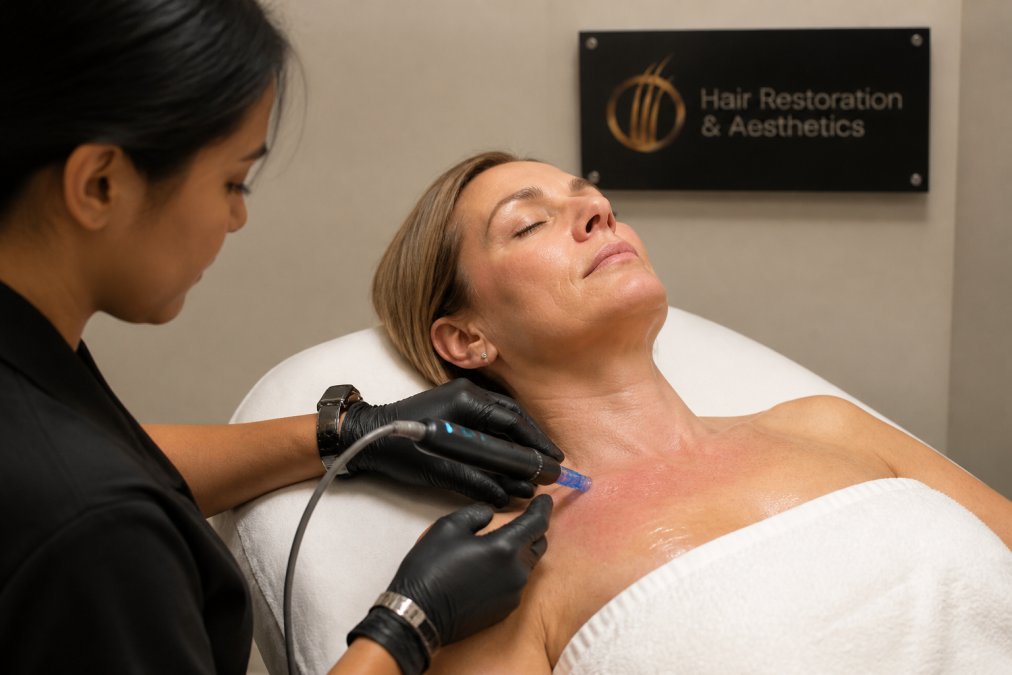
Décolletage microneedling is a minimally invasive skin rejuvenation treatment that uses fine needles to create controlled micro-injuries in the chest skin, triggering the body's natural collagen production (pubmed.ncbi.nlm.nih.gov). At Hair Restoration Clinic of Granite Bay, we explain that this process, called collagen induction therapy, helps improve skin texture, tone, and firmness.
The chest area shows age faster than many people expect. Skin there is thin and gets constant sun exposure. So fine lines, creases, and sun spots appear early.
Is microneedling for décolletage worth it? For many people, yes. It targets concerns that creams struggle to fix.
A quick look at what it addresses:
- Fine lines and wrinkles
- Sun damage and hyperpigmentation
- Crepey or loose skin
- Uneven skin texture
- Early signs of skin laxity
The treatment works with your body's own healing response. No surgery. No long recovery.
Benefits of Microneedling for the Chest
The main benefit is real collagen remodeling, not just surface-level smoothing. Microneedling for the chest can improve skin elasticity and fade sun damage over time.
Here's what patients notice most:
- Firmer skin. Collagen rebuilds dermal thickness, which helps with mild skin laxity.
- More even tone. It can reduce the look of hyperpigmentation and sun spots.
- Smoother texture. Fine lines and creases soften with each session.
- Better product absorption. Topical serums and hyaluronic acid penetrate deeper after treatment.
The chest is one of the first places to show sun damage. That makes it a strong candidate for this kind of skin rejuvenation.
How the Procedure Works: Collagen Induction Therapy
Collagen induction therapy works by creating tiny, controlled wounds in the skin. Your body responds by producing new collagen and elastin, which rebuilds the skin from within.
Here's the process, step by step:
- Numbing. A topical numbing cream is applied for comfort.
- Cleansing. The chest area is cleaned and prepped.
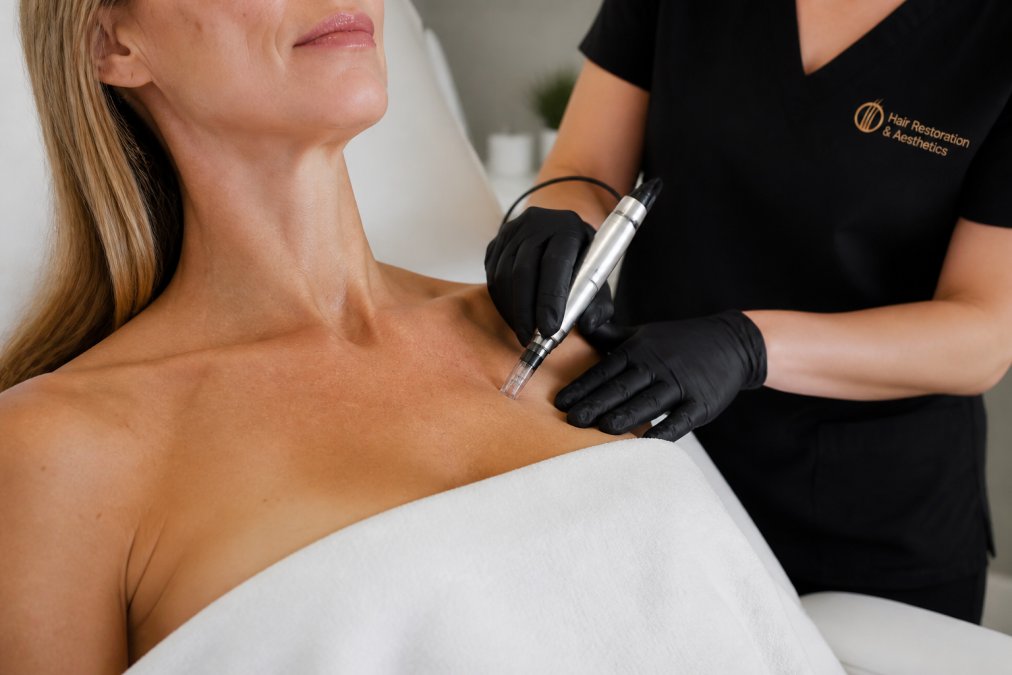
- Needling. A device with fine needles passes over the skin, creating micro-channels.
- Serum application. Topical serums, often with hyaluronic acid, are applied.
- Aftercare. You leave with simple post-procedure instructions.
Most sessions take under an hour. The depth is adjusted for your skin type and concern.
Is It Worth It? Results and Realistic Expectations
For most people with sun damage, fine lines, or mild laxity, microneedling for décolletage is worth it. But "worth it" depends on what you expect, how your skin responds, and whether you can commit to a series plus maintenance. Here is the honest breakdown.
Who tends to get the best return:
- People with early to moderate sun damage, not deep creasing
- Those with mild laxity who want firmer texture without surgery
- Anyone willing to complete three to four sessions and maintain once or twice a year
- People who will actually wear sunscreen daily afterward
Who should think twice:
- Deep, established creases that have lost structural volume, microneedling improves texture and tone but does not restore lost volume
- Very loose or hanging skin, which typically needs a different approach
- Anyone unwilling to protect the chest from sun, since unprotected UV exposure undoes collagen gains
- People with active chest acne, open lesions, or an active infection in the area
What results actually look like over time:
- Week 1-2: Skin may look slightly brighter; this is mostly hydration and surface healing, not new collagen.
- Week 4-12: New collagen matures. This is when firming and smoothing become visible.
- After a full series: Best texture, tone, and firmness, typically peaking around three to six months after the last session.
- Without maintenance: Collagen gradually declines again, and results soften over roughly 12 to 18 months.
The chest heals and responds more slowly than the face, so patience matters more here than it does for facial treatment.
How to judge value honestly:
Rather than asking whether the treatment is worth it in the abstract, ask three questions:
Schedule a Free Consultation →
- Does it target my actual concern (texture, tone, mild laxity) rather than a concern it can't fix (volume loss, deep folds)?
- Can I complete the full series and the maintenance schedule?
- Will I protect the area from sun afterward?
If the answer to all three is yes, most practitioners find the results justify the commitment. If any answer is no, a different plan, or a different treatment, may serve you better.
This is where a consultation helps. A qualified provider can assess your skin, rule out contraindications, and set realistic goals before you commit, you can Schedule a Free Consultation to talk through whether your chest skin is a good candidate.
Microneedling Recovery Time: Chest vs. Face
Chest recovery takes longer than facial recovery. The décolletage skin is thinner and heals more slowly, so redness and sensitivity can last a few days longer.
Typical timeline:
| Area | Redness Duration | Back to Normal Activities | Full Healing |
|---|---|---|---|
| Face | 1-2 days | Next day | 3-5 days |
| Chest | 2-4 days | Next day | 5-7 days |
Most people return to work the next day.
Microneedling Aftercare for Décolletage: A Day-by-Day Guide
A simple day-by-day plan:
- Day 1: Keep the area clean. Skip makeup and heavy creams. No sun.
- Days 2-3: Use a gentle moisturizer. Avoid harsh actives like retinol.
- Days 4-7: Add sunscreen daily. Avoid gyms, pools, and saunas.
- Week 2+: Slowly restart your normal routine.
Always use a broad-spectrum sunscreen with a high sun protection factor. This is the single most important step for lasting results.
How Many Microneedling Sessions for Chest Skin?
Most people need three to four sessions for chest skin, spaced about four to six weeks apart. The exact number depends on your concerns and how your skin responds.
A common plan looks like this:
- Mild concerns: 3 sessions
- Moderate sun damage or laxity: 4 sessions
- Maintenance: 1 session every 6 to 12 months
Long-Term Maintenance and Combination Therapy
A realistic maintenance schedule for aging chest skin:
- Year 1 after your initial series: One maintenance session every 6 months.
- Year 2 and beyond: One session every 6 to 12 months, adjusted to how your skin responds and how much sun exposure you get.
- Year-round: Daily broad-spectrum sunscreen on the chest, reapplied when you are outdoors.
- At home between sessions: Gentle moisturizer, vitamin C in the morning, and a retinoid at night only once your provider clears you to restart actives.
Combination therapy that pairs well with chest microneedling:
- Topical serums. Hyaluronic acid and vitamin C support hydration and tone. Applying them right after needling improves absorption, which is one reason in-office treatment outperforms at-home serums alone.
- Platelet-rich plasma (PRP). Some providers apply PRP during the same session to support the wound-healing response. Evidence for added benefit on the chest is still developing, so ask your provider whether it changes your plan.
- Laser facials and skin rejuvenation. These can target pigment and tone alongside microneedling. Spacing matters, most providers separate these treatments by a few weeks rather than stacking them on the same day.
At-home devices vs. professional treatment, the safety gap:
- Needle depth. At-home devices use shorter needles that reach only the upper skin layers. That limits collagen induction and makes results inconsistent.
- Infection risk. The chest is thin, mobile skin with less subcutaneous cushioning than the face. Reusing a roller, or using it on skin that is not properly cleansed, raises the risk of irritation and infection.
- Pigment risk. On darker Fitzpatrick skin types, improper depth or technique increases the chance of post-inflammatory hyperpigmentation, new dark patches instead of clearer skin.
- No adjustment for your skin. A professional can adjust needle depth, pass count, and serum selection to your skin type and concern. A roller cannot.
At Hair Restoration Clinic of Granite Bay, our team offers microneedling and skin rejuvenation guided by a board-certified physician, Dr. Piyush Kumar, MD. We assess your skin, build a maintenance plan that fits your goals, and advise on which combination treatments make sense for your chest skin.
Frequently Asked Questions
Does microneedling the chest area help with sun damage?
Yes, décolletage microneedling can improve the appearance of sun damage, including uneven skin tone and hyperpigmentation. The controlled micro-injuries stimulate collagen production and cellular turnover, which helps fade pigment over time. Results build gradually across sessions, and pairing treatment with daily broad-spectrum sun protection factor is essential to protect your investment and prevent new damage from undoing your progress.
What is the typical downtime after microneedling the chest?
Most people experience redness (erythema) for 24 to 72 hours after treatment. The chest area tends to stay red slightly longer than the face because the skin is thinner and more exposed. Mild sensitivity and a sandpaper-like texture are normal for a few days. You can typically return to work the next day, but avoid strenuous exercise, saunas, and direct sun for at least 48 hours to support proper wound healing.
How many sessions of microneedling are needed for the décolletage?
Most providers recommend a series of three to six sessions spaced four to six weeks apart for the chest. The exact number depends on your skin concerns, laxity, and how your skin responds. Fine lines and texture often improve after two or three sessions, while sun damage and skin laxity may need the full series. After the initial course, maintenance sessions every three to six months help preserve results.
Is microneedling safe for thin skin on the chest?
Microneedling can be safe for thinner chest skin when performed by a qualified provider who adjusts needle depth appropriately. The décolletage has less dermal thickness than the face, so a conservative approach is important. People with active acne, open wounds, or certain skin conditions should wait. A consultation with a board-certified physician helps determine whether décolletage microneedling suits your skin type and history.