
 ultimate-guide
Is Laser Hair Removal Permanent for All Skin Tones?
Table of Contents
- How Laser Hair Removal Works and Why Permanence Is Complicated
- Fitzpatrick Skin Type Laser Hair Removal: Why Skin Tone Changes Everything
- How Long Does Laser Hair Removal Last? Setting Realistic Expectations
- Laser Hair Removal Maintenance Sessions: What Your Schedule Looks Like
- Safety, Side Effects, and Contraindications Across Skin Tones
- Hormonal Hair Growth vs. Cosmetic Hair Removal: Why Regrowth Happens
- Conclusion
- Frequently Asked Questions
Last Updated: September 14, 2026
How Laser Hair Removal Works and Why Permanence Is Complicated
Laser hair removal is a medical procedure that targets pigment inside the hair follicle with concentrated light energy, and whether it is permanent depends far less on the device than on your biology. The honest answer to "is laser hair removal permanent for all skin tones" is no, not in the way most people hope. At Hair Restoration Clinic of Granite Bay, we explain this to every patient before treatment begins, because expectations set correctly are the difference between satisfaction and disappointment.
The procedure damages follicles during their active growth phase, which is why results build over a series of sessions rather than appearing after one visit. Most patients see a significant, long-lasting reduction in hair density rather than a permanent end to all hair growth.
Selective Photothermolysis and the Anagen Phase
Selective photothermolysis is the principle that lets a laser destroy a pigmented target while leaving surrounding skin intact. The laser's wavelength is absorbed by melanin in the hair, converting light into heat that damages the follicle.
Timing matters as much as technology. Hair only responds to treatment during the anagen phase, the active growth stage when the follicle is connected to the hair shaft. Because not every follicle is in anagen at once, single sessions leave dormant hairs untouched. That is the mechanical reason a series of treatments, spaced weeks apart, is standard.
Fitzpatrick Skin Type Laser Hair Removal: Why Skin Tone Changes Everything
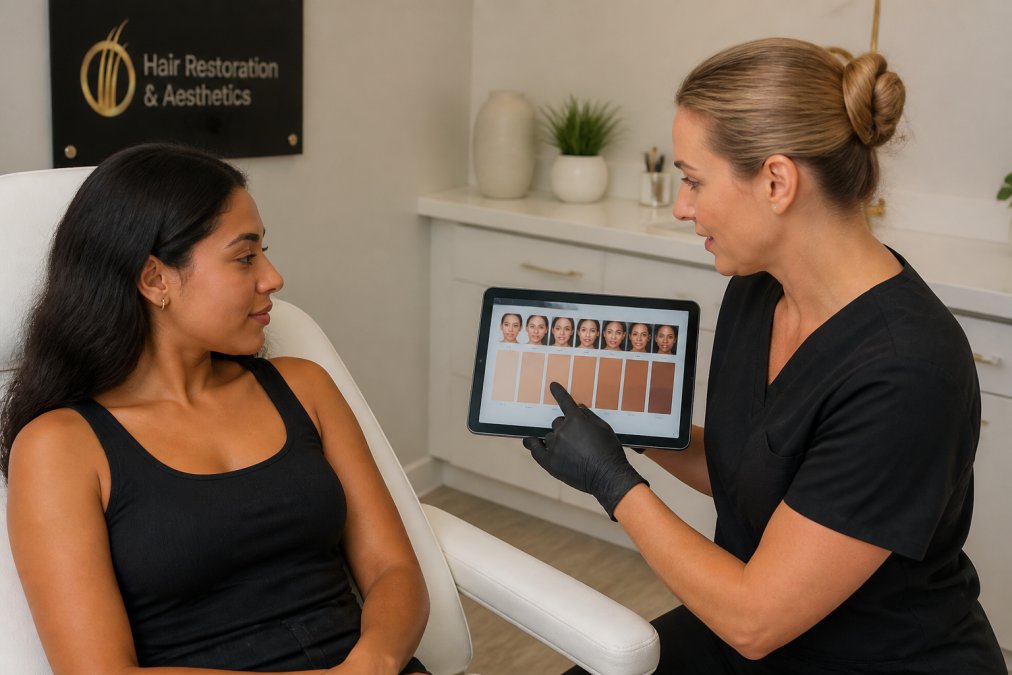
Fitzpatrick skin type laser hair removal is the single biggest variable in your outcome, because the laser cannot easily tell the difference between pigment in your hair and pigment in your skin. The Fitzpatrick scale classifies skin from Type I, which burns easily and never tans, through Type VI, which is deeply pigmented and rarely burns.
For lighter skin types, lasers can use higher energy with less risk to the surrounding skin. For deeper skin tones, the margin for error narrows considerably. That is not a reason to avoid treatment. It is a reason to choose a provider who adjusts settings for your skin rather than running one protocol for everyone.
How Melanin Interacts With Laser Energy
Melanin is the pigment that gives both hair and skin their color, and it absorbs laser energy indiscriminately. When the gap between hair pigment and skin pigment is wide, the laser can be tuned to hit the hair and spare the skin. When that gap is narrow, as it often is for patients with darker skin and dark hair, the settings must be more conservative.
The practical consequence is that patients with deeper skin tones frequently need more sessions at lower energy, not fewer. Attempting to speed things up with aggressive settings raises the risk of hyperpigmentation, hypopigmentation, and in rare cases scarring. A qualified provider will prioritize your skin's safety profile over a faster calendar.
How Long Does Laser Hair Removal Last? Setting Realistic Expectations
How long does laser hair removal last is a question with a genuinely unsatisfying answer: it varies, and it is never truly forever. Most patients enjoy a substantial reduction in hair growth for months to years after a completed series, with any regrowth typically finer and lighter than the original hair.
Several factors shorten that window. Hormonal shifts, certain medications, and underlying conditions can all stimulate new growth from follicles that were previously dormant. This is why we describe laser hair removal as long-term reduction rather than permanent removal, and why we ask about your medical history before quoting a treatment plan.
Laser Hair Removal Maintenance Sessions: What Your Schedule Looks Like
Laser hair removal maintenance sessions are not a sign that treatment failed. They are the predictable result of biology, and planning for them prevents the frustration that comes from expecting a one-and-done fix. Most practitioners find that patients who understand the maintenance arc before they start are far more satisfied with their results than those who were promised permanence.
A realistic framework looks like this:
- Initial series: Sessions spaced roughly four to eight weeks apart, depending on the treatment area and your hair growth cycle. The face and neck tend to cycle faster than the legs or back, so facial treatments are often scheduled closer to the four-week mark.
- First year after the series: Occasional touch-up sessions if regrowth appears in isolated patches. Many patients need one or two touch-ups in the first twelve months, often on the chin, upper lip, or underarms where hormonal influence is strongest.
- Ongoing: Maintenance visits at whatever interval your own regrowth pattern dictates. A common pattern is once or twice a year for many patients, but some need quarterly visits while others go eighteen months between sessions.
| Stage | Typical Timing | What It Addresses |
|---|---|---|
| Initial series | Every 4-8 weeks | Follicles entering anagen phase |
| Touch-ups | As regrowth appears | Isolated patches of new growth |
| Long-term maintenance | Once or twice yearly | Hormonal or age-related regrowth |
What an Annual Touch-Up Actually Looks Like
An annual touch-up is not a full repeat of your initial series. It is a shorter session, often fifteen to thirty minutes depending on the area, that targets the scattered follicles that have re-entered an active growth phase. Most patients describe the sensation as milder than their initial treatments because the hair is finer and less dense.
The key is to treat regrowth when it is still sparse. Waiting until a patch is thick and dark means more sessions, more time, and more cost. A good rule of thumb: if you notice a consistent pattern of new hair in the same spot for more than a few weeks, that is your signal to book a touch-up rather than waiting for your next scheduled visit.
Why Some Patients Need More Maintenance Than Others
Regrowth patterns are not random. They cluster around a few predictable drivers:
- Hormonal conditions: Polycystic ovary syndrome, thyroid disorders, and androgen imbalances can stimulate new follicles long after treatment. These patients often need more frequent maintenance than the average.
- Medications: Certain prescriptions, including some hormonal therapies and steroids, can trigger new hair growth.
- Age and life stage: Menopause, pregnancy, and perimenopause all shift hormone levels in ways that can wake up dormant follicles.
- Treatment area: Hormonally sensitive areas like the face, neck, and bikini line tend to need more maintenance than the legs or back.
Maintenance Is Not a Failure
The single most common misconception is that needing maintenance means the laser did not work. In reality, maintenance is the expected outcome of treating a biological system that keeps changing. The goal is not zero hair forever. The goal is fewer, finer hairs that are easier to manage, with predictable touch-ups that keep you ahead of regrowth rather than chasing it.
Schedule a Free Consultation →
Safety, Side Effects, and Contraindications Across Skin Tones
Safety and side effects are manageable when the treatment is matched to your skin, and risky when it is not. The most common reactions are temporary redness and mild swelling around the treated follicles, which typically settle within a day or two (the American Academy of Dermatology). Some patients describe the sensation as a rubber band snap against the skin, and that discomfort usually fades within minutes after the session ends.
More serious complications, including burns, blistering, and lasting skin discoloration, are strongly associated with inappropriate laser settings for a given skin tone. The risk is not evenly distributed. Patients with deeper skin tones face a narrower margin for error because the laser must distinguish between melanin in the hair and melanin in the surrounding skin. When that distinction fails, the laser can heat the skin itself.
Specific Contraindications to Know Before You Book
A thorough pre-treatment assessment screens for conditions and circumstances that make laser treatment unsafe or ineffective. The most common contraindications include:
- Active acne or open lesions in the treatment area. Lasers can worsen inflammation and increase the risk of scarring when the skin barrier is compromised.
- Keloid scarring history. If you form keloids easily, any laser injury, even a minor one, can trigger a keloid in the treated area.
- Recent sun exposure or tanning. Tanned skin has more melanin, which raises the risk of burns and pigment changes. Most providers ask you to avoid sun exposure for at least two weeks before treatment (the American Academy of Dermatology).
- Photosensitizing medications. Certain antibiotics, acne treatments, and pain medications increase your skin's sensitivity to light. Your provider needs a full medication list before clearing you for treatment.
- Pregnancy. While there is no evidence that laser hair removal harms a pregnancy, most providers defer treatment as a precaution.
- Active skin infections or cold sores in the treatment area.
- Recent use of isotretinoin. This acne medication can make skin more fragile and slower to heal, so many providers require a waiting period after you stop taking it.
Why Skin Tone Changes the Safety Calculus
The Fitzpatrick scale is not just a cosmetic classification. It is a safety tool. For lighter skin types, lasers can use higher energy with less risk to the surrounding skin. For deeper skin tones, the margin for error narrows considerably. That is not a reason to avoid treatment. It is a reason to choose a provider who adjusts settings for your skin rather than running one protocol for everyone.
A qualified provider will also consider your hair color alongside your skin tone. The ideal candidate has dark hair and light skin because the contrast gives the laser a clear target. Patients with dark hair and dark skin can still be treated safely, but they often need a laser with a longer wavelength that bypasses the skin's surface pigment and reaches the follicle more selectively.
What to Expect After a Session
Post-treatment reactions are usually mild and short-lived. Redness and swelling around the follicles are normal and typically resolve within twenty-four to forty-eight hours. Some patients notice a slight crusting or a sensation similar to a mild sunburn. Cool compresses and a gentle moisturizer can help. Avoid direct sun exposure, hot baths, and strenuous exercise for the first day or two, and do not pick at any scabbing that forms.
The American Academy of Dermatology's guidance on laser hair removal outlines what a proper pre-treatment assessment should cover, including how to evaluate your skin type and medication history before clearing you for treatment.
Hormonal Hair Growth vs. Cosmetic Hair Removal: Why Regrowth Happens
Hormonal hair growth versus cosmetic hair removal is the distinction most guides skip, and it explains why some patients see hair return despite a technically successful series. Laser treatment removes hair that exists. It does not change the hormonal signals that may be prompting new follicles to produce hair in the first place.
Conditions such as polycystic ovary syndrome, thyroid disorders, and shifts in androgen levels can drive ongoing growth. If your regrowth pattern is dense, rapid, or concentrated in hormonally sensitive areas, the underlying cause deserves medical attention alongside any cosmetic treatment. This is a gap topic competitors rarely address directly, and it changes what an honest provider will promise you.
Conclusion
The question of whether laser hair removal is permanent for all skin tones has a clear answer: it is not, and any provider who says otherwise is either misinformed or overselling. What laser hair removal reliably delivers is a substantial, long-lasting reduction in hair density, with results that depend heavily on your skin tone, hair color, and hormonal profile. Managing that expectation honestly is the foundation of a good outcome.
At Hair Restoration Clinic of Granite Bay, every laser hair removal plan begins with a medical assessment and a candid conversation about what your skin type can realistically achieve. Led by board-certified physician Dr. Piyush Kumar, MD, our team adjusts treatment protocols to your individual skin tone and history rather than applying a single standard approach, and we offer a free consultation so you can ask questions before committing to anything. Schedule a free consultation with Hair Restoration Clinic of Granite Bay and get a treatment plan built around your skin, not a template.
Frequently Asked Questions
Is laser hair removal considered permanent by the FDA?
The FDA uses the term "permanent hair reduction" rather than "permanent hair removal." This means the treatment can significantly reduce the amount of hair that regrows over a long period, but it does not guarantee that every hair follicle is destroyed forever. Some follicles enter dormant phases and can produce new hair months or years later. Most patients see 70 to 90 percent reduction after a full treatment series, with periodic maintenance sessions needed to sustain results across all skin tones.
Can darker skin tones safely get laser hair removal?
Yes, darker skin tones can safely receive laser hair removal when the provider uses the right technology and settings. Nd:YAG lasers, which have a longer wavelength, bypass the melanin in the epidermis and target the hair follicle more precisely, reducing the risk of burns, hypopigmentation, or hyperpigmentation. The key is choosing a provider experienced with Fitzpatrick skin types IV through VI who adjusts laser energy and cooling settings accordingly. A consultation and test spot before full treatment is standard practice.
How many sessions are typically required for lasting results?
Most people need six to eight sessions spaced four to six weeks apart. The exact number depends on hair color, hair density, skin tone, the treatment area, and the laser used. Hair grows in cycles, and lasers only affect follicles in the active anagen phase, which is why multiple sessions are necessary. Lighter hair colors and certain hormonal conditions may require additional sessions. Your provider will assess your progress and adjust the plan after each visit.
What disqualifies you from laser hair removal?
Several factors can disqualify you, including active skin infections or cold sores in the treatment area, recent sun exposure or tanning, use of certain photosensitizing medications like isotretinoin, pregnancy, and a history of keloid scarring. Certain skin conditions such as active eczema, psoriasis, or vitiligo in the treatment area may also be contraindications. Your provider will review your medical history during a consultation to determine whether treatment is appropriate for your skin and health situation.