
 blog
blog
Best Hair Restoration Options for Women: 2026 Guide
Table of Contents
- Why Women Lose Hair: Causes and Diagnosis
- Female Pattern Hair Loss Treatment: Medical Options That Work
- Non-Invasive Hair Restoration: Alma TED, PRP, and Low-Level Laser Therapy
- FUE Hair Transplant for Women: Who Qualifies and What to Expect
- Hair Restoration Recovery Timeline: Week by Week
- Cost-Benefit Analysis: Matching Treatments to Your Goals
- The Emotional Side of Hair Loss: Support and Maintenance
- Frequently Asked Questions
Last Updated: September 18, 2026
Why Women Lose Hair: Causes and Diagnosis
Hair loss in women rarely has one simple cause. A dermatologist or trichologist looks at your hair cycle, hormones, and scalp health to find the real driver before recommending any treatment.
Female pattern hair loss, also called androgenetic alopecia, is the most common type. It shows up as widening of the part and overall thinning rather than a receding hairline. The other big category is telogen effluvium, a shedding condition triggered by stress, illness, childbirth, or rapid weight loss.
Androgenetic Alopecia vs. Telogen Effluvium
Androgenetic alopecia is a genetic, progressive condition driven by hair follicle miniaturization. Follicles shrink over time, producing thinner, shorter hairs until they stop growing altogether. Telogen effluvium is different: it is a temporary shedding phase where more hairs than normal enter the resting stage of the hair cycle at once.
- Androgenetic alopecia: gradual, patterned thinning that worsens without treatment
- Telogen effluvium: sudden, diffuse shedding that often resolves once the trigger is removed
- Both together: common, and the reason a proper workup matters
What a Scalp Biopsy and Blood Work Reveal
A clinical diagnosis starts with history and a scalp exam. Blood work checks for thyroid issues, iron deficiency, and hormonal imbalance. A scalp biopsy, when needed, confirms whether miniaturization is present.
Female Pattern Hair Loss Treatment: Medical Options That Work
Medical treatment for female pattern hair loss aims to slow miniaturization and support regrowth. Two categories dominate: topical solutions and oral medications.
Minoxidil, Spironolactone, and Oral Medications
Oral options have expanded the toolkit for women who do not respond to topicals alone.
- Minoxidil (topical): first-line, applied daily to the scalp
- Spironolactone: an anti-androgen that blocks the hormone driving follicle miniaturization
- Finasteride: used in some cases, though it is not FDA-approved for women of childbearing age
- Biotin and supplements: support scalp health but do not treat pattern loss on their own
Non-Invasive Hair Restoration: Alma TED, PRP, and Low-Level Laser Therapy
Non-invasive hair restoration covers treatments that support follicle health without surgery. They work best as part of a plan, often alongside medication, not as standalone replacements for it. The key distinction is what each one actually does at the follicle level.
Alma TED: Acoustic Sound Wave Therapy
Alma TED delivers acoustic sound waves to the scalp through a handheld applicator. The mechanical energy is thought to improve local circulation and help drive topical nutrients deeper into the follicle environment. It is needle-free and requires no downtime, which makes it appealing for women who want to support hair health without injections or recovery days.
Platelet-Rich Plasma (PRP)
PRP uses your own blood. A small sample is drawn, spun in a centrifuge to concentrate the platelets and growth factors, then injected back into the scalp at the thinning areas. The growth factors are believed to stimulate follicle activity and extend the growth phase.
Low-Level Laser Therapy (LLLT)
LLLT uses red or near-infrared light delivered through a cap, comb, or headband. The light energy is absorbed by cells in the follicle and is thought to support the hair cycle and reduce inflammation. It is the only non-invasive option here that is designed for consistent at-home use.
How the Three Compare
| Treatment | Mechanism | In-Office or At-Home | Session Cadence | Best For |
|---|---|---|---|---|
| Alma TED | Acoustic sound waves | In-office | Series, then maintenance | Early thinning, needle-averse patients |
| PRP | Concentrated growth factors | In-office | 3-4 initial, then maintenance | Active thinning with healthy follicles |
| LLLT | Light energy | At-home device | Every other day | Early thinning, disciplined users |
At Hair Restoration Clinic of Granite Bay, Alma TED is offered as a non-surgical option for patients who want to support hair health without downtime. The right choice depends on your diagnosis, your stage of loss, and how consistently you can stick with a protocol.
FUE Hair Transplant for Women: Who Qualifies and What to Expect
FUE hair transplant candidacy for women depends on two things: a stable donor area and a clear diagnosis. Unlike men, many women have diffuse thinning rather than a defined bald patch, which changes who qualifies.
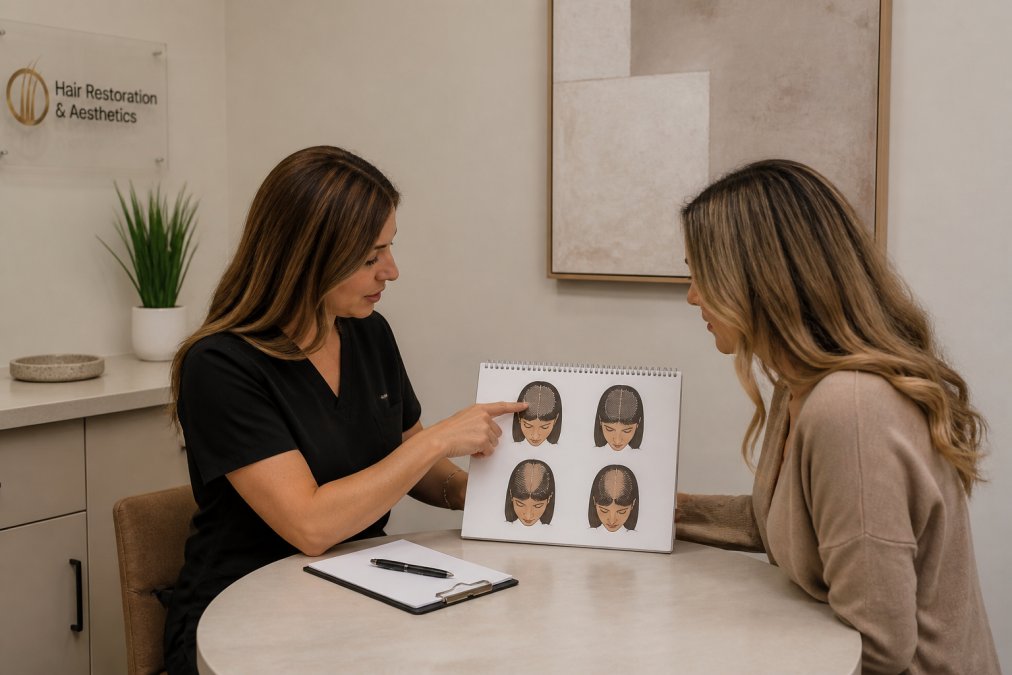
The best candidates usually have:
- Confirmed pattern loss with a stable donor zone
- Realistic expectations about density, not full restoration
- A plan to continue medical therapy after surgery
Hair Restoration Recovery Timeline: Week by Week
Recovery from FUE is faster than most people expect. Here is the general timeline patients should plan around.
| Timeframe | What to Expect | Activity Level |
|---|---|---|
| Days 1-3 | Mild swelling, tenderness | Rest, no strenuous activity |
| Week 1 | Scabbing forms, grafts settle | Light work, no heavy lifting |
| Weeks 2-4 | Scabs clear, shock loss possible | Normal activity resumes |
| Months 3-6 | New growth begins | Full activity |
| Months 12-18 | Final density visible | Full activity |
Cost-Benefit Analysis: Matching Treatments to Your Goals
Most articles list treatments. Fewer help you decide which one is actually right for your situation. The framework below matches options to the underlying cause and to what you are trying to achieve, because a woman with telogen effluvium from a stressful year needs a very different plan than a woman with progressive androgenetic alopecia.
Step 1: Match the Treatment to the Cause
| Underlying Cause | First-Line Approach | Supportive Options |
|---|---|---|
| Androgenetic alopecia (pattern loss) | Topical minoxidil, oral anti-androgens | PRP, LLLT, Alma TED, FUE |
| Telogen effluvium (stress, illness, childbirth) | Address the trigger; watchful waiting | Nutritional support, gentle scalp care |
| Hormonal imbalance (thyroid, PCOS, menopause) | Treat the hormonal driver first | Medication once the driver is managed |
| Diffuse thinning with stable donor area | Medical therapy plus non-invasive support | FUE if density goals require it |
Getting the cause wrong is the most expensive mistake in hair restoration. A treatment that does not match the driver will not work, no matter how much you spend on it.
Step 2: Define Your Goal
- Maintenance goal, slow early thinning and hold what you have. Medication plus a non-invasive treatment like Alma TED or LLLT is usually enough.
- Regrowth goal, thicken existing hair and improve density. Medication plus PRP, or a surgical option if follicles are gone.
- Restoration goal, rebuild density in areas that have already thinned significantly. FUE transplant with ongoing medical support.
Step 3: Weigh the Trade-Offs
Every option carries a cost that is not just financial.
- Time commitment: LLLT requires at-home use every other day. PRP requires in-office visits every few months. Medication is daily and lifelong.
- Reversibility: Stopping minoxidil typically reverses its gains within months. Surgical results are permanent but depend on continued medical support to protect the surrounding hair.
- Downtime: Non-invasive options have none. FUE involves a recovery period with visible healing.
- Uncertainty: Response to PRP and LLLT varies between patients. Medication and surgery have more predictable outcomes when candidacy is correct.
Step 4: Get an Accurate Plan Before You Commit
Pricing depends on the treatment plan, the number of sessions, and the area treated, which is why a quote without a diagnosis is meaningless. Hair Restoration Clinic of Granite Bay offers a free consultation and payment plans, so patients can understand the full scope of their plan before making a decision. You can Schedule a Free Consultation to discuss your diagnosis and goals with a physician.
The Emotional Side of Hair Loss: Support and Maintenance
Hair thinning affects more than appearance. Many women describe anxiety, self-consciousness, and a loss of confidence, and those feelings deserve attention alongside the medical plan.
Frequently Asked Questions
What is the most effective hair restoration treatment for women?
There is no single best option because effectiveness depends on the cause of your hair loss. For female pattern hair loss, topical minoxidil and oral medications like spironolactone are often first-line. Non-invasive options such as Alma TED and platelet-rich plasma can improve hair density. FUE hair transplant for women works best when the donor area is stable. A clinical diagnosis helps match the right treatment to your specific type of hair thinning.
Are FUE hair transplants suitable for women?
Yes, FUE hair transplant for women can be suitable, especially for those with stable donor hair on the back of the scalp and localized thinning. Women with diffuse hair loss may not be ideal candidates because the donor area itself may be thinning. A consultation with a board-certified physician can determine candidacy through a scalp evaluation and medical history review. Graft survival rates are generally high when the procedure is performed by an experienced team.
How does Alma TED therapy work for hair thinning?
Alma TED uses acoustic sound waves to stimulate the hair follicle environment without needles or incisions. The treatment is non-invasive and typically requires no downtime. It can be used alone or alongside other therapies like minoxidil or PRP to support hair regrowth. Many patients see improvements in hair density after a series of sessions. A consultation can confirm whether this option fits your type of hair loss.
Can non-invasive treatments improve hair density?
Non-invasive hair restoration options like low-level laser therapy, PRP, and Alma TED can improve hair density in some women, particularly those in the early stages of thinning. Results vary based on the cause of hair loss, consistency of treatment, and individual response. These options are often combined with topical or oral medications for better outcomes. A physician can help you set realistic expectations and track progress over time.
Hair loss in women is treatable, but only with a plan built around your actual cause. At Hair Restoration Clinic of Granite Bay, board-certified physician Dr. Piyush Kumar, MD, brings over a decade of experience and the Cole follicular unit extraction system for natural-looking FUE results, plus non-invasive Alma TED therapy for patients who want to avoid surgery. Schedule a free consultation to find out which hair restoration option fits your goals.