 ultimate-guide
Advanced Hair Health Solutions 2026: What Actually Works
Table of Contents
- Why Hair Health Science Moved Fast in 2026
- FUE Hair Transplant Benefits: Why Follicular Unit Extraction Leads Surgical Restoration
- Alma TED Hair Restoration Results: Non-Invasive Acoustic Sound Wave Therapy
- Non-Surgical Hair Thinning Treatments That Have Real Evidence Behind Them
- The Hair Restoration Recovery Timeline: Week by Week
- Long-Term Costs and Maintenance: What Advanced Hair Health Solutions Really Require
- How to Choose a Hair Restoration Specialist
- Frequently Asked Questions
Last Updated: September 16, 2026
Why Hair Health Science Moved Fast in 2026
Advanced hair health solutions in 2026 look nothing like the shampoos and serums of five years ago. The field has shifted toward regenerative medicine, peptide infusions, and therapies that target the scalp environment itself, not just the hair shaft. At Hair Restoration Clinic of Granite Bay, we've watched this shift change what's possible for patients with thinning hair.
Regenerative Medicine, Peptides and the Scalp Microbiome
Regenerative medicine is the practice of stimulating the body's own repair mechanisms to restore tissue function, including dormant hair follicles. In hair restoration, this means growth factor therapy, peptide infusions, and treatments that improve the scalp's microbial balance.
Three developments stand out:
- Growth factor therapy delivers signaling proteins that encourage follicle stimulation and prolong the growth phase of the hair cycle.
- Peptide infusions support hair shaft integrity and cuticle repair at the follicle level.
- Scalp microbiome care reduces inflammation that quietly suffocates the dermal papilla over time.
FUE Hair Transplant Benefits: Why Follicular Unit Extraction Leads Surgical Restoration
Follicular unit extraction (FUE) remains the gold standard for surgical hair restoration because it removes individual follicular units without a linear strip scar. The result is natural-looking density and a faster return to normal activity than older techniques.
- No linear scar across the back of the scalp
- Grafts placed at natural angles for undetectable hairlines
- Suitable for eyebrow restoration as well as scalp work
- Shorter recovery than strip-based methods
Alma TED Hair Restoration Results: Non-Invasive Acoustic Sound Wave Therapy
For patients who want improvement without surgery, Alma TED acoustic sound wave therapy is the most credible non-invasive option available today. It uses low-frequency ultrasound to improve circulation and nutrient delivery to the follicle, which supports hair follicle rejuvenation in thinning areas.
Non-Surgical Hair Thinning Treatments That Have Real Evidence Behind Them
Non-surgical hair thinning treatments fall into three evidence-backed categories: topical treatments, peptide and growth factor infusions, and therapies that regulate the hair cycle. Each works through a different mechanism, and combining them usually outperforms any single approach, but only when the combination is matched to what is actually driving your thinning.
How Each Category Actually Works
- Topical treatments such as minoxidil remain the most studied option for hair thinning prevention. They work by prolonging the growth phase and widening the follicle, which is why they are widely recommended as a baseline rather than a standalone cure.
- Peptide infusions target the follicle directly, supporting hair shaft integrity and cuticle repair. Think of them as structural support rather than a growth switch.
- Growth factor therapy uses concentrated signaling proteins to encourage follicle stimulation, essentially reminding dormant-but-viable follicles to re-enter the growth phase.
- Low-level laser and acoustic therapies such as Alma TED improve scalp conditions and nutrient delivery without needles, which makes them a strong fit for early-to-moderate thinning.
The Cochrane review of interventions for androgenetic alopecia found that certain topical and oral treatments have stronger evidence than others, which is why a physician-guided plan beats a shelf full of products.
The Angle Most Guides Miss: Internal Health Drives External Results
Here is where most treatment roundups stop, and where the real opportunity begins. Every category above works on the follicle from the outside. But the follicle is a living structure fed by your bloodstream, and what is in that bloodstream shapes how well any topical or infusion can perform.
- Nutrient status matters. Iron, vitamin D, zinc, and B vitamins are commonly implicated in hair shedding. A deficiency can quietly cap the results of even a perfect topical regimen.
- Metabolic and hormonal factors matter. Thyroid function and androgen activity both influence the hair cycle. Treating the scalp while ignoring an underlying driver is a common reason results plateau.
- Inflammation is systemic as well as local. Scalp inflammation gets the attention, but whole-body inflammation can keep the follicle environment hostile no matter how many growth factors you apply.
- Get baseline labs through a physician rather than guessing from symptoms.
- Correct what is actually low, not what a supplement marketing page says you need.
- Re-test to confirm the correction held before judging whether your topical or infusion protocol is working.
- Layer, don't replace. Internal support makes external treatments work better; it does not substitute for them.
Matching the Treatment to the Stage
Evidence-backed does not mean universally appropriate. The right mix depends on where you are:
- Early thinning, active follicles: topicals, peptide infusions, and acoustic therapy tend to perform best, often combined.
- Moderate thinning with stable donor hair: non-surgical options can strengthen surrounding hair before or alongside surgical restoration.
- Long-dormant, fully bald areas: non-surgical options have limited reach, a scalp evaluation determines what is realistic.
The Hair Restoration Recovery Timeline: Week by Week
Recovery from FUE is faster than most patients expect, but the timeline matters for planning work and social commitments.
| Timeframe | What to Expect | Activity Level |
|---|---|---|
| Days 1-3 | Mild swelling, tiny scabs form | Rest, no strenuous activity |
| Week 1 | Scabs loosen and fall away | Return to desk work |
| Weeks 2-4 | Grafts settle, shock loss possible | Normal activity resumes |
| Months 3-6 | New growth becomes visible | Full activity |
| Months 12-18 | Final density achieved | Full activity |
Long-Term Costs and Maintenance: What Advanced Hair Health Solutions Really Require
Advanced hair health solutions are an ongoing commitment, not a one-time purchase. That single fact separates a plan that holds for a decade from one that quietly fades after eighteen months. Surgical restoration provides permanent transplanted follicles, but protecting the surrounding native hair usually requires maintenance, and most patients underestimate that second half of the equation.
The Two Budgets Every Patient Actually Has
Think of advanced hair health as two separate budgets that behave differently:
- The restoration budget, a one-time or short-course investment (FUE, eyebrow restoration, a series of Alma TED sessions) that establishes your new baseline.
- The maintenance budget, a recurring, open-ended commitment that protects the result. This is the budget patients forget, and it is the one that determines whether year five looks like year one.
What Drives Maintenance Frequency
Maintenance is not a fixed schedule, it is calibrated to your biology and your treatment mix. The variables that move the needle most:
Schedule a Free Consultation →
- Underlying pattern of loss. Diffuse thinning across the crown tends to need more ongoing support than a stable, well-defined area.
- Rate of progression. A slow, stable pattern may need only periodic check-ins; a fast-moving one needs a tighter cadence.
- Treatment mix. Transplanted follicles are permanent, but non-transplanted hair continues to miniaturize without support. The more native hair you are protecting, the more the maintenance layer matters.
- Adherence. A physician-guided topical or oral regimen only works if it is actually used. Consistency beats intensity.
The Cost-Per-Result Framework
Instead of comparing sticker prices between providers, which tells you almost nothing, compare cost per year of maintained result. Here is how to build that number yourself:
- Define the goal. Full density? A conservative, natural-looking improvement? The goal sets the ceiling on what you should spend.
- Separate one-time from recurring. List the restoration cost once, then list every recurring item (maintenance sessions, follow-up evaluations, home care) as an annual figure.
- Divide by the years you expect the result to hold. A plan that costs more up front but needs less annual upkeep often wins over five to ten years.
- Add the cost of doing nothing. Cycling through over-the-counter products that never address the follicle is the most expensive path of all, because you pay repeatedly and get no compounding benefit.
Questions to Ask Before You Sign
- What is the one-time cost, and what is the expected annual maintenance cost?
- Which parts of the plan are permanent, and which require ongoing treatment?
- What happens if I stop the maintenance layer, what is lost, and how quickly?
- Are follow-up evaluations included, or billed separately?
- Is there a written plan I can take home and compare?
Pricing depends on the treatment plan, graft count, and number of sessions, so we quote after a consultation rather than publishing a flat figure. What we will always do is put the full plan, one-time and recurring, in writing, so you can run the cost-per-result math yourself before committing.
How to Choose a Hair Restoration Specialist
Choosing a specialist comes down to credentials, technique, and transparency. Ask directly about board certification, the number of procedures performed, and whether you can review before-and-after photos of patients with similar hair loss.
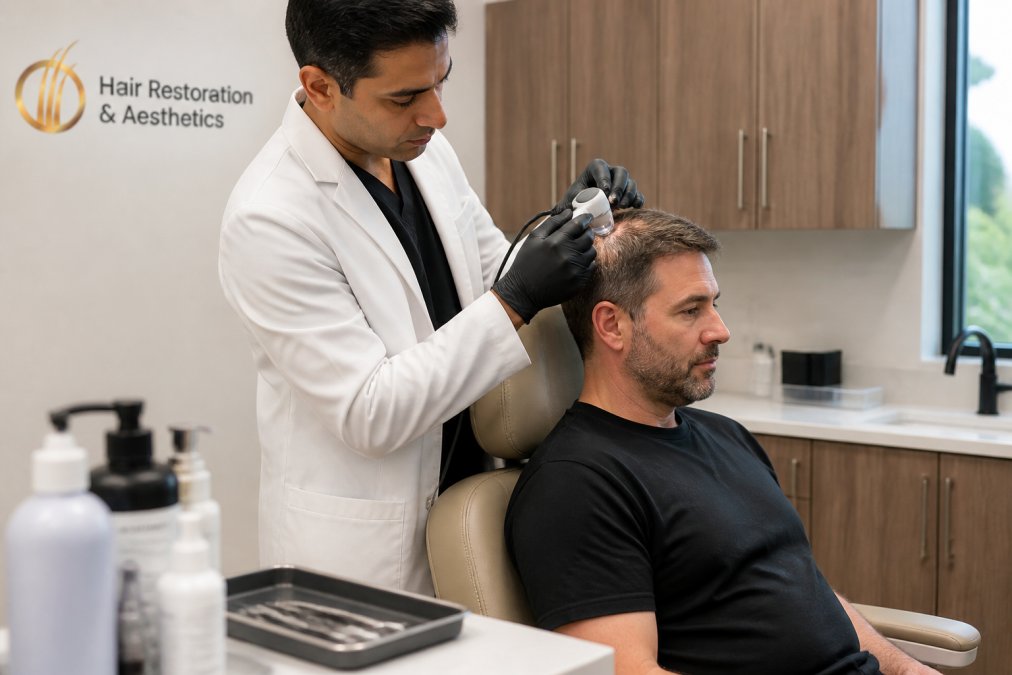
Use this checklist before committing:
- Verify board certification and license status
- Ask how many procedures the physician personally performs
- Request before-and-after photos of comparable cases
- Confirm which technology is used, such as FUE or acoustic therapy
- Get the full plan and pricing in writing
- Ask about follow-up and maintenance expectations
Frequently Asked Questions
What is the best hair regrowth treatment in 2026?
There is no single best option for everyone. For pattern baldness with visible thinning, follicular unit extraction (FUE) offers the most durable results because it relocates healthy follicles to thinning areas. For early-stage thinning or as a complement to surgery, non-surgical options like Alma TED acoustic sound wave therapy, topical treatments and peptide infusions can support hair density and scalp health. A board-certified physician can assess your hair cycle, scalp inflammation and follicle health to match the right approach.
How does FUE hair transplantation work for long-term results?
FUE removes individual follicular units from a donor area, usually the back of the scalp, and implants them into thinning or balding zones. Because the transplanted follicles are genetically resistant to pattern baldness, they typically keep growing for years. Most patients see meaningful density around 6 to 12 months after the procedure. Long-term results depend on donor hair quality, surgical technique and ongoing scalp care. A consultation can confirm whether you are a good candidate.
What is Alma TED acoustic sound wave therapy?
Alma TED is a non-invasive treatment that uses acoustic sound waves to stimulate the scalp, improve circulation and support follicle health without needles or downtime. It is often used for early-stage thinning, as a stand-alone option for patients who want to avoid surgery, or alongside FUE to support graft survival. Results build gradually over a series of sessions, and the best outcomes come from pairing it with a physician-guided hair health plan.
What does the hair restoration recovery timeline look like after FUE?
Most FUE patients return to desk work within 2 to 3 days and resume light exercise after about a week. Scabbing typically clears within 7 to 10 days. Transplanted hair often sheds in weeks 2 to 8, which is normal, and new growth starts around month 3 to 4. Visible density usually appears by month 6, with final results around month 12. Following your physician's aftercare instructions protects the grafts and supports healing.
Are non-surgical hair thinning treatments really effective?
They can be effective for early-stage thinning, mild density loss or as support after a transplant. Options like Alma TED, topical treatments, peptide infusions and growth factor therapy target follicle stimulation, scalp microbiome balance and hair cycle regulation. They work best when matched to your specific cause of thinning and used consistently. A physician can confirm whether non-surgical care is enough or whether FUE would deliver better long-term density.
How much do advanced hair health solutions cost long-term?
Pricing depends on the treatment plan, the number of sessions and whether you combine surgical and non-surgical options. FUE is a one-time procedure with a recovery period, while non-surgical treatments like Alma TED or topical protocols usually require ongoing maintenance sessions to sustain results. Many clinics, including Hair Restoration Clinic of Granite Bay, offer a free consultation and payment plans so you can review costs before committing. Ask for a written plan with expected maintenance intervals.
What should I look for when choosing a hair restoration specialist?
Verify board certification, experience with the specific technique you are considering, and whether the physician performs the procedure personally. Ask how many procedures they have completed, request before-and-after photos of patients with similar hair loss, and confirm which technology they use. A free consultation is a good opportunity to review credentials, ask about recovery and see whether the plan matches your goals. Avoid providers who promise guaranteed results or skip a proper scalp evaluation.
Can I combine FUE with non-surgical treatments like Alma TED?
Yes. Many physicians combine FUE with non-surgical options to support graft survival and overall scalp health. Alma TED acoustic sound wave therapy, topical treatments and peptide infusions can be used before and after surgery to improve circulation and follicle stimulation. Your recovery timeline and treatment schedule should be set by your physician so the non-surgical sessions do not interfere with graft healing. A combined plan often delivers better density than either approach alone.